
EQT Makes it Official, Files with FERC to Extend MVP into NC
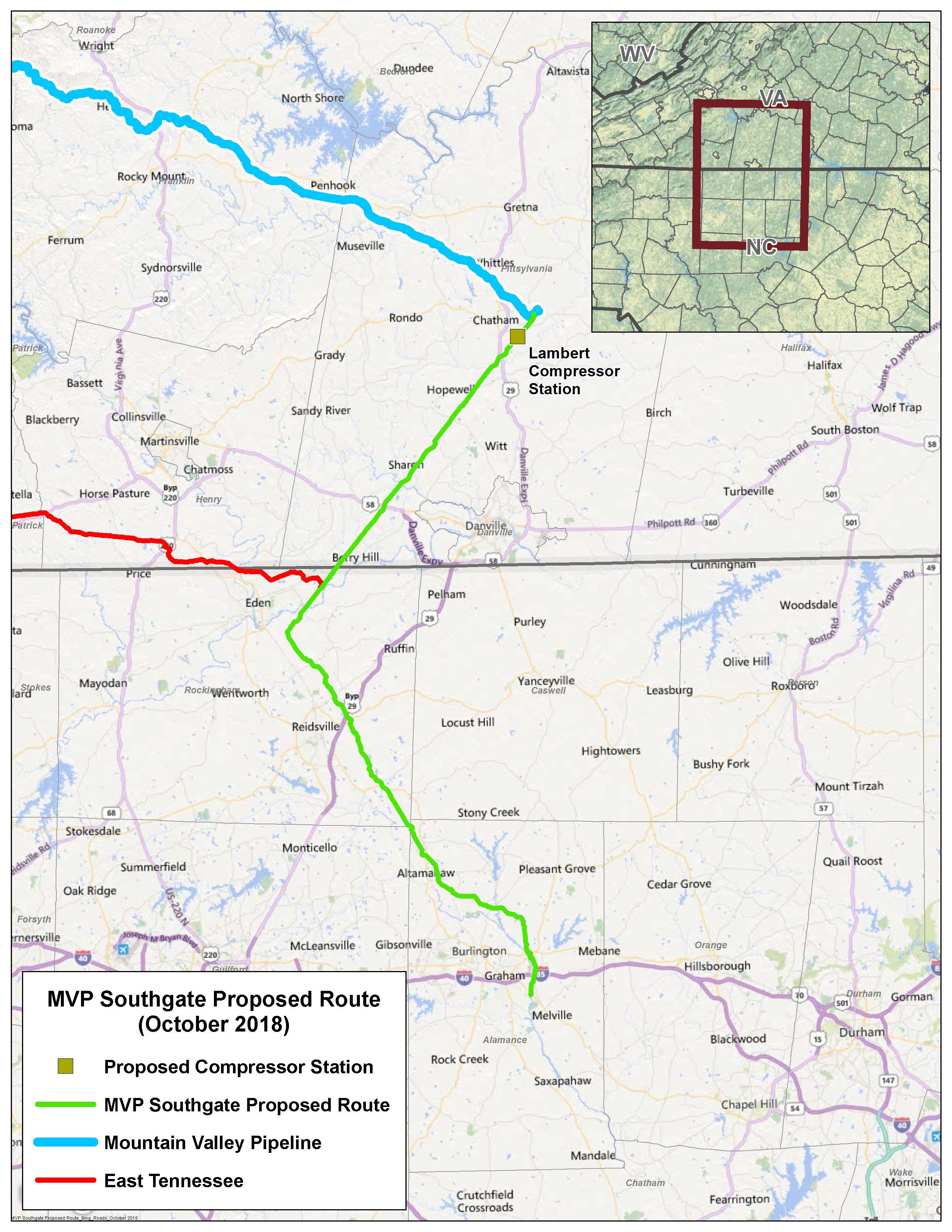
In April MDN told you that even though Mountain Valley Pipeline (MVP) had only just begun to build along it’s 300+ mile route from West Virginia to southern Virginia, and even though the project faces enormous opposition from extremists who sit in the tops of trees and on top of poles, MVP went on offense by announcing a binding open season (time when customers can sign on the dotted line) to expand the not-yet-built pipeline even further (see Mountain Valley Pipeline Launches Plan to Expand 70 Miles into NC). The MVP Southgate project, as it’s called, will flow gas from the MVP mainline where it terminates in Pittsylvania County another 70 miles south to new delivery points in Rockingham and Alamance counties in North Carolina. Yesterday MVP (i.e. EQT Midstream) filed the official request with FERC.
Read More “EQT Makes it Official, Files with FERC to Extend MVP into NC”
 More than four years ago MDN posed the question, could an alternate trading hub like Dominion South in Pennsylvania ever replace the venerable Henry Hub trading hub in Louisiana as the world benchmark (see
  We spotted an intriguing editorial in the Williamsport Sun-Gazette. It quotes a study by “an independent, market-based think tank” with some phenomenal findings. If you invest $1 million in solar, over a 30-year period you’ll get around 25 million kilowatt hours of electricity. If you invest that same $1 million in wind, you’ll get 50 million kilowatt hours over a 30-year period. But if you invest the same $1 million in natural gas-fired electric generation (cost to extract the gas, etc.), you’ll get 400 million kilowatt hours of electricity over 30 years! Natgas yields 8 times as much electricity per dollar as wind, and 16 times as much as solar.
 Who regulates what when it comes to the federal government and the oil and gas industry? We have an alphabet soup of federal agencies and agencies within agencies that regulate some aspects of drilling (on federal lands), pipelines, and by extension (because of air emissions) compressor stations, trucking and more when it comes to our industry. We recently spotted a helpful article that gives a high-level overview of who is regulating what. It’ll make your head spin! And this is just at the federal level. Add to this each state with its own regulatory fiefdoms and it’s a miracle any drilling ever happens.
 The “best of the rest”–stories that caught MDN’s eye that you may be interested in reading: Pa. House and Senate remain in Republican control despite Democrat gains; New Jersey-based design and engineering firm to open office in Canonsburg; LANTA hopes to add even more compressed natural gas buses to fleet; Cabot and Williams on an education adventure with small schools; Voters reject oil well setbacks as Colorado’s Proposition 112 defeated; Naperville council expected to OK plan for new compressed natural gas filling station on city land; NYMEX December natural gas spikes 28.3 cents to $3.567/MMBtu on forecast for early-season cold snap; US EIA boosts Q4 gas marketed production forecast by 1.83 Bcf/d to 94.32 Bcf/d; US transportation sector used 43.4 billion cubic feet of natural gas for vehicle fuel in 2017; China to boost shale oil, gas production; The world can live without Iranian oil; Oil markets yawn as Iran sanctions come into effect; Oil and gas firms sound alarm as capital once destined for Canada flees to more competitive U.S.; China’s gas pipelines on wheels.
 The deal is done. On Monday, Encino Acquisition Partners completed its purchase of all of Chesapeake Energy’s Ohio Utica Shale assets for $2 billion, originally announced in July (see
  If all goes as planned, this Friday U.S. Well Services (USWS), a company that specializes in fracking shale wells using gas-fired electric (as opposed to diesel) engines, will begin to trade its stock publicly. USWS has operations in the Marcellus/Utica, as well as other plays. Does the company sound familiar? Last week we told you that Pittsburgh-based driller Huntley & Huntley has contracted with USWS to frack the wells it is drilling (see
  Last week National Fuel Gas Company (NFG), which operates drilling subsidiary Seneca Resources and pipeline subsidiary Empire Pipeline, issued its fourth quarter 2018 (everyone else’s 3Q18) update. Via Seneca Resources, NFG drills wells in northcentral and northwestern PA. Via Empire Pipeline, they build and maintain hundreds of miles of pipelines in PA and New York, where the company is headquartered. NFG operates a utility (gas and electric) company in addition to Seneca and Empire. A lot of spinning plates to watch. But they do a great job. Much of the focus of the update was on the upstream–on Seneca Resources. According to CEO Ron Tanski, in 2019 more than half of the company’s capital expenditures will go for Seneca’s drilling program. Seneca has and will continue to operate three drilling rigs, with plans to expand production by 24%.
 As of September, the 1,000-megawatt Moxie Freedom Marcellus-fired power plant located near Wilkes-Barre, PA (Luzerne County) is up and running and feeding electricity it produces into the local power grid (see
  A number of times we’ve highlighted a cool training program offered by the The Gas Technology Institute (GTI). The
  PJM is the largest electric grid operator in the U.S. It serves 65 million people in 13 states plus the District of Columbia (including PA, OH, and WV). Last week PJM released a summary of findings for a report that evaluates PJM’s “resiliency”–ability to deliver electricity even under adverse conditions and heavy loads. Know what they found? PJM is reliable and can withstand periods of highly “stressed” conditions, including the phaseout of more coal-fired power plants. PJM, perhaps more than any other grid, relies increasingly on natural gas. The study shows reliance on Marcellus/Utica natgas is solid, contrary to the what scaremongers claim. There is no reason to worry.
 The New York Public Service Commission recently approved a petition by Consolidated Edison Company of New York, Inc. (Con Edison) for a $5 million, three-year natural gas demand response pilot program, one of the first demand response projects for natural gas. Demand response (DR) programs, somewhat common in the electricity sector, helps manage utility usage during periods of peak demand. How do they do it? In the case of Con Ed’s now-approved program, the utility will pay its customer to use less natural gas.
 Flashback: In May of this year, Energy Transfer CEO Thomas Long said Rover Pipeline would be fully online by June 1st (see