EQT Wastewater Pipeline in Greene County Springs a Leak
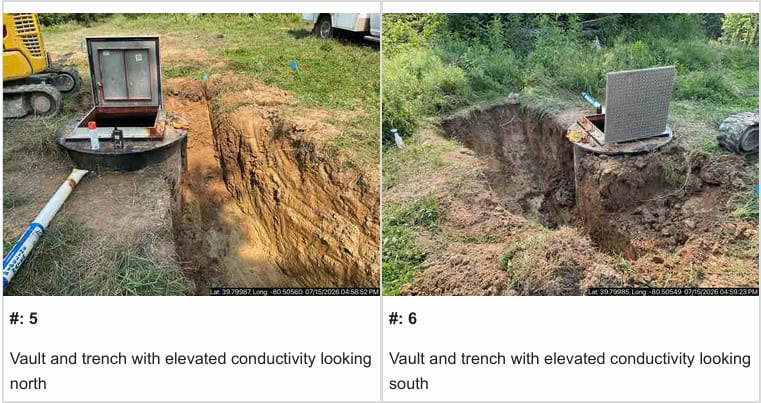
On July 15, 2026, Pennsylvania’s DEP inspected Equitrans’s [EQT] NIDGH015 shale gas wastewater pipeline after the company reported a contaminated water release in Aleppo Township, Greene County. The spill of unknown quantity occurred July 14 around 6:00 p.m., roughly 1,200 feet from EQT’s Walter Stinger well pad, when a riser and valve within a plastic vault failed, leaking through a hole cut in the vault’s side. DEP found the vault wasn’t shown on the approved Erosion and Sedimentation Plan, and nearby wetlands and a stream weren’t delineated. Multiple violations were issued, with a written response due July 31. This marks Equitrans’ second release in the township within weeks.
Read More “EQT Wastewater Pipeline in Greene County Springs a Leak”

 Despite rising Northeast gas demand from retiring coal plants and new data centers, plus added Appalachian pipeline capacity, production growth isn’t guaranteed—operators prioritize capital discipline, debt reduction, and shareholder returns over volume. Appalachia has held flat at roughly 33-36 Bcf/d since 2020. Can anything tempt Marcellus/Utica drillers to drill and produce more than they are now? According to RBN Energy, sustained Henry Hub prices above $4/MMBtu (versus the current $3.50-$3.60 long-dated curve) and better takeaway infrastructure could be enough of a temptation.
  Thanks to the work of David Hess at the PA Environment Digest Blog, which tracks Department of Environmental Protection (DEP) notices published in the Pennsylvania Bulletin, we know of two water pipeline projects (for EQT and Expand Energy) approved by the DEP related to drilling new shale wells in two different northeastern PA counties: Lycoming and Bradford. Water is used for fracking. New water pipelines mean new fracking is on the way in those locations.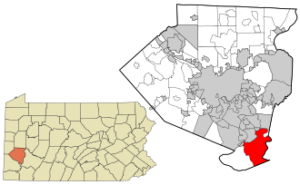
 The Marcellus/Utica region received 28 new drilling permits last week, June 29 – July 5, down 3 from two weeks ago. Last week, Pennsylvania issued 18 new permits. Ohio issued 4 new permits. And, West Virginia issued 6 new permits. The drillers who received new permits included: Antero Resources (6), CNX Resources (10), EOG Resources (4), EQT (1), Expand Energy (3), and Range Resources (4).
  In a recent interview with Bloomberg, EQT CEO Toby Rice declared that natural gas is poised to surpass petroleum as America’s top energy source by 2030, ending oil’s 75-year dominance that began in 1950 when it overtook coal. In 2025, gas accounted for 36% of U.S. energy consumption, compared with petroleum’s 37%, with Rice predicting a crossover within a couple of years. The shale revolution’s cheap gas has displaced coal in power generation, fueled economic electrification, and complemented intermittent renewables, while flat gasoline demand — partly due to EVs — has stalled oil consumption. The EIA projects gas demand growing 3.4% through 2027 versus 0.6% for petroleum, and booming LNG exports add further momentum.
 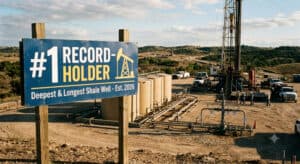 EQT Corporation, the largest driller in the Marcellus/Utica (based on M-U production), recently achieved two records with the same Marcellus well. EQT drilled not only the “deepest” shale well in the continental U.S. (by “measured depth”), but also the longest horizontal shale well (by lateral length). EQT’s Longwell 9H well, located in Wetzel County, West Virginia (near the Pennsylvania border), eclipses a record set by Expand Energy in 2025 in Marshall County, WV.
  This is a momentous occasion. Yesterday, the Federal Energy Regulatory Commission (FERC) issued a “Notice to Proceed with Construction” order authorizing Mountain Valley Pipeline (owned by EQT Corporation) to proceed with construction of MVP Southgate pipeline in North Carolina. This follows FERC granting permission to begin building Southgate in Virginia in April (see
  EQT Corp’s mixed-index natural gas product blends NYMEX Henry Hub futures with one or more physical basin indices (such as Dominion South) into a single sales contract, often weighted toward Henry Hub for hedging liquidity. Splitting exposure between national futures and local spot dynamics dilutes price swings, helping power generators, LNG exporters, and large industrials reduce earnings volatility while retaining some upside from favorable regional spreads.