
Electrical Generation | Energy Services | Fayette County | Industrywide Issues | NextEra Energy | Pennsylvania
NextEra’s Fayette Gas Plant Open House Splits the Neighborhood
 NextEra Energy took its $13 billion, 3,750-megawatt (MW) East Riverside Energy Center to the people on Tuesday night, and the people showed up. Hundreds of Fayette County residents filled Brownsville Area High School for their first look at what would be one of the largest gas-fired power plants in the country. They got poster boards, experts to chat with, and a five-minute slideshow every hour. What they didn’t get was a microphone for questions. We picked up a few new details, including one that producers and pipeline companies should read twice. Read More “NextEra’s Fayette Gas Plant Open House Splits the Neighborhood”
 NextEra Energy and Dominion Energy, which want to combine into the country’s biggest electric utility in a $67 billion deal, launched a full-blown charm offensive (i.e., piles of money) aimed at Virginia yesterday. The two companies unveiled what they call a “transformational” benefits package that doubles bill credits for homeowners (from two years to four), promises 1,000 new direct jobs, and throws in a brand-new office tower in downtown Richmond, paid for by NextEra shareholders. Why all the sweeteners? Because Virginia Gov. Abigail Spanberger says she is “deeply skeptical” the deal is good for her state, and she has formally inserted herself into the regulatory review. Here’s what’s in the new package, how it’s being received, and why it matters to Marcellus/Utica drillers.
  We told you back in July that the two landowners fighting the 2,180-megawatt (MW) Canadys Station gas-fired power plant in South Carolina’s Lowcountry were teeing up an appeal straight to the state Supreme Court (see
  Back in March, MDN told you that New Fortress Energy (NFE) had entered a voluntary UK Restructuring Plan — the British cousin of a U.S. prepackaged bankruptcy (see
  The streak is over. After three straight reports at 588, the national rig count finally moved, adding three to reach 591. Oil rigs went up. Gas rigs went up. And here at home? Nothing. The Marcellus/Utica sat at 33 for a second consecutive week, which is what “unchanged” looks like when you’re already at your lowest number in two years. Meanwhile WTI crossed $100 a barrel and our gas slid to $2.83. Read those two numbers together and you’ve got the whole week.
  Energy Transfer, one of the biggest midstream players in the country and a familiar name to Marcellus/Utica landowners thanks to the Revolution and Mariner East systems, announced last week that it is pulling its primary stock listing off the New York Stock Exchange and moving it to the brand-new Texas Stock Exchange (TXSE) in Dallas. Three affiliated companies are going with it. Together the four represent close to $100 billion in market value — the largest chunk of listing business the NYSE has ever lost to a startup rival. Before you declare the end of Wall Street, though, there’s an asterisk the size of Texas attached to this one.
  Eastern Gas Transmission and Storage (EGTS), a wholly owned subsidiary of Berkshire Hathaway Energy (Warren Buffett’s company), got the last piece of paper it needed yesterday for an important new pipeline project. FERC’s Office of Energy Projects issued a notice to proceed (NTP) on Sept. 10, authorizing EGTS to start building the Appalachian Reliability Project (ARP) — the 550,000 dekatherms/day expansion that will push more Marcellus and Utica gas from western Pennsylvania into Ohio. Even better, the approval comes in roughly six months ahead of the company’s own published timeline.
  Duke Energy just handed Marcellus/Utica producers something more useful than another press release. It handed us a calendar. Back in July we told you Duke had picked its sites: two 1,360-megawatt (MW) combined-cycle gas plants on its Davie County, North Carolina parcel, and the largest liquefied natural gas (LNG) storage facility in company history directly across the Yadkin River in Davidson County (see
  Last week we told you Dominion Energy cleared its first hurdle for the monster 3,000-megawatt (3 gigawatt) Cumberland Energy Center in Cumberland County, Virginia (see
  Virginia Democrats have spent the summer hammering the proposed $67 billion NextEra-Dominion merger — letters to regulators, a 64-question interrogation, a statewide listening tour, a demand for a special session. Last week the pile-on reached the very top when House Speaker Don Scott (D-Portsmouth) filed his own letter with the State Corporation Commission (SCC). Here’s the twist: the same Democrat leaders doing the loudest complaining just refused to do the one thing that would actually slow this deal down.
  Big Green scored a win yesterday — but not the win they’re telling you they got. On Tuesday, September 8, a three-judge panel of the U.S. Court of Appeals for the Third Circuit vacated the Clean Water Act Section 401 water quality certification (WQC) that the New Jersey Department of Environmental Protection (NJDEP) issued last November for Williams/Transco’s Northeast Supply Enhancement (NESE) project — the $1 billion, 400,000 Dth/d expansion that carries Marcellus gas from Pennsylvania, across New Jersey, under Raritan Bay, and into New York City (see
  Six weeks after announcing it would sell up to 49% of its $1.2 billion Florida Energy Pathway pipeline (see
  It’s that time of year again. Cove Point LNG, the Berkshire Hathaway-operated export terminal on the Maryland shore of the Chesapeake Bay, is heading into its annual maintenance turnaround — and when the plant goes down, roughly 850 million cubic feet per day (MMcf/d) of demand for Marcellus/Utica gas simply evaporates. MDN has obtained the official notice from pipeline operator BHE GT&S laying out exactly what happens and when.
  EQT is planning another pipeline — and this one is big. Through a brand-new subsidiary called Appalachian Transmission Gateway LLC (ATG), the Marcellus/Utica’s largest driller has opened bidding on the “POWER Pipeline,” a 42-inch, 50-mile line that would carry a full 1 billion cubic feet per day (Bcf/d) of gas from Greene County, Pennsylvania, west to the Clarington hub in Monroe County, Ohio. The open season quietly began Aug. 26 and runs through Oct. 26. We found no press release announcing it — the notice simply went up, and the trade press caught it a week later.
 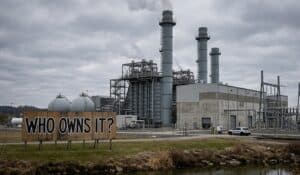 Fayette County, Pennsylvania, spent six months quietly chasing NextEra Energy’s giant gas plant, and now that it’s landed, county officials are publicly sharing their support. Two follow-up stories — one from the Pittsburgh Business Times, one from Salena Zito at the Washington Examiner — fill in a lot of what we didn’t have yesterday about the East Riverside Energy Center. Including who is actually going to own the thing. Hint: it isn’t NextEra.