
DTE Asks Michigan for 2 Gas Plants — 2,100 MW of New M-U Demand
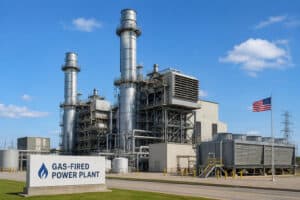 When we covered DTE Energy’s second quarter results in July, we grumbled that the company was throwing $10 billion at unreliable renewables and only $2.5 billion at a single new gas plant to replace a retiring coal fleet (see DTE Energy 2Q: Coal Exit by 2032 Means New Gas Plant and M-U Demand). Turns out we were counting low. On Tuesday, August 25, DTE Electric filed a “Filing Announcement” with the Michigan Public Service Commission (MPSC) — a required 30-day heads-up before a big filing lands — telling regulators it will ask for Certificates of Necessity for two new combined-cycle gas turbine (CCGT) plants: one at roughly 700 megawatts (MW) and one at roughly 1,400 MW. That’s 2,100 MW of new gas-fired generation in a state that produces almost no gas of its own. Guess where the molecules come from. Read More “DTE Asks Michigan for 2 Gas Plants — 2,100 MW of New M-U Demand”
 South Carolina’s utility regulators voted unanimously yesterday to let a $2.8 billion artificial intelligence data center in Spartanburg County build and run its own 457-megawatt natural gas power plant without asking the state’s permission first. The decision is a big win for the “behind-the-meter” model — where a data center brings its own generation instead of leaning on the grid — and it’s a model that is going to burn a lot of molecules. Possibly some of ours.
  The PJM market monitor asked federal regulators to kill Hull Street Energy’s purchase of two gas-fired peaking plants unless Hull Street promised not to point them at data centers. On August 13, FERC said no — and said the monitor hadn’t supported its argument. Thirteen days later, the deal closed. Hull Street Energy (HSE), a private equity firm in the Washington, D.C. area, announced yesterday that it completed the acquisition of the Lee County Generating Station in Dixon, Illinois, and the Tait Electric Generating Station near Dayton, Ohio, from Rockland Capital. HSE calls the pair the “GridFlex Portfolio” and has folded it into Milepost Power, its thermal generation platform.
  PJM Interconnection — the grid operator that keeps the lights on for 67 million people across 13 states and DC, including most of the Marcellus/Utica region — dropped its new five-year strategy last Wednesday (Aug. 19). Most of the coverage focused on the four bullet-point priorities, which read like every corporate strategy document ever written. But if you skip to page 5, PJM says two things out loud that our industry has been shouting for a decade: pipeline constraints are choking the grid, and the grid is getting less reliable as it gets more intermittent.
  Score one for the good guys. The Ohio Power Siting Board (OPSB) voted yesterday (Aug. 20) to hand Chestnut Run Energy LLC its Certificate of Environmental Compatibility and Public Need — the golden ticket needed to build a 1,300-megawatt (MW), $2 billion natural gas-fired power plant in Washington Township, Carroll County. That’s smack in the middle of Utica Shale country. MDN first told you about this project back in April (see
 Gov. Josh Shapiro signed Executive Order 2026-05 on Tuesday, imposing what he called “the strictest guardrails in the nation” on AI data centers — and, we’d argue, on the gas-fired power plants that will run them. Two western PA projects lost fast-track permitting status the same day. But the real damage is buried in a 33-page model consent order that got almost no attention. We don’t think it’s unfair or hyperbole to say Shapiro just destroyed the AI data center industry in the Keystone State.
  Norway’s Equinor — the company we all used to call Statoil — announced Monday it is buying a majority interest in the Lackawanna Energy Center (LEC), the big Marcellus-fired power plant in Jessup, PA, just outside Scranton. Equinor is paying $940 million for 87.71% of the Class A shares in the 1,483-megawatt plant, buying them from funds managed by Global Infrastructure Partners (GIP), which is now part of BlackRock. Invenergy, which built LEC and has run it since day one, stays on as operator. MDN has followed this plant since it was nothing but a proposal and a pile of angry town council meetings (see
  It’s official. In June, we told you OpenAI was in “advanced negotiations” to lease the gargantuan 10-gigawatt (GW) data center campus rising on federal land in Piketon (Pike County), Ohio (see
  Net Power, backed by the Rice brothers (of Rice Energy and EQT fame), has spent years chasing the holy grail of natural gas power: a plant that burns gas and emits essentially zero carbon dioxide. Last year the company backed off that goal and pivoted to post-combustion carbon capture (PCC), which grabs about 90% of the CO2 using off-the-shelf technology. Close enough, the market said. Last week, Net Power pivoted again — and this one’s a doozy. The first phase of its flagship West Texas project will now be built with no carbon capture at all. Just a gas plant. Meanwhile, the company took a $193.7 million charge to write its original Allam Cycle technology and its La Porte demonstration plant down to zero.
  The independent watchdog that grades the PJM electric grid put out its half-year report card last Thursday under the cheerful headline “Market Monitor Finds PJM Wholesale Electricity Markets Competitive.” Read down three paragraphs, and you find the opposite — the capacity market flunked, three years running, and the Monitor blames data centers. Buried further still is a number that ought to end a certain argument in Harrisburg for good: the biggest single driver of PJM’s price spike wasn’t natural gas. It was the wires.
  Competitive Power Ventures (CPV) and EQT Corporation have signed a 10-year gas supply agreement that locks up the entire fuel appetite of the CPV Shay Energy Center, the $3 billion, 2,100-megawatt (MW) combined-cycle plant headed for Doddridge County, West Virginia. It’s the deal that turns Shay from a project on paper into a project with a fuel contract.
  Something happened over the past ten days that ought to look awfully familiar to anyone who was around Marcellus country in 2009. A single advocacy shop dug a permit out of a state filing cabinet, handed it to a friendly reporter at the New York Times, and within a week roughly two dozen outlets were running the same three sentences about Amazon becoming “the largest single source of pollution in the United States.” It’s not a coincidence, it’s not organic, and it’s not staying in Texas. Big Green has told us, in print, that the data center fight is the anti-fracking playbook run a second time — and one of the projects already on their list belongs to Williams, in Ohio, burning Utica gas.
  Both federal and state regulators signed off last Thursday on PowerTransitions’ purchase of the 1,242-megawatt (MW) Roseton Generating Facility in Newburgh, New York — the sixth and by far the largest gas-fired plant the Houston-based company has grabbed in the Empire State this year. The Federal Energy Regulatory Commission (FERC) issued its order Aug. 13 (Docket EC26-95-000), and the New York Public Service Commission approved the transfer the same day. But the most interesting thing in the FERC order isn’t the approval. It’s the name of the company doing the buying.
  PJM Interconnection, the grid operator that keeps the lights on for 67 million people across 13 states including Pennsylvania, Ohio, and West Virginia, filed its long-awaited data center framework with the Federal Energy Regulatory Commission (FERC) on Wednesday, August 13. The short version: if you’re a new data center and you don’t bring your own electricity to the party, you get switched off first when the grid gets tight. Homes and small businesses get cut last. It’s a rule that, read correctly, is one enormous purchase order for Marcellus/Utica gas.