
DOE Sec. Wright Says Constitution Pipeline Project a “No-Brainer”
 The Trump administration and its officials continue to aggressively push the Williams 125-mile Constitution Pipeline project, which would stretch from the prolific shale gas fields of Susquehanna County, PA, into and through New York State, to Schoharie County, NY, to move Marcellus gas into New York State and New England. In June, Trump EPA Administrator Lee Zeldin visited Binghamton to advocate for reviving the long-stalled project (see EPA Admin. Zeldin Stops in Binghamton to Push for Constitution Pipe). Last Thursday morning (July 2nd), Department of Energy Secretary Chris Wright appeared on the Fox Business program Mornings with Maria (Bartiromo) to discuss the current state of energy here at home and around the world (including the Iran war). It was a question that Bartiromo posed to Wright near the end of the interview that piqued our interest. Read More “DOE Sec. Wright Says Constitution Pipeline Project a “No-Brainer””
 A rare bipartisan backlash against AI data centers has emerged, with more than 70 state and local governments passing restrictions or moratoriums due to concerns about water use, electricity consumption, noise, and utility rate hikes. Critics span the political spectrum, from Bernie Sanders and Alexandria Ocasio-Cortez to conservatives like Pennsylvania State Treasurer (and Republican candidate for Governor) Stacy Garrity. Public relations experts blame the industry’s failure to build trust, communicate transparently, and engage communities early, comparing tech companies’ top-down approach to the tobacco industry’s playbook. The consequences are mounting: 25 data center projects were canceled in 2025 — quadruple 2024’s total — while roughly 99 of 770 planned projects face local opposition. Pennsylvania is at risk of forfeiting some $92 billion in private investments (see
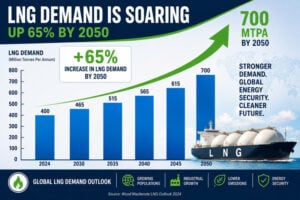 Shell, which dropped “Royal Dutch” from its name after leaving the Netherlands in 2022 due to high taxes and overregulation, is one of the world’s supermajors (oil and gas driller). Shell is also one of (perhaps THE) largest producers and vendors of LNG, or liquefied natural gas, worldwide. The company has just released its tenth annual LNG Outlook 2026 (full copy below), which highlights key trends in 2025 and hauls out the crystal ball to predict where things are heading over the next 25 years. Shell’s annual LNG outlook says shipping disruptions in the Strait of Hormuz from the Iran war—which shut in roughly one-fifth of global monthly LNG supply—could keep 2026 global LNG trade flat if flows normalize within three months, with growth resuming in 2027.
 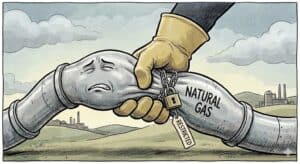 Williams’ Transco Southeast Supply Enhancement Project (SESE) is a 55-mile, 42-inch-wide pipeline that will run through Pittsylvania County, Virginia, and Rockingham, Guilford, Forsyth, and Davidson counties in North Carolina. Construction for SESE started March 2, 2026, according to FERC filings. Transco (Williams) received its final federal authorization and a Notice to Proceed, and crews mobilized in early spring. Initial activities have included tree felling, installation of acoustic barriers, and test drilling in preparation for blasting. Antis finally gave up trying to block construction of SESE in June (see
 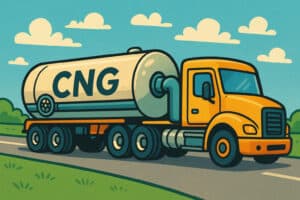 We spotted a press release from Hexagon Agility that the company has secured its largest-ever single order for “Mobile Pipeline” modules from Certarus, valued at about $100 million, with an option for up to $25 million more by 2028. It triggered a “connect the dots” moment for us. Mobile pipelines are another term for virtual pipelines, which is a euphemism for trucking natural gas via CNG (mostly) and sometimes LNG. The Hexagon press release indicates strong new demand for such technology in the AI data center market. No pipeline? No problem! Just truck it in via a virtual pipe instead.
  Global research firm Wood Mackenzie warns that a decade of cheap U.S. natural gas is ending, with Henry Hub prices—historically stuck between $2 and $4 per MMBtu—expected to approach $5 by 2035. The shift is driven by surging demand from LNG exports and AI data centers. U.S. LNG exports jumped from 0.5 Bcf/d in 2016 to 15.0 Bcf/d in 2025, with capacity expected to nearly double by 2031. Meanwhile, power-sector demand could require an additional 17 Bcf/d by the mid-2030s. Supply-side tailwinds—prime drilling acreage, cheap associated gas, and annual productivity gains—have largely run their course. WoodMac says $5 gas remains globally competitive.
  Over the past two weeks, just prior to heading out on summer vacation, the U.S. Supreme Court issued a number of extremely important decisions. One of them was Slaughter v. Trump, a 6-3 decision in which the Supremes overturned the 91-year-old Humphrey’s Executor precedent, granting the president broad authority to remove members of independent federal agencies for any reason. Chief Justice John Roberts wrote that the president must have trusted subordinates to ensure accountability, though the Court exempted the Federal Reserve to preserve its independence. This ruling permanently solidifies President Trump’s earlier removals of Democratic appointees, significantly expanding executive control over critical regulatory bodies, including the National Labor Relations Board, the Federal Trade Commission, and most importantly for MDN readers, the Federal Energy Regulatory Commission (FERC).
  Last week was (once again) noteworthy for the Baker Hughes rig count. Although the Marcellus/Utica count didn’t budge, the national count increased by another 7 rigs. The national count has risen over the last three weeks — by 18 rigs! The new national count, 580, is also the highest the combined count has been since May 2025. The combined M-U rig count remained at 36 active rigs for the eighth consecutive week. The M-U’s chief competitor, the Haynesville, maintained its count of 55 active rigs, operating 19 more than the M-U.
  Data center growth is rapidly reshaping Northeast power and natural gas markets, with projects clustering near transmission lines, substations, gas-fired power generation, and pipeline corridors. Virginia remains the epicenter, led by Northern Virginia’s massive hyperscale hub and tens of gigawatts of planned capacity. Ohio is emerging fast around Columbus, with more than 15 GW proposed. Pennsylvania could become a major growth story, pairing Marcellus/Utica gas resources with large campuses such as Homer City’s planned 4.5-GW gas-fired/data center redevelopment. However, PA is attempting to shoot itself in the foot with talk of both short- and long-term moratoriums on new data center construction. So, the jury is still very much out on how successful PA will be with data centers.
  In April, MDN reported that PowerTransitions, an independent power producer specializing in redeveloping legacy power facilities, had agreed to acquire five New York gas-fired power plants — Batavia, Hillburn, Massena, Shoemaker, and Sterling — totaling 323 megawatts (MW) from Alliance Energy Group affiliates (see
  Wow! Where did the last 10 years go? In June 2015, MDN brought you the news of two Pennsylvania business groups, the Delaware County Chamber and the Washington County Chamber, along with two labor unions, the Laborers’ International Union of North America (LiUNA) with 25,000 members and the International Union of Operating Engineers (IUOE) Local 66 with 7,000 members, joining forces to form the
  All we can say is, get the heck out of New York while you still can. Sooner or later, property values in the “Empire” State will crash. (Probably sooner rather than later.) Yesterday, the U.S. Court of Appeals for the Second Circuit (2nd Circuit) ruled in support of New York State banning natural gas from being used in new home (and business) construction across the entire state. If it stands, it is the beginning of the end for NY. The end will eventually come when Wall Street firms finally give up and move from New York City to Texas or Florida, completely bankrupting the state from lost revenues.
  In February, MDN alerted you to yet another gas-fired power plant project that Williams (the pipeline giant) was adding to its roster. Williams entered the gas-fired power plant space (actually building and operating them) in April 2025 via a subsidiary called Will-Power (see
  Northampton Capital Partners, a middle-market infrastructure asset manager with roughly $1.4 billion under management, has partnered with New Jersey–based Olympus Power to form a joint venture called Winslow Power. Winslow has agreed to acquire three natural gas–fired power plants totaling 752 MW from a Vistra Corp. subsidiary: the 541-MW Casco Bay combined-cycle facility in Veazie, Maine; the 108-MW Beaver Falls dual-fuel turbine in Croghan, NY; and the 103-MW Syracuse dual-fuel turbine in Solvay, NY. Pending regulatory approval, the deal is expected to close later in 2026. And yes, there is a Marcellus/Utica connection in this story.
 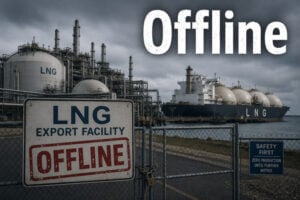 The Golden Pass LNG terminal is a liquefied natural gas (LNG) terminal and regasification facility in Sabine Pass (Port Arthur), Texas. It is among the largest LNG facilities in the world. It can accommodate up to 15.6 million metric tons (MT) of LNG per year, the equivalent of approximately 2 billion cubic feet of natural gas per day (Bcf/d). In April, Golden Pass exported its first LNG cargo (see