
Supreme Court to Decide Landowner Request for Pipeline Legal Fees
 The Supreme Court will hear a North Dakota eminent domain dispute (Leonard Hoffman v. WBI Energy Transmission) over whether gas pipeline companies must pay landowners’ attorney fees when taking property under the Natural Gas Act. While the case is specific to North Dakota, it has the potential to affect the entire country—landowners and drillers everywhere should watch this case closely. The case stems from WBI Energy Transmission’s 12-mile pipeline across ranchland in the Bakken, where landowners challenged compensation offers and later sought more than $383,000 in legal fees. Read More “Supreme Court to Decide Landowner Request for Pipeline Legal Fees”
 Yesterday, the Ohio Oil and Gas Land Management Commission (OGLMC) voted to open another 14,953 acres of publicly owned state land in eastern Ohio to safe fracking. At the same meeting, the OGLMC rejected applications to open about 8,000 acres of land in the same area for development, given the overlap between those parcels and some that were bid out. Anti-fossil fuel nutters showed up at the meeting and made asses of themselves, as they so often do. One anti (who should have been arrested and removed) shouted that the Commissioners should “jump off a bridge.” Sounds like a threat to us. Is anyone investigating?
  The Federal Energy Regulatory Commission (FERC) isn’t letting any grass grow under its feet regarding the advancement of the Constitution Pipeline, a 125-mile greenfield pipeline from the Marcellus gas fields of Susquehanna County, PA, to Schoharie County, NY, to deliver Marcellus gas into New York State and New England. FERC is actively reviewing two requests related to reviving the project (see
 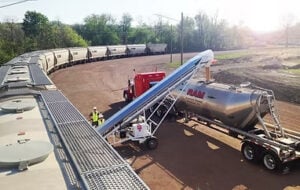 We love a good railroad story, and at its core, that’s what this story is. Investment firm FTAI Infrastructure has completed its acquisition of Tidewater Logistics, a barge-and-rail transloading company operating in Ohio, West Virginia, and Texas, for about $45 million in cash. Tidewater serves producers, shippers and industrial customers in Appalachian Basin and Gulf Coast shale and energy markets, making it complementary to FTAI’s Wheeling & Lake Erie Railway. Tidewater’s facilities include frac sand transloading in Steubenville, OH; Fairmont, WV; and Allenport, PA.
  We have an update on the lawsuit to overturn New York’s laws that ban shale fracking. In April, a father and son who own mineral rights for a 164-acre tract in Delaware County, NY, filed a lawsuit (with the help of the Pacific Legal Foundation) against New York for “taking” their rights to profit from fracking their minerals (see
  Chestnut Run Energy plans to construct a $2 billion natural gas-powered electric power plant in Carroll County, Ohio, capable of powering up to 900,000 homes (see
 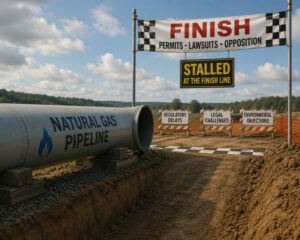 This is so frustrating. After seven years, $150 million, and 31 of 34 miles already underground, Connecticut has halted a pipeline project designed to provide a more dependable natural gas supply to the booming southeastern Connecticut economy. Ealier this year MDN told you that Connecticut’s Department of Energy and Environmental Protection (DEEP) had determined that Eversource Energy’s plan to install a natural gas pipeline through Hurd State Park and the Connecticut Valley Railroad State Park Trail requires a formal Environmental Impact Evaluation, unnecessarily delaying a tiny portion (1.1 miles) of this critically-important reliability project (see
  Earlier this month, MDN brought you the news that Talen Energy would file an application to expand its power generation facility with two new gas-fired power units in Montour County, PA (see
  The highly functional and responsible Susquehanna River Basin Commission (SRBC), unlike its dysfunctional and irresponsible counterpart, the Delaware River Basin Commission (DRBC), continues to support the shale energy industry by approving water withdrawals and consumptive use requests for responsible, safe shale drilling. The SRBC published a notice in the June 27th Pennsylvania Bulletin that the SRBC approved and/or renewed 34 general water use permits in May for individual shale gas well drilling pads in Bradford, Clinton, Lycoming, McKean, Sullivan, Susquehanna, Tioga, and Wyoming counties.
  Last September, MDN told you that two major Kinder Morgan pipeline projects that will flow Marcellus/Utica molecules in the southeastern U.S. took a big step forward at the Federal Energy Regulatory Commission (FERC) with FERC actively working on an environmental impact statement (EIS) for both projects (see
  In mid-April, MDN brought you the great news that a major lawsuit had been filed against New York State, alleging a “taking” of private property by the state through its ban on fracking (see
  It never ends well for landowners who believe they can block pipeline surveyors from accessing their land. In April 2025, MDN told you about a new greenfield expansion of Kinder Morgan’s Elba Express pipeline into South Carolina to serve growing demand for natural gas in the state (see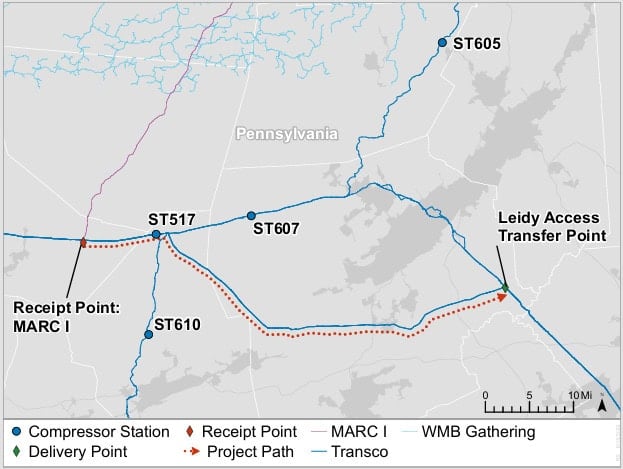
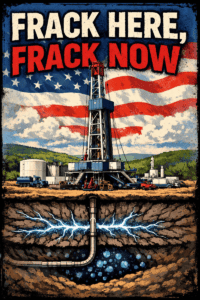 The Ohio Oil and Gas Land Management Commission (OGLMC) is set to vote on Monday to open roughly 23,000 acres of publicly owned wildlife preserves in eastern Ohio to fracking. The panel will weigh accepting bids on about 15,000 acres split between Jockey Hollow and Egypt Valley, plus opening another 8,000 acres of Egypt Valley. Approval would bring Ohio’s leased public land to more than 30,000 acres across Salt Fork State Park and six wildlife areas, mostly in the Belmont-Harrison-Guernsey region. Ohio has already collected roughly $57 million in signing bonuses, plus 18–20% royalties.
  In October 2025, we reported that Ohio Republican Senators had introduced Senate Bill (SB) 219, the first significant update to Ohio’s oil and gas laws since the Kasich administration more than a decade ago (see
 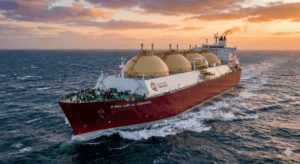 In early 2024, we reported that Penn America Energy CEO Franc James, the potential builder of the proposed Penn America LNG export facility in the Philadelphia area, said that he “pumped the brakes” on the project but that it wasn’t dead yet (see