
EIA April STEO Lowers Projected HH Spot Price for 2026 & 2027
 The U.S. Energy Information Administration (EIA) issued its latest monthly Short-Term Energy Outlook (STEO) yesterday. The STEO is the agency’s monthly best estimate of where energy prices and production will head over the next 12 months. There was a revision to the agency’s prediction about the spot price (at the Henry Hub) for natural gas in 2026 and 2027. Just last month, EIA predicted the HH spot price would average $3.76 per million British thermal units (MMBtus) this year, and $3.85 next year (see EIA Mar. STEO Makes Big Change Down (-$0.55) re 2026 Avg Spot Price). Yesterday, those prices were revised to $3.67 in 2026 (down 9 cents) and $3.59 in 2027 (down 26 cents). Read More “EIA April STEO Lowers Projected HH Spot Price for 2026 & 2027”

 The Trump administration’s proposed Fiscal Year 2027 budget would establish four Centers of Excellence at the National Energy Technology Laboratory (NETL), focusing on oil and natural gas, coal, critical minerals, and geothermal energy. Pittsburgh’s South Park facility will house the oil and gas center, while Morgantown, West Virginia, will host the coal center. NETL’s infrastructure funding will rise 2% to $58 million, but research operations will face an 8% cut to $80 million. Programs supporting coal-impacted communities and clean hydrogen hubs would be eliminated. Industry groups, including the Marcellus Shale Coalition and Pennsylvania Coal Alliance, praised the administration’s energy-focused direction.
  Caturus has reached major milestones in its “wellhead-to-water” strategy, finalizing customer offtake agreements (new customer signups) for its $12.5 billion, 9.5 MTPA Commonwealth LNG project in Louisiana. This commercialization milestone paves the way for imminent project financing and a final investment decision (FID) in the coming weeks. Key international partners, including EQT LNG Trading, Glencore, Mercuria, PETRONAS, and Aramco Trading Americas, have signed long-term Sale and Purchase Agreements.
 In Antero Resources Corp. v. Stonewall Gas Gathering LLC, the Texas Business Court resolved a contract dispute over a 2014 gas gathering agreement following a bench trial. The court denied Antero’s claims for $200 million in past and future monetary damages. However, it granted Antero “declaratory relief” and specific performance, ordering Stonewall to reduce Antero’s service fees in accordance with the affiliate agreements and to produce the requested contract documents. The court awarded Antero $1 in nominal damages for discovery breaches, while a ruling on attorney’s fees was deferred pending further proceedings.
 The Mountain Valley Pipeline (MVP), which began operations in 2024 through West Virginia and Virginia, is now slated for an extension, the MVP Southgate, into North Carolina. This expansion faces opposition from some residents and environmental groups who raise concerns about safety, environmental impact, eminent domain issues, and the need for increased natural gas infrastructure (they believe cataclysmic global warming comes from burning natural gas). Despite court challenges and past environmental violations, the project has received government approvals and is forging ahead. On March 23, the Federal Energy Regulatory Commission (FERC) issued a notice to proceed with construction in Virginia.
  National Grid New York is upgrading its 50-year-old Grasmere Gate Station on Staten Island, a critical piece of natural gas infrastructure serving approximately 80,000 customers. This two-phase project, which began in March 2025 and is expected to finish by June 2026, involves a complete rebuild of mechanical equipment and components to enhance safety, strengthen physical structure, and improve efficiency. The work was crucial during a winter with record-breaking natural gas demand and is part of National Grid’s ongoing investment in modernizing infrastructure across Brooklyn, Queens, and Staten Island to meet current and future energy needs. Here’s our question: How in the world did lunatic anti-fossil fuel fanatics not notice this upgrade was happening and protest to stop it?
 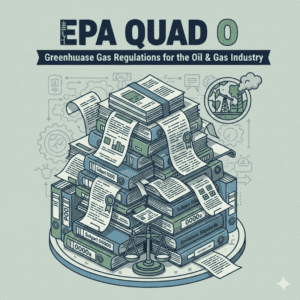 The EPA has revised certain Biden-era oil and natural gas regulations, specifically aspects of the 2024 Clean Air Act rules (OOOOb/c, known as “Quad O”), to reduce compliance burdens and lower energy costs. Administrator Lee Zeldin states these changes aim to unleash domestic energy by providing flexibility to operators, saving an estimated $2.5 billion over 15 years. Key revisions include extending temporary flaring allowances from 24 to 72 hours and adjusting Net Heating Value (NHV) monitoring requirements, both expected to reduce unnecessary testing without affecting emissions. This action is part of a broader effort to make regulations more workable, promote American energy dominance, and ultimately benefit American families through lower energy costs.
  A decision issued by the Pennsylvania Commonwealth Court has helped to rein in attempted lawfare (the abuse of our judicial system) by an anti-fossil fuel group in southwestern PA. Protect PT, a group we’ve covered many times in the past, tried to assert “standing” (the right to sue) in a case involving an EQT well pad that needed to be moved by 178 feet from its original location. The local zoning board was happy to give the antis “standing” in their hearings, but when Protect PT didn’t like the board’s decision, they tried to appeal it to a court. The trial court told Protect PT the group didn’t have standing under the very specific requirements of the law.
  Anti-fossil fuel fanatics haven’t given up on trying to block construction of the Williams Northeast Supply Enhancement (NESE) pipeline, a $1 billion+ project designed to increase Transco pipeline capacity and flows of Marcellus gas heading into New York City and other northeastern markets. Last November, the states of New York and New Jersey issued federal Clean Water Act permits for their respective states, allowing NESE to be built (see
  Virginia is officially rejoining the Regional Greenhouse Gas Initiative (RGGI) carbon tax scheme this July after a liberal court deemed its previous withdrawal under former Governor Glenn Youngkin unlawful. This reentry forces utilities like Dominion Energy to resume purchasing carbon credits—modern-day indulgences for the “sin” of emitting carbon dioxide, the same thing mammals exhale with every breath. The cost will be passed on to ratepayers through monthly bill increases. Virginians have no one to blame but themselves when their electric bills soar due to this idiotic carbon tax that does nothing more than allow politicians to pass out money to their favorite constituent groups as a reward for voting them into office. Welcome to the USSR of Virginia.
  A study by the Pittsburgh Technology Council and Philadelphia Alliance for Capital and Technologies projects that Pennsylvania’s data center expansion will generate $12 billion in annual economic output and nearly 20,000 jobs by 2036. With a forecasted 4,000% increase in data center construction, the commonwealth is leveraging its status as a leading energy exporter and its $29 billion manufacturing sector to support global cloud infrastructure. By integrating robust natural gas and nuclear resources with data development, Pennsylvania is positioning itself as a leader in the AI economy. That is, IF antis don’t blow the opportunity by blocking new data centers (see
  Please excuse our immodesty while we toot our own horn. MDN first tipped you back in July 2025 that the Democrat anti-fracking movement in Pennsylvania (and beyond) was rapidly becoming anti-data center (see
  On Tuesday, seven radicalized Big Green groups filed a court challenge to the Federal Energy Regulatory Commission’s (FERC) authorization for Mountain Valley Pipeline, LLC, to construct the MVP Southgate gas pipeline. The petition for review, filed by the Southern Environmental Law Center (SELC), Appalachian Mountain Advocates, and Sierra Club in the United States Court of Appeals for the District of Columbia Circuit (DC Circuit), asks the court to vacate the amended certificate of convenience and public necessity issued by FERC in December 2025.