
CT GOP Candidate for Gov Sues NY to Allow Constitution Pipeline
 Connecticut gubernatorial candidate Betsy McCaughey (Republican) has sued New York Governor Kathy Hochul (Democrat), alleging a violation of the Interstate Commerce Clause for blocking the Constitution Pipeline. McCaughey claims Hochul’s actions prevent cheaper Marcellus Shale natural gas from reaching New England, thereby increasing Connecticut’s electricity rates. McCaughey, who lives in Greenwich, claims legal standing to sue as a consumer and ratepayer. The lawsuit, filed in U.S. District Court, aims to force New York to allow construction of the pipeline, which she argues would provide Connecticut residents with more affordable energy. Do-nothing Governor Ned Lamont (lifer Democrat, running for a third term) dismissed the suit as a political stunt. Read More “CT GOP Candidate for Gov Sues NY to Allow Constitution Pipeline”
 AI data centers are in the news every single day. We don’t think it’s melodramatic to say that AI is changing the world right now. We also believe it’s accurate to say that everyone (yes, you reading this) will use AI at some level (if you don’t already) within the next year or two. AI, or artificial intelligence, requires, in the aggregate, millions of computers. All of those computers need a place to live (i.e., data centers). And those data centers need electricity to run. Tapping into the local electric grid is not a good option because it takes the grid years to plan, build, and add new sources of power. “Hyperscalers” (massive cloud service providers like Amazon’s AWS, Microsoft’s Azure, or Google’s Cloud, offering scalable, on-demand computing, storage, and networking resources) need to build data centers to house the computers that power AI today. Not years from now. This is a conundrum. A Pittsburgh battery company has partnered with a Houston, Texas, turbine maker to provide a natural gas-based solution ready in months, not years.
  MDN first tipped you back in July 2025 that the Democrat anti-fracking movement in Pennsylvania (and beyond) was rapidly becoming anti-data center (see
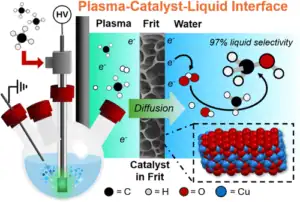 From time to time, we highlight research with the potential to impact the Marcellus/Utica region. In 2023, we told you about Japanese researchers discovering a new (and cheaper) way to convert natural gas into methanol at room temperature in water using a special enzyme (see
 As we report in today’s lead story, Williams held a groundbreaking ceremony for the Transco Northeast Supply Enhancement (NESE) project in New York City yesterday (see Groundbreaking Ceremony for NESE Pipe in NYC an All-Star Event). One of the speakers at the event, the master of ceremonies, was Williams CEO Chad Zamarin. One of the comments he made at the event that deserves its own post here on MDN was news about the Constitution Pipeline project, a 124-mile greenfield pipeline from the Marcellus gas fields of Susquehanna County, PA, to Schoharie County, NY, to move Marcellus gas into New York State and New England.
  The highly functional and responsible Susquehanna River Basin Commission (SRBC), unlike its highly dysfunctional and irresponsible counterpart, the Delaware River Basin Commission (DRBC), continues to support the shale energy industry by approving water withdrawals and consumptive use for responsible and safe shale drilling. The SRBC also tells shale drillers when to stop withdrawing if low water flow (i.e., drought) conditions exist. That’s what the SRBC did yesterday. The agency, via its Hydrologic Conditions Monitor, warned shale drillers that, at 15 listed locations (all in Pennsylvania), they must stop water withdrawals until streamflow reaches a specific “trigger flow” target (different for each location). Another 9 locations are approaching restrictions.
  The U.S. Department of Energy (DOE) Hydrocarbons and Geothermal Energy Office (HGEO) announced a $14 million project to test enhanced geothermal systems (EGS) in Pennsylvania. Led by the Pennsylvania Department of Environmental Protection (DEP), the initiative will leverage existing oil and gas infrastructure, specifically the Appalachian Utica Shale, to explore the efficacy and scalability of EGS in the eastern U.S. This project aims to convert a horizontal shale gas well for geothermal use, assessing optimal well placements and fracturing techniques. If successful, it could provide a replicable model for expanding reliable, cost-effective geothermal electricity nationwide, utilizing abundant underground heat resources.
  The Philadelphia Gas Commission postponed a vote on Philadelphia Gas Works’ (PGW) $182 million proposal to replace and expand its natural gas liquefier (LNG plant) in Port Richmond. The commission’s staff and the Public Advocate recommended rejecting the project, arguing it was oversized and could burden customers with unnecessary debt. They also cited incomplete plant and project designs. PGW argued the upgrade is crucial for safety and affordability, preventing potential harm to customers during cold winters and avoiding the need to truck in liquefied natural gas.
  As we reported last week, anti-fossil fuel fanatics haven’t given up on trying to block construction of the Williams Northeast Supply Enhancement (NESE) pipeline, a $1 billion+ project designed to increase Transco pipeline capacity and flows of Marcellus gas heading into New York City and other northeastern markets (see
  We spotted an interesting article that posits Williams’ strategy is to expand its mighty Transco natural gas pipeline system by increasing the capacity of existing infrastructure rather than building new pipelines. The Transcontinental Gas Pipe Line (Transco) is the largest-volume, highest-capacity interstate natural gas transmission system in the U.S. It spans roughly 10,000 miles (with 60+ compressor stations) from the Gulf Coast (Texas/Louisiana) to New York City. The Williams strategy of expanding Transco rather than building new pipes minimizes disruption to communities and the environment while meeting growing demand from residential, commercial, industrial, and power generation sectors.
 Natural Allies for a Clean Energy Future
 U.S. Secretary of the Interior Doug Burgum visited Lackawanna College yesterday to observe how students are trained for energy-focused careers in natural gas, petroleum, and robotics. He emphasized that these students will contribute to the growth of key industries, creating significant career opportunities. Burgum, joined by Congressmen Rob Bresnahan and Dan Meuser, commended the college’s programs and shale industry-donated equipment, highlighting their role in an American renaissance driven by energy, innovation, and manufacturing. He also discussed how data centers, or “AI manufacturing,” could utilize Pennsylvania’s Marcellus Shale natural gas to generate electricity, bringing economic benefits and lowered utility costs, drawing parallels to his experience in North Dakota.