
Gas-Fired Elec Plant Near Indianapolis Starts Up, Fueled by M-U?
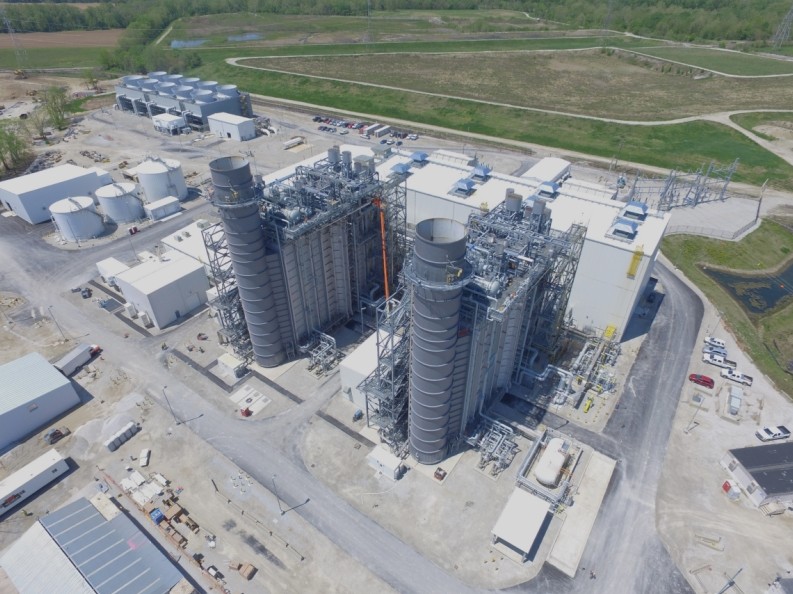
Seems like a day doesn’t by that we don’t notice yet another natural gas-fired electric plant project has been announced, or in this case, has come online! Here’s a project not previously on our radar. Indianapolis Power & Light (IPL) built and recently brought online a 671-megawatt combined-cycle natural gas-fired electric plant about 30 miles southwest of downtown Indianapolis. The new plant can power up to 370,000 homes. Gas-fired plants are a huge market for Marcellus/Utica gas. “But Jim,” you say. “This plant is in Indiana! There’s no Marcellus/Utica gas in Indiana. In fact, Rover, NEXUS and other pipelines don’t go through Indiana, so why are you excited about this plant?” Good question. We’re excited because there ARE pipelines in the vicinity that flow our gas–including the mighty Rockies Express (REX), which was reversed in June 2014 and now flows our gas all the way to points in Missouri (see Rockies Express Pipeline Reverses Flow from Utica to Midwest). According to a statement issued by IPL, the new Eagle Valley gas-fired plant can access “low-cost fuel” from the Rockies Express Pipeline and Texas Gas interstate pipelines. That is, Marcellus/Utica gas…
Read More “Gas-Fired Elec Plant Near Indianapolis Starts Up, Fueled by M-U?”
 In August 2015, MDN told you about a lawsuit brought by a group of left coast radicalized children who want to force the federal government to become communist and “force action” on mythical climate change (see
  A shocking and at times farcical tale of how an environmental lawsuit turned into the world’s biggest fraud is revealed in a new play. The world premiere of “The $18-Billion Prize,” based on the true story of rainforest natives and their New York lawyer “fighting for justice” against one of the world’s biggest oil companies, opens May 19 at San Francisco’s Phoenix Theatre. Performances continue through June 3. Written, or perhaps a better word is assembled, by Phelim McAleer and Jonathan Leaf, the play uses exact words from transcripts of court documents. In 1993, Steven Donziger, a Harvard-educated American lawyer, represented indigenous groups from Ecuador’s rainforest in a class action lawsuit against Chevron–a shakedown. The case received an enormous amount of media attention, including major coverage by Vanity Fair, Rolling Stone and 60 Minutes to name a few, and it drew the support of international celebrities. Chevron, to their credit, fought back. An American court found evidence of fraud and ordered Donziger to hand over his files and diaries, which exposed a massive bribery and corruption scheme. The play will make you laugh, and cry, and make you angry that such a long-running fraud could be perpetrated here in the United States…
 Nearly a year ago MDN reported that Big Green group THE Delaware Riverkeeper (aka Maya van Rossum) and the odious Philadelphia-based Clean Air Council (CAC) had suffered a crushing legal defeat in their attempt to interfere with shale drilling on the opposite side of the state from where the Delaware River and Philly is located (see
  Perhaps our headline uses a poor choice of words, but that’s what immediately comes to mind in describing the enormous amount of gas (and oil) production coming from America’s shale plays–in particular the Marcellus/Utica (for gas) and the Permian (for oil). Yesterday our favorite government agency, the U.S. Energy Information Administration (EIA), issued our favorite monthly report, the Drilling Productivity Report (DPR). The DPR is the EIA’s best guess, based on expert data crunchers, as to how much each of the U.S.’s seven major shale plays will produce for both oil and natural gas in the coming month. We sound like a broken record, but the numbers continue to be mind-blowing–hitting new all-time, breath-taking highs each month. This month is no exception. Last month the EIA predicated natural gas output from the seven major shale plays would go up another 1+ billion cubic feet per day (see
  West Virginia has a long, proud history as a coal producer. And according to West Virginia Coal Association President Bill Raney, some 95% of the electricity produced and used in the Mountain State comes from coal-fired plants. However, natural gas burns cleaner than coal, and frankly, natgas is now cheaper than coal. Yet WV still has not permitted or allowed a single new gas-fired plant to be constructed. Why not? The obvious answer is because Big Coal is pushing back and pushing back hard. Last September WV’s Secretary of Commerce, Woody Thrasher, admitted publicly that his beloved state is unfriendly to new natgas-fired electric plant projects (see
  Last November we updated you on a lawsuit filed by a group of anti-fossil fuelers in Penn Township (Westmoreland County), PA (see
 MDN has previously written about the Appalachian NGL (natural gas liquids) Storage Hub, a $10+ billion infrastructure project with no specific location identified as yet, but West Virginia often named (see
 On Friday, the Federal Energy Regulatory Commission (FERC) issued Dominion Energy permission to begin construction of the actual pipeline for the Atlantic Coast Pipeline (ACP) project–in West Virginia. ACP is a (now) $6.5 billion project, up from a projected $5 billion due to delays from regulatory agencies and frivolous lawsuits filed by Big Green groups, that will run from WV through Virginia and into North Carolina–almost to the border with South Carolina. Until now FERC had allowed prep work, like tree cutting. But now actual pipeline construction can begin, which is a momentous occasion, worthy of celebration!…
 Last week RCL Chemical announced it has partnered with Y2X Infrastructure to build a $325 million gas-to-liquids (GTL) plant in Floyd County, Kentucky. GTL plants convert natural gas, a hydrocarbon, into other hydrocarbons, like diesel fuel, gasoline, solvents and waxes. An abundance of cheap natural gas in the Marcellus/Utica is one of the prime motivators for establishing GTL plants in the region. Although we’ve heard plenty of talk about such plants, we’ve only seen a few prototypes get built thus far. The RCL/Y2X story caught our attention because Kentucky hates new gas pipelines, yet wants to build a plant that will use gas coming from pipelines (see
  What’s happening with Kinder Morgan’s $4 billion Utica Marcellus Texas Pipeline (UMTP) project? In February MDN told you that Kentucky antis went to court to try and block a plan by Kinder Morgan to convert a portion of the Tennessee Gas Pipeline (TGP) that flows natural gas from the Gulf Coast to the northeast, to reverse the pipeline and flow natural gas liquids (NGLs) from the Marcellus/Utica region to the Gulf Coast (see
  Here’s a theme we have been writing about more and more–because it’s important. That theme is this: Oil drillers in Texas (and New Mexico), in the Permian Basin, are drilling so fast and so furious to get oil out of the ground, that they are creating an overabundance of natural gas that increasingly competes with Marcellus/Utica gas. How? Every time you drill for one hydrocarbon, like oil, other hydrocarbons often come of the ground with it. In this case, natural gas. The unintended but significant quantities of natgas coming out of the ground along with Permian oil is referred to in the biz as “associated gas.” As we wrote in March, natural gas prices in Texas did something that hasn’t happened in years–they became cheaper than the price of natural gas selling in the saturated Marcellus/Utica (see
  In April, the Pennsylvania Joint State Government Commission released a report (full copy below) tackling the question of whether or not PA’s environmental laws and regulations are more stringent than federal requirements. The report compared the main state and federal laws in place covering clean air, clean water, natural resources, waste management and more. The report says PA’s laws, “are generally no more stringent than their federal counterparts.” But in the same paragraph, the report says, “Where additional regulations have been made, it is generally justified as a compelling and articulable Pennsylvania interest and addresses definable public health, safety or environmental risks. The area of greatest deviation involves differences between the federal Clean Water Act and the Clean Streams Law. Other more stringent regulations are found in the areas of safe drinking water, the handling of hazardous materials, and mineral extraction. In some instances, Pennsylvania regulations build upon and supplement federal law; in others, Pennsylvania has acted in areas not regulated by the federal government” (pg 6). What does that say to you? It says to us: “Heck yeah, the enviro laws in PA are a lot more strict than federal laws, but there’s good reasons (according to the authors of the report) for it.” Are there good reasons for PA raising the bar higher than the federal government requires?…