
Mountaineer Plans Pipe Expansions in WV Panhandle “Every Year”
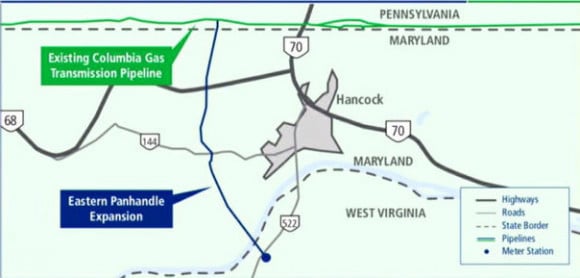
In 2017, Mountaineer Gas launched its Eastern Panhandle Expansion pipeline project–a project to deliver natural gas via local distribution channels to a new industrial facility in Berkeley County, WV, and to provide gas to other local businesses and residents in the Tri-State area. Mountaineer’s pipeline expansion will be fed by a 3.5-mile Columbia Gas pipeline due to run under the Potomac–which is being fought vigorously by anti fossil-fuelers. There are three phases to the Eastern Panhandle Expansion project: Phase One runs a 22.5-mile, 10-inch-diameter steel pipeline from Morgan County to Martinsburg; Phase Two includes a loop to Charles Town (Jefferson County); and Phase Three will build a four mile segment of pipeline into Martinsburg. The West Virginia Dept. of Environmental Protection approved the Eastern Panhandle Expansion in February (see WV DEP Issues Permit for Mountaineer Gas Pipeline in Eastern WV), and work on Phase One began in March (see Mountaineer Gas Begins Work on Morgan County, WV Pipeline). According to an article just published, work on Phase One was initially delayed because of heavy rainfall in April/May (but is now going well), and Phase Two is planned to begin in the first or second quarter of 2019. The interesting thing (for us) is a comment from Mountaineer VP Thomas Westfall, who said this: “Over the next 20 years, we will have a lot of additional interest [in gas service in the Tri-State area], and we will be proposing expansion projects in this area every year.” Meaning Phases One, Two, and Three are only the beginning, which is sure to drive the antis bonkers…
Read More “Mountaineer Plans Pipe Expansions in WV Panhandle “Every Year””
 A newly published study by the Interstate Natural Gas Association of America (INGAA) Foundation is raising eyebrows. The study, titled “North America Midstream Infrastructure through 2035” (full copy below), says the United States and Canada together will need to invest a total of $791 billion, or an average of $44 billion per year, from 2018 to 2035, to build new natural gas and oil pipelines (and associated infrastructure). That is some serious cash! The study makes certain assumptions, like this one: “Because production costs are relatively low in the Marcellus and Utica compared with production costs elsewhere, the study anticipates both production and infrastructure needs related to natural gas will be focused in the U.S. Northeast.” Meaning a lot of the money to build pipelines will go to our region. And this: “The study estimates about 25 billion cubic feet per day of new capacity to move Marcellus and Utica supplies to consumers and export facilities through 2035.” Whoa! According to the updated EIA Drilling Productivity Report issued on Monday, the Marcellus/Utica region will produce 28.9 Bcf/d of natural gas in July. Another 25 Bcf/d on top of that (essentially doubling current production) means by 2035 our region will produce over 50 Bcf/d of natgas. Incredible! No wonder we need more pipeline investment. Here’s an overview, along with a copy of the full study…
 Here’s what happens when the Heinz Endowments, William Penn Foundation, National Resources Defense Council and other far-left “environmental” funders don’t fund a study: real science gets done. We’ve knocked Yale University in the past when so-called studies (junk science) were released about fracking in the Marcellus/Utica (example from March 2018:
 You can’t say we didn’t warn you. In early April, when the current “trade war” with China began to heat up, we said this with respect to the deal China signed to invest $83.7 billion in West Virginia shale and petrochemicals: “However, if a trade war does develop, it would be foolish to not think those investments (withholding them) will be used against us.” (
 Yesterday our favorite government agency, the U.S. Energy Information Administration (EIA), issued our favorite monthly report, the Drilling Productivity Report (DPR). The DPR is the EIA’s best guess, based on expert data crunchers, as to how much each of the U.S.’s seven major shale plays will produce for both oil and natural gas in the coming month. Each month, as has been happening for months on end, the Marcellus/Utica region (called Appalachia in the report) continues to see production go through the roof. Last month (and the month before and the month before) EIA predicted M-U production would go up by more than 1/3 of a billion cubic feet (see
 The good news keeps rolling in for Mountain Valley Pipeline–a $3.5 billion, 301-mile pipeline currently under construction from Wetzel County, WV to the Transco Pipeline in Pittsylvania County, VA. MVP is being built to move Marcellus/Utica gas south. Following multiple lawsuits and regulatory challenges by Big Green groups, MVP is getting work done and on track to be completed this year. Just last week we told you that following delays by illegal protesters sitting in trees in the Jefferson National Forest, the Federal Energy Regulatory Commission helpfully extended tree cutting season for MVP to July 31 (see
 Here’s a project we’ve mentioned in passing as part of other posts, but until now, have not specifically focused on. In August 2017, Enbridge received approval (a certificate) from the Federal Energy Regulatory Commission (FERC) to construct and operate the Texas Eastern Appalachian Lease Project (“TEAL Project”). TEAL boosts the capacity along the Texas Eastern Transmission Company (Tetco) pipeline and connects it to the NEXUS pipeline. NEXUS has been under construction since last October (see
 TransCanada, one of Canada’s leading midstream/pipeline companies, cooked up a deal in 2016 to pipe natural gas from Canada’s West Coast to the East Coast in order to fend off cheap supplies of Marcellus/Utica gas that will flow into Canada from the NEXUS and Rover pipelines (see

 It increasingly looks like LyondellBasell Industries, one of the largest plastics, chemicals and refining companies in the world, will buy out/take over Braskem, the largest petrochemical company in Latin America (headquartered in Brazil). Braskem and its parent company Odebrecht, as you may recall, was hot-to-trot to build a multi-billion dollar ethane cracker near Parkersburg, WV–four years ago. Odebrecht got mired in scandal in Brazil and that put things on hold in 2015 (see


 In May MDN told you that Big Green groups were successful in getting the U.S. District Court of Appeals for D.C. to force the Federal Energy Regulatory Commission (FERC) to either move forward with, or reject a rehearing request on their decision to approve the Mountain Valley Pipeline (see
 As MDN predicted, yesterday the Pennsylvania Public Utility Commission (PUC) voted to overturn a previous action by liberal administrative law judge, Elizabeth Barnes, to shut down the Mariner East 1 (ME1) pipeline (see