
OH Bill Passes House to Create Carbon Capture/Pore Space Law
 Ohio House Bill (HB) 170, which authorizes Carbon Capture and Storage (CCS) by injecting captured CO2 into subsurface “pore space,” passed the Ohio House and has advanced to the Ohio Senate. The bill establishes a state regulatory framework, delegating to the Ohio Department of Natural Resources (ODNR) the authority to govern Class VI injection wells. This bill, if it becomes law (as seems likely), has significant implications for both drillers and landowners. Read More “OH Bill Passes House to Create Carbon Capture/Pore Space Law”
 Vallourec Star, a steel pipe manufacturer in Youngstown, OH, serving the shale and other industries, was approved yesterday by the Ohio Tax Credit Authority for a seven-year job creation tax credit. It means the company will create 40 new full-time positions. The tax credit supports Vallourec Star’s plan to expand its current operations to manufacture a new line of high-quality steel pipe.
  Diversified Energy (DEC) has achieved the Gold Standard Reporting certification, the highest level awarded by the UN’s Oil & Gas Methane Partnership 2.0 (OGMP 2.0). Diversified says this recognition validates the company’s commitment to significantly reducing methane emissions and providing transparent, measurement-based reporting, which the UN’s IMEO views as the industry standard. Given that the UN (United Nations) seeks to destroy fossil energy, we find it odd that the organization hands out awards to oil and gas companies.
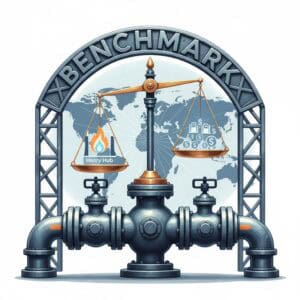 For over 30 years, the Henry Hub in Louisiana has served as the key anchor for natural gas pricing in the contiguous United States. Its role, however, has dramatically evolved over the last decade, primarily due to the rapid growth of U.S. LNG exports. Henry Hub has shifted from being a benchmark for U.S. natural gas to the primary index for global LNG cargo pricing. Consequently, the volume of physical gas exchanged at the hub is at its highest, and Henry Hub prices are now considered a premium compared to other domestic markets.
  Last week, the Baker Hughes U.S. national rig count added rigs for a second consecutive week, bringing the national count up by two to 550. Despite last week’s rig increase, the total count was still down 35 rigs, or 6% below this time last year. Rigs in the Marcellus/Utica remained the same last week at a combined 37 rigs, the same number for four weeks in a row. Pennsylvania remained unchanged at 17 active rigs. Ohio was the same at 13 rigs. And West Virginia maintained its 7 rigs, which it has operated since May 30. The Marcellus had 23 rigs and the Utica 14.
  Back in July, MDN told you that the New Fortress Energy project to build a regional LNG liquefaction plant in landlocked Wyalusing (Bradford County), PA, was dead and buried, given the company had changed its plans for the site (see
  EQT Corporation self-reported a wastewater spill at its Secretariat Well Site in Gilmore Township (Greene County), PA, on October 3. Multiple spots were found after the completions crew removed its containment apparatus from the pad. EQT immediately got to work remediating the site and has (so far) removed 340 barrels of wastewater (14,280 gallons) and 21.5 roll-off boxes of dirt. EQT reported the spill to the Pennsylvania Department of Environmental Protection (DEP) as soon as it was observed on October 3. A DEP inspector finally showed up on October 10.
  The Trump administration wants to win the race for artificial intelligence (AI) with China. The administration is pulling out all the stops to ensure the U.S. is #1 in AI. That means building new data centers. Last Thursday, Secretary of the Department of Energy (DOE) Chris Wright took the unusual step of sending a directive to the Federal Energy Regulatory Commission (FERC), instructing the agency to initiate rulemaking procedures to rapidly accelerate the interconnection of large loads, including data centers. Wright even included his own proposed rule for FERC to adopt (spoon-fed).
 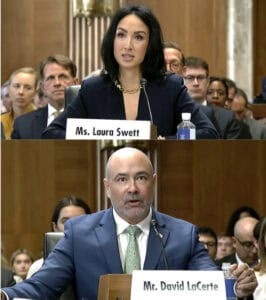 Two weeks ago, MDN brought you the rumor that President Trump was about to appoint newly confirmed Federal Energy Regulatory Commission (FERC) Commissioner Laura Swett as the next Chairperson of the agency (see
 Something remarkable has happened in the Pennsylvania State Senate, where Republicans hold a slim majority with 27 members and Democrats have 23 members. In an unusual act of bipartisanship, six of the Democrat Senators (26% of all PA Democrat Senators, more than one-quarter) voted with all 27 Republicans to pass a bill that would erase Regional Greenhouse Gas Initiative (RGGI) regulations from Pennsylvania’s books. RGGI is a carbon tax on coal- and gas-fired power plants in the state.
  We happened across a lawsuit we didn’t know about, involving an issue we’ve seen before. A landowner in Belmont County, Ohio, filed a lawsuit in June 2024 alleging that Gulfport Energy, in a joint development agreement with EQT (the lease owner), drilled three wells under the landowner’s property that tapped into the Point Pleasant formation, which sits immediately below the Utica. The landowner said the lease only allows drilling in the Utica and Marcellus and NOT in the Point Pleasant.
  In the olden days of fracking (20 years ago), drillers would drill and frack one well at a time, called a Zipper Frac. Around five years ago, in 2020, fracking two wells at a time became vogue, a technique called SimulFrac (simultaneous fracturing). Today, SimulFracs are used by all major producers, including those operating in the Marcellus/Utica. Now coming into vogue is the next evolution: TrimulFrac, or fracturing three wells simultaneously. Fracking three wells at a time requires even more sophisticated logistics, real-time monitoring, and effective equipment management.
  For years, we’ve tracked and sometimes discussed lawsuits (a better term is lawfare) from the left against fossil fuel companies. These lawsuits seek to blame oil and gas companies for causing global warming by putting “too much” carbon dioxide into the atmosphere, even though you breathe CO2 out with every breath you take, as do all mammals. The left doesn’t even care if it loses these lawsuits (although they’d love to win some of them) because the very act of forcing companies to defend themselves, and paying big money to do so, means they must raise the price of their goods, and consumers eventually pay those higher prices. A Big Green attorney working on some of these lawsuits openly admits—we’d call it bragging—that the lawsuits are a backdoor carbon tax aimed at forcing consumers to pay more. It’s SICK.
  Williams engaged in some LNG jiu-jitsu yesterday, announcing several transactions related to LNG exports. It’s somewhat complicated, but we’ll break it down. First, Williams sold its interest in the Haynesville’s South Mansfield upstream (drilling) venture to JERA, Japan’s top power generator, for $398 million. Williams will continue to operate the gathering system for the South Mansfield wells. Second, Williams is buying 80% (becoming the operator) of the Driftwood Pipeline LLC, which includes the construction of Line 200, a fully permitted greenfield pipeline connecting Woodside’s Louisiana LNG facility to multiple pipelines, including Transco and Louisiana Energy Gateway (LEG). Third, Williams is buying a 10% stake in the Louisiana LNG export facility. Williams will pay $378 million for the Driftwood Pipeline and the 10% stake in Louisiana LNG. However, Williams will contribute another $1.9 billion for its share of capital expenditures for the LNG facility and pipeline. Williams’ total investment will be roughly $2.3 billion. And yes, there is a connection to the Marcellus/Utica.