
Michigan Judge Rules Rover Pipeline Can Access Holdout Properties
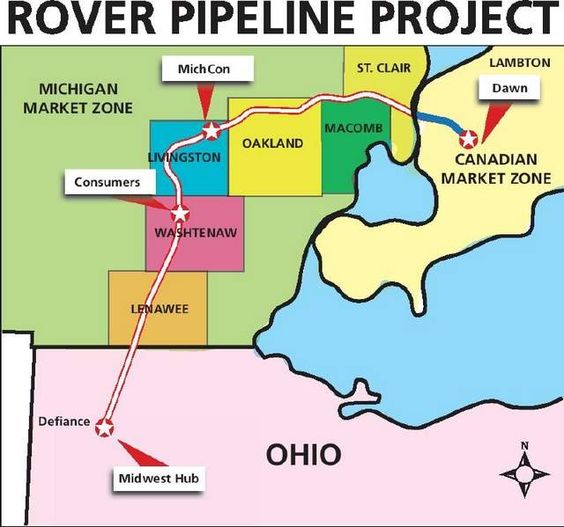 On Feb. 3, the Federal Energy Regulatory Commission (FERC) gave its final approval to Energy Transfer’s Rover Pipeline project–a $3.7 billion, 711-mile Marcellus/Utica natural gas pipeline that will run from PA, WV and eastern OH through OH into Michigan and eventually into Canada (see ET Rover Pipeline Gets Final Approval by FERC). When FERC approves a project like Rover, the project automatically gets the power to invoke eminent domain against landowners who refuse to sign easements to allow the pipeline. Rover has done that in several states, including Ohio and Michigan. Landowners who own 116 tracts of land in Michigan where Rover will traverse have refused to negotiate or allow Rover access to their land. Those days are over. A federal judge in Michigan has just ruled Rover can immediately seize land along the route of the pipeline and begin tree clearing and construction…
Read More “Michigan Judge Rules Rover Pipeline Can Access Holdout Properties”
 There is a concerted effort by a small group of fossil fuel haters to strip away the Constitutional property rights of all Marylanders by passing a permanent ban on fracking in the state. They’ve already convinced the Maryland House to pass a ban bill. The haters spew outright lies about fracking and attract local media outlets with gullible reporters who never question their outlandish claims. While they make false claims about fracking, that it pollutes water, air and in general kills everything, make no mistake–the root of their objection is that fracking extracts fossil fuels which, in the religion of environmental extremists, causes man-made global warming. That is what animates them. Unfortunately, as we have previously observed, Christian pastors from liberal denominations are claiming that the issue of fracking is a “moral” issue, a “good vs. evil” conflict (see
  New York’s corrupt Attorney General, Eric Schneiderman, is getting desperate. We want to go on record as one of the first to say he’s sowing the seeds of his own destruction. Schneiderman is a train wreck waiting (and about) to happen. We refer, of course, to Schneiderman’s eerie similarity to Captain Ahab in Moby Dick in attempting to hunt down ExxonMobil, Schneiderman’s great white whale. Recently Schneiderman, in cooperation with a sycophantic mainstream media, released information that former CEO Rex Tillerson (now Secretary of State) had a second email account. But unlike Hillary Clinton, Tillerson’s second account was not on a private server and was not used (as Schneiderman alleges) to secretly discuss how Tillerson “knew” burning oil and other fossil fuels causes mythical man-made global warming. Schneiderman’s action in running to the press to “reveal” a “secret” email account is a faint–a way to misdirect people from the real story, which is that Schneiderman continues to refuse to disclose his own emails that prove this whole Exxon witch hunt began when Schneiderman colluded and closely coordinated with the Rockefeller Brothers Fund, Rockefeller Family Fund, and billionaire green activist Tom Steyer. A log of emails shows coordination just prior to the launch of the #ExxonKnew campaign for which Schneiderman is the point man. He’s desperate to avoid releasing his own emails–emails that will implicate him…
 Yesterday President Trump released a detailed budget proposal which includes reducing the way-overbloated (and insidiously bureaucratic) Environmental Protection Agency budget by 31%. The budget would also ax some 3,200 EPA employees–about 21% of the 15,000 employed at the agency. It is sheer brilliance and long overdue. The EPA, under Barack Obama, sought to enforce national regulation of the oil and gas industry–something not permitted under the Constitution. It’s about time the agency was right-sized and its mission reigned in. Of course the reaction by the left has been predictable–from apoplexy to terror (snowflakes always melt so quickly). Here’s how the EPA budget news is being spun by mainstream media…
 Pennsylvania moved to the head of Marcellus pack when it comes to production reporting back in 2015. Until January 2015, drillers in PA were required to file production numbers with the Dept. of Environmental Protection (DEP) every six months, in October 2014 the Republican state legislature passed a bill that then-Gov. Tom Corbett signed into law moving reporting from every six months to every month (see
  The Delaware River Basin Commission (DRBC) held a regularly scheduled business meeting yesterday in Washington Crossing, PA. As predicted, a number of anti-fossil fuel zealots turned up to make noise about the PennEast Pipeline project–and about the prospect of the DRBC allowing shale drilling. As we disclosed yesterday, the zealots all read from the same document prepared by Her Eminence, THE Delaware Riverkeeper, Maya van Rossum (see
  A group of approximately 250 Ohio landowners, represented by an Ohio eminent domain law firm, is doing its best to stop Energy Transfer’s Rover Pipeline project dead in its tracks. Rover is playing beat the clock to finish tree clearing following a Federal Energy Regulatory Commission (FERC) final approval of the project on Feb. 3 (see
  On Feb. 3, the Federal Energy Regulatory Commission (FERC) approved a long-delayed project–National Fuel Gas Company’s (NFG) Northern Access 2016 pipeline project (see


 Today is the day that (some of) Maya’s minions will show up at a meeting of the Delaware River Basin Commission to attempt to bully DRBC staff during the public comments period. As we’ve been reporting (from a well-placed mole on the DRBC email list) Maya has been issuing orders to her minions–people who apparently aren’t bright enough to form their own thoughts about matters like the PennEast Pipeline (see
  You’ve heard the phrase, “The Emperor has no clothes.” A lawsuit against the Delaware River Basin Commission (DRBC) by a Wayne County, PA landowner over the DRBC’s ongoing moratorium of shale gas drilling, is exposing the DRBC as having “no clothes” when it comes to their authority over shale drilling (see
  On Monday, MDN wrote about a new bill introduced in the West Virginia legislature that would exempt storage tanks used by the oil and gas industry from a 2014 law passed following a coal industry storage tank failure that temporarily polluted the drinking water for 300,000 WV residents (see
  Yesterday MDN reported on a new West Virginia bill (Senate Bill 576) that aims to bring both the drilling industry and rights owners together to support co-tenancy and joint development–which are stripped down pieces of previous forced pooling bills that failed in the past (see