
WV DEP Secretary Issues Letter Explaining MV Pipeline Decision
 In March, the West Virginia Dept. of Environmental Protection (WVDEP) issued a federal water crossing permit for the Mountain Valley Pipeline (MVP)–a $3.5 billion, 301-mile pipeline that will run from Wetzel County, WV to the Transco Pipeline in Pittsylvania County, VA (see WV DEP Grants Mountain Valley Pipeline Water Crossing Permit). In June, a group of profoundly radical “environmental” organizations filed a lawsuit in the U.S. Court of Appeals for the Fourth Circuit against the WVDEP for doing their job issuing the permit (see Radicals File Lawsuit Against WV DEP for Approving MV Pipeline). Because of the pressure of that lawsuit, WVDEP caved and reversed their decision in September, rescinding (called “vacating”) the permit for MVP (see Trouble for Mountain Valley Pipe: WV DEP Withdraws Water Permit). The WVDEP said they would “re-evaluate the complete application to determine whether the state’s certification is in compliance with Section 401 of the federal Clean Water Act.” The 4th U.S. Circuit Court of Appeals upheld WVDEP’s decision and granted the agency’s motion to invalidate the previous certificate they granted the project (see Court Backs WVDEP Move to Cancel Permits for Mountain Valley Pipe). Then earlier this month, in yet another 180 degree about face, WVDEP announced it has “lifted the suspension” of the MVP stormwater permit–and that the agency has decided to waive the permit, MVP has no need to get it before beginning construction (see WVDEP Reverses, Waives Water Permit for Mountain Valley Pipeline). Since that time WVDEP has faced withering criticism from antis, accusing the agency of abandoning their oversight of the project. On Monday, WVDEP Secretary Austin Caperton issued a letter to agency staffers (and to the public) to explain the agency hasn’t given up anything–that instead they have opted for a different type of oversight of the MVP project. We have to confess, it’s a very good letter and explains a lot. Bottom line: WVDEP is still very much large and in charge when it comes to overseeing impacts from the project on WV’s streams and rivers…
Read More “WV DEP Secretary Issues Letter Explaining MV Pipeline Decision”
 Although we consider Pennsylvania Gov. Tom Wolf to be a failure, every now and again (rare as hen’s teeth), he swerves into doing something good. Or perhaps we should say he takes credit for doing something good, whether or not he actually had anything to do with it at all. Yesterday Gov. Wolf’s office issued a press release to announce that the state will spend $2.35 million via the Pipeline Investment Program (PIPE) to install natural gas lines in Tunkhannock Township (Wyoming County), which will provide clean-burning, locally extracted Marcellus Shale gas to 102 residential homes, 13 businesses and several civic buildings. The project will create something like 200 temporary construction jobs. Kudos to Wolf for not screwing this one up…
 Honestly, the Sierra Club launches so many petitions with FERC (Federal Energy Regulatory Commission), and so many lawsuits against FERC regarding pipelines, it’s hard to keep them all straight. One of the northeast pipelines the Clubbers oppose is NEXUS, a $2 billion, 255-mile interstate pipeline that will run from Ohio through Michigan and eventually to the Dawn Hub in Ontario, Canada. NEXUS got final approval for the project from FERC in August, the first major pipeline to get approved following a newly restored quorum at FERC (see
  When did little old ladies become climate jihadists? That’s what happened yesterday in Lancaster County when three old ladies, obviously radicalized at some point (maybe they’re old hippies who have always been radicalized?), tied themselves together with a plastic pipe device that needed to be cut away so they could be removed from the spot where they were blocking Atlantic Sunrise Pipeline construction equipment. The entire episode took three hours. When asked nicely by the police to remove the plastic device and unhook themselves, the old ladies refused. So the police had to carefully operate to cut them apart. We figure their stunt easily cost $3,000 in delays–so we sincerely hope Williams sends each of them a bill of $1K to cover the downtime. Plus the old ladies will need to compensate the police and court system for handling their unnecessary case. These three added to the 29 previously arrested in two other episodes now make 32 arrested opposing Atlantic Sunrise–out the “thousands” the clattering Clatterbucks (Mark and Malinda, the radicals spearheading these actions) claim said would rise up to illegally block construction. So much for the big boasts of radical antis…
 No doubt being advised and funded by national Big Green groups, a group of backbencher local green groups (Little Green) have taken the first step in what will no doubt turn into a lawsuit to try and stop the Atlantic Coast Pipeline project from getting built. The Federal Energy Regulatory Commission (FERC) approved Atlantic Coast, a $5 billion, 594-mile natural gas pipeline that will stretch from West Virginia through Virginia and into North Carolina, in October (see
 We love Rob Powelson, newly-minted Federal Energy Regulatory Commission member appointed by President Trump. Before joining FERC, Powelson was a member of the Pennsylvania Public Utility Commission. We love him because he speaks his mind. Although he’s circumspect about what he says, Powelson still finds a way to get in those zingers. You never have to wonder what he thinks. For example, in March of this year (before joining FERC), Powelson said this: “The jihad has begun…At the Federal Energy Regulatory Commission groups actually show up at commissioners’ homes to make sure we don’t get this gas to market. How irresponsible is that?” (see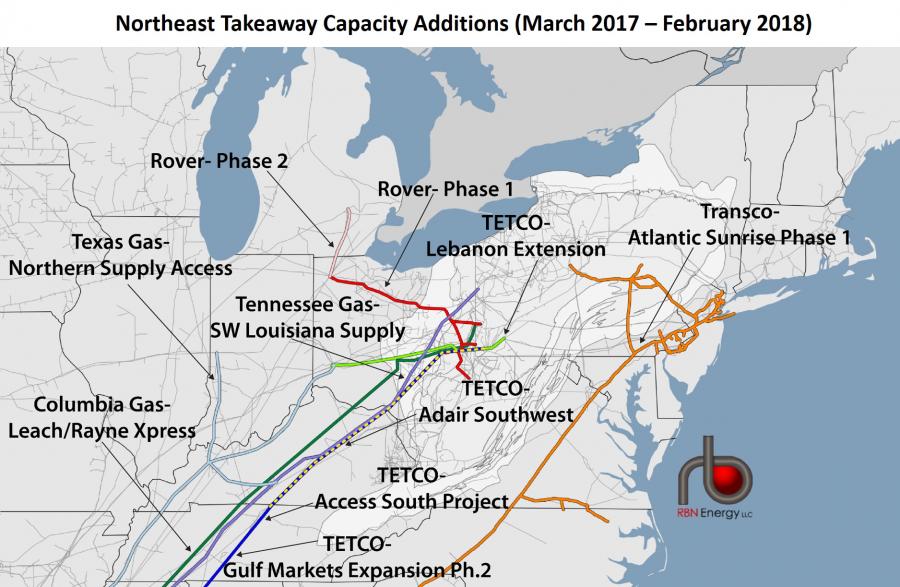
 An organic farmer in Lancaster County, PA is accusing Williams and their Atlantic Sunrise Pipeline project of violating the conditions they agreed to. What kinds of violations? “Heavy equipment was stored on the property.” Ooooookay. Uh, we don’t think they dig pipeline trenches with hand shovels any more. What about his horrific violation: “Nonorganic bags of mulch have continued to be stored on the property.” Have you ever seen a bag of “organic” mulch at Lowes or Home Depot? No, neither have we. Here’s another one: “For weeks, trucks traveled between the organic farm and a neighboring nonorganic property.” Apparently the organic farmer doesn’t like his neighbor. We suppose he’s afraid the tires will pick up some non-organic dirt (whatever that is) and track it onto his property. Does he drive a car? Does he visit “nonorganic” locations around the county? You see the hypocrisy. Here’s one we really liked: “Soil from an adjacent nonorganic property blew onto the organic farm.” What the heck is that? Now Williams is supposed to control the wind?? The last person we know of who walked Mom Earth and was able to control the wind was J.C. (Mark 4:39). And perhaps worst of all, a complete tragedy: “Signs warning construction workers of an organic farm were not posted.” You get the drift. This is all nonsense–either minor violations or outright fabrications. Williams pushed back and said so. Just one more anti, grumbling and grabbing a headline…
 TransCanada Corporation, headquartered in Calgary, Alberta, released their third quarter 2017 update yesterday. On July 1, 2016, TransCanada completed its buyout of Columbia Pipeline, a $10 billion deal (see
  Yesterday was quite a roller coaster ride for Williams with regard to a work stoppage in building the $3 billion Atlantic Sunrise Pipeline. It was just two days ago that the Federal Court of Appeals for the District of Columbia issued an emergency stop work order for Atlantic Sunrise, idling some 2,500 workers in PA and costing the company $8 million a day in downtime (see
  Energy Transfer’s top brass delivered some bad news and some good news on yesterday’s analyst phone call to discuss third quarter 2017 performance. Two projects vital to the Marcellus/Utica are being built by ET–Mariner East 2 (ME2) and Rover Pipeline. The bad news is that ME2, a natural gas liquids (NGL) pipeline project that stretches from eastern Ohio across the state of PA to the Marcus Hook refinery near Philadelphia, will be delayed an extra nine months. ME2 has a new in-service target date of “second quarter 2018.” Progress on ME2 is not as fast as it could be primarily due to an ongoing onslaught of lawsuits by Big Green organizations, coupled with delays from the PA Dept. of Environmental Protection. The good news for ME2 is that by Dec. 31st, 99% of the pipeline will be in the ground and buried. The news for Rover is all good. Rover is a $3.7 billion, 711-mile natural gas pipeline that will run from PA, WV and eastern OH through OH into Michigan and eventually into Canada. Rover had been dogged by problems with horizontal directional drilling (HDD), but those problems are now behind it. Yes, head of the Ohio EPA, Craig Butler, continues his Captain Ahab routine to try and stop the project (see
  Four local candidates in two townships in Chester County, PA (near Philadelphia) won seats on the town boards of Uwchlan and West Goshen in Tuesday’s election. They ran on a platform of using town resources to agitate and try to prevent the construction of the Mariner East 2 pipeline through their towns. All four candidates are the pocket of Big Green group Food & Water Watch, which contributed to their campaigns. Yes, Big Green has just bought themselves (another) four politicians in the Philly area. What’s new? The four will now embark on actions that will threaten their respective towns with potentially bankrupting lawsuits, should they follow through with their threats. We hope the residents in those towns will appreciate their taxes doubling or tripling to cover legal fees. The four “winners” were: Mayme Baumann and Bill Miller in Uwchlan, and Mary LaSota and Robin Stuntebeck in West Goshen (all Democrats). The losers were all the residents living in those two towns…
 When we notice municipal referendums and ballot measures related to blocking shale drilling and pipelines, we always highlight them. Such a ballot measure appeared on the ballot in Bowling Green (Wood County), OH on Tuesday. We honestly were not aware of it prior to reading an article in the Toledo Blade. The ballot measure called for a ban on pipelines that flow natural gas and other fossil fuels over city-owned property. It’s aim is to prevent NEXUS Pipeline from building nearby. Antis got enough signatures for this glittering jewel to appear on the November ballot. And how did the good people of Bowling Green vote? They saw right through this one–voting it DOWN by a huge margin: 61%-39%. That’s a blowout, politically. But you know antis. Nothing, including the truth, will ever change their minds. The Bowling Green ballot measure was the work of out-of-towners–the Community Environmental Legal Defense Fund (CELDF)–about whom we’ve written plenty (
 In February 2016, MDN told you about Laclede Group, a St. Louis-based natural gas utility, with plans to build a ~60-mile pipeline from St. Louis through southwest Illinois and connect to the Rockies Express (REX) and Panhandle Eastern Pipeline (see