
Williams Tries an End-Run Around NY DEC for Constitution Permit
 Does Williams have an “ace in the hole” with respect to the Constitution Pipeline? The Constitution, a ~$900 million, 124-mile pipeline planned to run from Susquehanna County, PA into Upstate New York, was approved by the Federal Energy Regulatory Commission (FERC) in December 2014 (see FERC Issues Final Approval for Constitution Pipeline in PA/NY). After a year and a half of delays from the New York State Dept. of Conservation (DEC), an organization now corrupted by Gov. Andrew Cuomo, the DEC capriciously denied stream crossing permits for the project (see NY Gov. Cuomo Refuses to Grant Permits for Constitution Pipeline). Williams, the builder of the project, subsequently sued in federal court to force the state to issue the permits. The outcome of that lawsuit is due any month now (see Constitution Pipeline Still Waiting on “Biggie” Court Decision). However, Williams is now attempting another strategy, parallel to their lawsuit, that may grant them game, set and match. The stream crossing permits withheld by the NY DEC are permits issued under Section 401 of the federal Clean Water Act. The DEC has the (delegated from the federal government) responsibility for issuing or denying Water Quality Certification (WQC) under Section 401. What if the feds were to snatch back that responsibility for themselves? Williams is asking the Trump White House to have the Army Corps of Engineers step in and grant the WQC for the Constitution under Section 401–as a replacement or substitute for the DEC. Such a move is allowed under the law–if a state refuses to act within a “reasonable” time period. If the Army Corps does step in and grant the Constitution a WQC, it would, in a word, emasculate the DEC and strip them of a great deal of their power–something we’ve previously warned about (see Bloomberg Predicts Court Will Strip NY’s Right to Stop Constitution). Will it work?… Read More “Williams Tries an End-Run Around NY DEC for Constitution Permit”

 Finally! President Trump has proffered two candidates to fill the (soon to be) four empty slots as commissioners for the Federal Energy Regulatory Commission (FERC). The FERC board is supposed to have five commissioners. It currently has two, and soon to be one. Three commissioners are needed to fulfill a quorum, allowing votes to be taken on important infrastructure (i.e. pipeline) projects. A number of vital Marcellus/Utica projects are on hold due to lack of quorum. The not-so-secret rumor running around Washington since March was that Trump would nominate Kevin McIntyre, Neil Chatterjee and Robert Powelson (see
  As we reported last week, six anti-pipeline residents living near where the Mariner East 2 pipeline will pass asked the Middletown (Delaware County, PA) town council to reject the path of the pipeline near their property because it would, supposedly, pass closer than town code allows. At a meeting earlier in the week, town council told the residents they’re out of luck–the town will not pursue any action to block Mariner East 2. Period. The residents, amped up and agitated by Big Green groups, was rumored to be considering a lawsuit against the pipeline to force it to conform with Middletown’s ordinance. It’s no longer a rumor. The amped up antis, spurred on and using lawyers from said Big Green groups, filed a lawsuit in the Delaware Court of Common Pleas on Friday…
  Once upon a time, during the Obama reign of terror, the out-of-control Environmental Protection Agency (EPA), as headed by the odious Gina McCarthy, blasted the PennEast Pipeline project (see
  Very good news for Spectra Energy’s Atlantic Bridge project in (of all places) New York State. In January the Federal Energy Regulatory Commission (FERC) gave its final stamp of approval for Atlantic Bridge (see
  Generally speaking, the western side of Ohio is seeing a lot of activity with new solar and wind installations. And the eastern side of the state is seeing a lot of activity with shale drilling and natural gas pipelines. But there is one county, Seneca County (slightly left of center, in the northern part of the state) where both renewable projects like solar and wind, and fossil fuel projects like pipelines, are both active. And that means landowners in Seneca County are being bombarded with offers from solar, wind, pipelines and electric lines. Some sage advice from the Ohio Farm Bureau Federation for landowners: hire a lawyer before you sign anything…
  National Fuel Gas Company (NFG), headquartered in Western New York State, is making noises (threats) that Gov. Andrew Cuomo should be very concerned about. NFG covers the full span of the oil and gas business–from upstream (with its wholly-owned drilling subsidiary Seneca Resources), to the midstream (with wholly-owned subsidiary Empire Pipeline) to downstream (NFG’s natural gas utility service to 740,000 customers in NY and PA). It’s a big company that generates a lot of jobs and revenue for New York State. Yet NY is metaphorically crapping all over NFG–and the company is signaling its willingness to retaliate by leaving. No, not move the company HQ, or sell off its gigantic utility business. Nothing of that sort (yet, anyway). But NFG CEO Ronald Tanski said on an earnings call last Friday that NFG is “getting lousy regulatory treatment in New York State” and that “Given this type of regulatory treatment in the state, we have to take a serious look at our ability to achieve any reasonable growth in New York.” Translation: We’ll stop launching new projects that invest billions in the Empire State, and instead invest that money and the jobs it creates in PA and other states. The “lousy treatment” NFG is getting is related to NY’s corrupt Dept. of Environmental Conservation decision to deny it permits to build the Northern Access Pipeline (see
  Last week TransCanada announced they are “selling” their interest in the Iroquois Gas Transmission pipeline and a second pipeline, Portland Natural Gas Transmission System (PNGTS), to a subsidiary of TransCanada for $765 million. Every now and again big energy companies transfer some of their assets to different subsidiary companies, on paper. We say “on paper” because nothing really changes with the management of the assets–in this case two pipelines. However, money does change hands because usually there are different sets of investors for the different subsidiaries. So TransCanada “sold” themselves (different set of investors) these two pipeline systems. Iroquois is majority owned by TransCanada–in two pieces. After the drop down sale, TC PipeLines will own both pieces, representing 61.1% of the Iroquois system. Iroquois is a 416-mile interstate natural gas pipeline extending from the U.S.-Canadian border at Waddington, NY, through New York State and western Connecticut to its terminus in Commack, NY, and from Huntington to the Bronx, NY. The second pipeline part of the transfer deal is PNGTS–an interstate natural gas pipeline company providing natural gas transportation service for gas utilities, paper mills, and electric generation plants throughout New England. Here’s info about the deal, and an overview for each pipeline system…
  Last week Energy Transfer Partners (ETP), the main operating division of Energy Transfer Equity (ETE), released its first quarter 2017 financial and operating update. ETP is the company that built the Dakota Access Pipeline, which was finally completed after Obama was ejected from office–and is right now building the Rover Pipeline. Another division of ETE was, until last month, Sunoco Logistics Partners. In April Sunoco LP was merged into ETP (see
 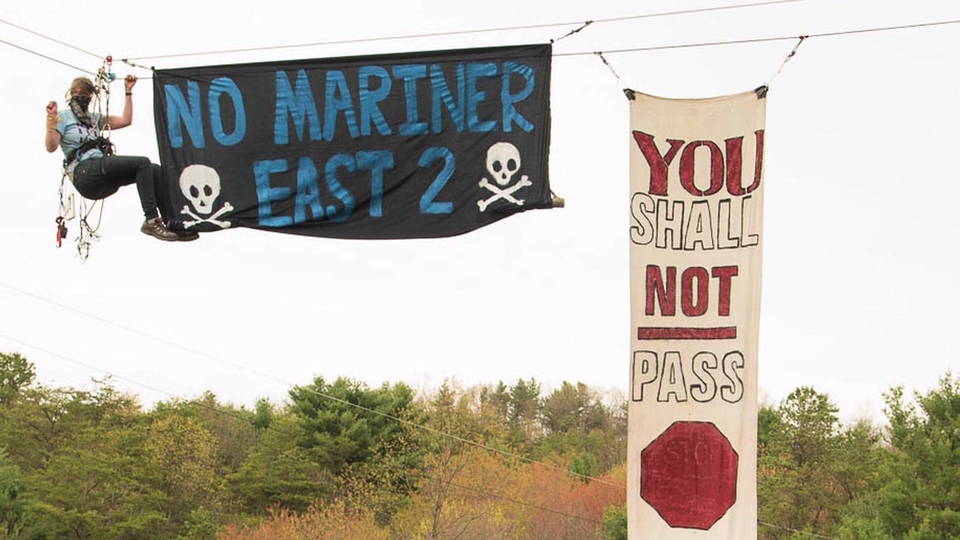 Elise Gerhart has been up a tree before. You may recall our story about Elise, daughter of a Huntingdon County, PA landowner, radicalized by Big Green groups (as evidenced by her association with well known protesters previously arrested), who took to a tree on her mom’s property in order to illegally stop crews working on tree clearing for the Mariner East 2 pipeline (see
 This one has us spitting nails. We have reported, for months, about the activities of so-called protesters against Williams’ $3 billion Atlantic Sunrise Pipeline project. In particular, there is a group in Lancaster County, PA opposing the pipeline creatively called Lancaster Against Pipelines (LAP). Some of their members previously attended and participated in protests against the Dakota Access Pipeline in Standing Rock, ND–protests that turned violent and destroyed millions of dollars in equipment (see
  Yesterday midstream and utility giant Dominion issued its first quarter 2017 update. Along with the update Dominion held an earnings call. On that call we learned new information about both the Atlantic Coast Pipeline (ACP) project, Dominion’s Cove Point LNG export project, and a plethora of other projects, including natgas-fired power plants and more pipelines in the works. Dominion CEO Tom Farrell shared the exciting news that Cove Point is now 89% complete and will be “in service” later this year. As for Atlantic Coast Pipeline, Dominion has now purchased 80% of the materials they will need to build it. Farrell said the pipeline will be online in the second half of 2019. Another six pipeline projects are underway (at a cost of $700 million)–with five of the six due to be done THIS YEAR. Dominion is a happening company. Below are extracts from the earnings call, the 1Q17 update (with financials), and the newest PowerPoint slide deck used during the earnings call…
 The U.S. The House of Representatives’ Committee on Energy and Commerce held a hearing on Wednesday to hear testimony on a proposed plan to grant the Federal Energy Regulatory Commission (FERC) more authority to speed up the pipeline approval process. Up for discuss is an amendment to the Natural Gas Act to grant FERC more authority in coordinating what is, admittedly, a complex review process. A more powerful FERC would, for example, likely be able to override states like New York that refuse to grant water crossing permits (permits that are issued under a federal law!). Don Santa, executive director of the Interstate Natural Gas Association of America, was one of the people testifying before the assembled Congressmen. He said things have gotten pretty bad over the past two years–yes with FERC, but also with other federal and state agencies. Here’s some of what was said at the hearing…
 The City of Green, Ohio, located in Summit County (south of Akron, north of Canton) seems to have no problems with spending boatloads of taxpayer money on anti-pipeline efforts. A few weeks ago Green City Council voted to give $10,000 to the anti-pipeline CORN–Coalition to Reroute Nexus. We call the group CORNballs and have written extensively about their supposed desire to just see the NEXUS pipeline routed around them, pretending to be NIMBYs (