
2nd Circuit Upholds NY DEC Water Permit for NESE Pipeline
 The U.S. Court of Appeals for the Second Circuit last Friday slammed the door on Big Green’s attempt to yank the New York water permit for the Williams/Transco Northeast Supply Enhancement (NESE) pipeline. Six environmental groups asked the court to vacate the Clean Water Act Section 401 water quality certification (WQC) that the New York State Dept. of Environmental Conservation (DEC) issued in November 2025. In a summary order issued Aug. 21, a three-judge panel said no. The permit stands. NESE, already under construction, keeps building. Read More “2nd Circuit Upholds NY DEC Water Permit for NESE Pipeline”

 Epsilon Energy (NASDAQ: EPSN) keeps calling its Susquehanna County, PA, acreage a “legacy” asset — and then keeps telling investors it’s sitting on up to 200 billion cubic feet of gas it hasn’t produced yet. At the EnerCom Denver energy investment conference on Tuesday, Epsilon’s VP of Finance put hard numbers on the northeast Pennsylvania position for the first time, disclosed pad-level economics that are rare to see in public, and dropped the news item that matters most to anyone with a lease inside the Auburn dedication: the company is reviewing an expansion of the Auburn Gas Gathering System to handle drilling coming in 2028 and beyond.
  Devon Energy just told the market it’s willing to write big checks to get stranded natural gas to better markets. The gas in question is in West Texas, not Susquehanna County — and that says something about where the old Cabot Oil & Gas assets stand in the new Devon. On Monday, Devon announced a positive Final Investment Decision (FID — meaning the money is committed and the shovels are coming) on the Solitude Pipeline System, a WhiteWater-led joint venture building two 48-inch natural gas pipelines from the Permian Basin to Katy, Texas.
  A new report from RBN Energy fills in a piece of the Project Beacon puzzle we haven’t fully covered: two separate Millennium Pipeline expansions — one already sanctioned, one still on the drawing board — that DT Midstream and TC Energy are advancing to feed New England’s growing appetite for Marcellus/Utica gas. One is moving fast. The other needs New York State’s blessing, which is never a sure thing.
  Forward natural gas prices for this coming winter at the Cove Point LNG terminal in Maryland have gone parabolic — and if you produce, gather, or transport Marcellus/Utica gas, you should care, because the pipes behind this story are the same pipes you use every day. A quick primer: a ‘forward price’ is what buyers and sellers agree today to pay for gas delivered on a future date — think of it as locking in a price months ahead of time. When forward prices spike, it means the market is already betting on tight supply or high demand down the road.
  We missed one, and it’s a big one. On July 31, the Federal Energy Regulatory Commission (FERC) handed Kinder Morgan certificates of public convenience and necessity for BOTH of its blockbuster Southeast projects — the Mississippi Crossing Project (MSX) on Tennessee Gas Pipeline, and the South System Expansion 4 Project (SSE4) on Southern Natural Gas and Elba Express. Put together, that’s roughly 500 miles of new steel, about $5.2 billion of capital, and something on the order of 3.8 million dekatherms per day of new firm transportation capacity aimed squarely at the fastest-growing gas market in the country. FERC issued the order right on time — the FAST-41 schedule said “no later than July 31,” and the Commission delivered on the last possible day.
  Chesapeake Utilities Corporation (NYSE: CPK) is a Dover, Delaware utility holding company that most folks in our patch have never heard of — which is a shame, because CPK owns two systems that Marcellus and Utica molecules flow through every single day. The company posted second quarter results Aug. 6 and held its analyst call Aug. 7. Buried inside the slides are updates on an Ohio data center pipeline, a nearly finished LNG plant on the Delmarva Peninsula, and a fresh $100 million bump to this year’s capital budget. Here’s CPK’s M-U story.
  When a pipeline construction contractor tells you its gas transmission work has more than doubled in a single year, that’s not a stock story — that’s a leading indicator. Energy Services of America (Nasdaq: ESOA), the Huntington, WV-based contractor that actually digs the ditches and welds the pipe across Appalachia, reported fiscal third quarter results Monday afternoon. Revenue hit $130.0 million, up 25.5% from $103.6 million a year ago. But the number that matters for our readers is buried in the fine print of the 10-Q: revenue from Gas & Petroleum Transmission work jumped from roughly $9.7 million to $21.2 million — an increase of about 120%.
  The last 18 months have been about as good as it gets for anyone who moves Marcellus and Utica molecules. President Trump’s Executive Order 14154 killed the Biden LNG export pause on day one. FERC rewrote its environmental review procedures in June 2025 to speed things up. And FERC finally drove a stake through Order No. 871, the Biden-era rule that let Big Green freeze construction on an approved pipeline just by filing an appeal (see
  Duke Energy reported second quarter 2026 results Tuesday, and while the earnings themselves are fine-but-boring utility fare, buried in the slide deck is one of the better demand stories going for Marcellus/Utica producers: Duke now has 6,025 megawatts (MW) of new gas-fired generation sited in North and South Carolina, every announced plant has its gas supply under contract, and the two pipelines that will carry most of those molecules south both trace back to Appalachia.
  Williams dropped its second quarter 2026 results after the close on Monday, August 3, and held the analyst call Tuesday morning. The headline numbers are good: adjusted EBITDA of $1.921 billion (up 6%), GAAP net income of $827 million (up 51%), and a raised full-year guidance midpoint of $8.4 billion. Wall Street liked it. But the story for MDN readers isn’t in the headline. It’s buried in the volume tables on page 8 of the release, in a capital spending line nobody read out loud, and in two new Transco projects in Pennsylvania and New Jersey that got about eleven seconds of airtime on the call.
  The Tennessee Valley Authority (TVA) posted its third-quarter fiscal 2026 results yesterday (Aug. 4) — a press release, an investor presentation, and a 10-Q filed with the Securities and Exchange Commission. The headline numbers are fine but boring: $10 billion in revenue over nine months, net income of $965 million, up $220 million from last year. Yawn. However, if you dig into the 10-Q, there’s real news for Marcellus/Utica producers. TVA’s giant new Cumberland gas plant has fired up for the first time. TVA borrowed $2 billion to pay for it — the largest such financing in the agency’s history. And TVA has quietly expanded its natural gas hedge book to nearly 1 trillion cubic feet. Let’s dig in.
  Two federal lawsuits landed in the same Washington, D.C. courthouse six days apart last month, and while both are nominally about pipelines in Mississippi and Alabama, Marcellus and Utica readers should pay close attention. Not because of where the pipe goes — but because of which pipelines the greens dragged into their complaints as Exhibit A.
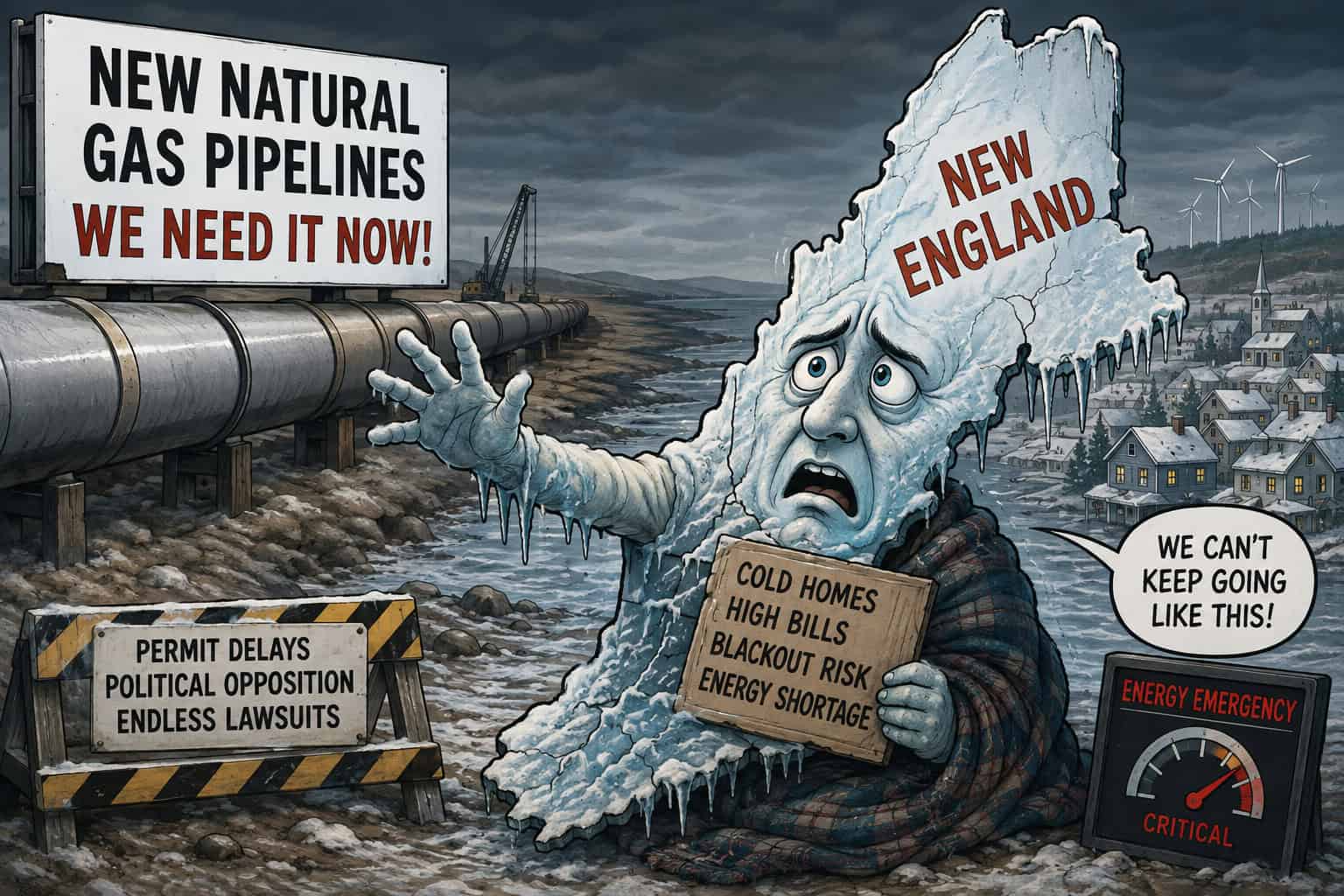
  Want to know what the smartest money in the natural gas business expects to happen in the Northeast this winter? Don’t ask a politician. Look at the forward curve. As of the first of August, traders were pricing December-through-February gas at Algonquin Citygate (the Boston benchmark), Iroquois Zone 2 in New York, and three Tennessee Gas Zone 6 points in New England above $18 per MMBtu. At the other 77 pricing hubs Natural Gas Intelligence tracks across the U.S. and Canada, that same three-month strip averages under $5. Read that again. Same country. Same historically abundant supply. Roughly four times the price.