
Antis Get a Do-Over for Iroquois Compressor Permit in Connecticut
 In March, we brought you the news that a Connecticut Superior Court judge tossed a lawsuit filed by Big Green group Save the Sound and the colluding Town of Brookfield, telling them their attempt to stop the state Department of Energy and Environmental Protection (DEEP) from ruling on the Iroquois compressor permit was premature (see Judge Tosses Premature Lawsuit to Block Iroquois CT Compressor). The judge said, in effect, wait until DEEP issues a final permit, then appeal. Final permits were expected “sometime in March.” It’s now late July. There are still no final permits. And DEEP has just handed the antis exactly the thing a judge said they’d have to wait for — and then some. Read More “Antis Get a Do-Over for Iroquois Compressor Permit in Connecticut”
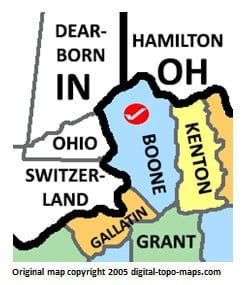 Texas Gas Transmission, LLC, a subsidiary of Boardwalk Pipelines, LP, wants to build the Dearborn County Lateral Project — roughly 12 miles of new 20-inch natural gas pipeline that begins at Texas Gas’s existing system in Dearborn County, Indiana, dips south across the Ohio River into Boone County, Kentucky, then hops back over the river into Hamilton County, Ohio. The destination is Vistra Corp.’s Miami Fort Power Plant, a coal-fired station slated for shutdown until someone had the good sense to convert it to natural gas instead. The lateral would move 265,000 dekatherms per day (Dth/d) of firm transportation service. A dekatherm is roughly one thousand cubic feet of gas, so call it about 265 MMcf/d (million cubic feet per day). Texas Gas filed with FERC in late May. Boone County leaders are not thrilled.
  The Federal Energy Regulatory Commission (FERC) is close to issuing an environmental assessment for the Constitution Pipeline, a 125-mile greenfield pipeline from the Marcellus gas fields of Susquehanna County, PA, to Schoharie County, NY (see
 Yesterday, EQT Corporation, the largest Marcellus/Utica-only producer by far, issued its second-quarter 2026 update. We’re pulling out what we consider to be the biggest news from that update for this separate post. During an earnings call with analysts, EQT CEO Toby Rice said that since the Federal Energy Regulatory Commission (FERC) approved the company’s 31-mile Mountain Valley Pipeline (MVP) Southgate project from southern Virginia into northern North Carolina in June (see
  Georgia Power announced yesterday that it will serve a new OpenAI data center project in Effingham County, Georgia — about 45 minutes from Savannah — expected to create thousands of jobs and billions of dollars in local investment. The $20 BILLION OpenAI facility will need roughly 3,200 megawatts (3.2 GW) of power, and OpenAI has agreed, under a 25-year deal, to provide up to 1,000 MW (1 GW) of flexible demand response, allowing Georgia Power to curtail deliveries during peak periods. The utility calls it among the largest single-facility demand response commitments in the U.S. OpenAI will cover full infrastructure and electric service costs with financial assurances, consistent with Georgia PSC rules. And yes! There is a direct connection to the Marcellus/Utica. Get ready; your future ChatGPT queries may be powered by M-U molecules!
  As part of Kinder Morgan’s second-quarter update, the company made an important announcement that (until now) it had not made. Namely, on May 26, 2026, TGP (Tennessee Gas Pipeline) placed in service its approximately $235 million Cumberland Pipeline project. The 30-inch pipeline is a 32-mile lateral originating from TGP’s existing 100 Line in Dickson County, Tennessee, and terminating at Tennessee Valley Authority’s (TVA) new natural gas-fired power plant in Stewart County, Tennessee. Big Green tried its best to block this project along with the gas-fired power plant, but failed.
  Yes, there is a direct connection between the Federal Energy Regulatory Commission’s (FERC) approval of the expansion of an underground salt-dome storage cavern project in Mississippi and the Marcellus/Utica. FERC has approved Leaf River Energy Center’s expansion of its New Home Salt Dome storage facility in Smith, Jasper, and Clarke counties, Mississippi, adding 19.18 Bcf of working gas capacity through new cavern development and facility upgrades. The project includes a new Cavern 5, expansion of Caverns 2 and 4, new compression, and pipeline additions, raising total working gas capacity from 36.0 to 55.18 Bcf.
  We stumbled across an article by East Daley Analytics that is a real eye-opener for us. East Daley analyzed 13 major public G&P (gathering and processing) operators (i.e., pipeline companies). They found that Expand Energy (created by the merger of Chesapeake Energy with Southwestern Energy), with major assets in the Marcellus/Utica and the Louisiana Haynesville, accounts for 52% of DT Midstream’s gathering volumes, 32% of Williams’, and 21% of Energy Transfer’s throughput. Yikes! Just one company.
 Last November, New Jersey (and New York) issued a federal Clean Water Act permit to build the Williams Northeast Supply Enhancement (NESE) pipeline project (see
  Thanks to the work of David Hess at the PA Environment Digest Blog, which tracks Department of Environmental Protection (DEP) notices published in the Pennsylvania Bulletin, we know of two water pipeline projects (for EQT and Expand Energy) approved by the DEP related to drilling new shale wells in two different northeastern PA counties: Lycoming and Bradford. Water is used for fracking. New water pipelines mean new fracking is on the way in those locations.
  A new wrinkle to report in the case of a South Carolina pipeline, the Elba Express Pipeline, and its quest to build an extension to a gas-fired power plant in Colleton County. In June, we told you that Kinder Morgan, the builder, had been forced to sue some 55 (of the 185) landowners along the proposed route to allow simple access to their property for a survey (see
  Poor lefty U.S. Senator Sheldon Whitehouse (Democrat from Rhode Island). He’s in a bind. Sen. Whitehouse sits on the committee currently negotiating how to loosen up on permitting rules for all sorts of projects, including natural gas pipelines. Whitehouse has traditionally been opposed to natgas pipelines getting built to furnish New England with more gas, but the governor of his own state, along with Dem governors from other New England states, want those pipes (for fear of being tossed out of office if they don’t bring down the price of gas and electricity). But on Whitehouse’s wacko left sit Massachusetts Senators Elizabeth “Pocahontas” Warren and Ed “wacky” Markey, who are 100% opposed to changing the rules for pipelines. Also opposing a change are foreign-backed environmental groups (big contributors to Whitehouse). What’s poor Sheldon going to do?
  The Abu Dhabi (United Arab Emirates) investment group 2PointZero, via its subsidiary ePointZero, closed on its deal to acquire U.S. natural gas infrastructure firm Traverse Midstream Partners for $2.25 billion. This acquisition includes stakes in the Rover Pipeline and Ohio River System, which connect the productive Utica/Marcellus shale region to major demand centers and export hubs. The all-cash transaction gives the Abu Dhabi-based energy infrastructure platform a 35% non-operated stake in the Rover Pipeline and a 25% interest in the Ohio River System (ORS), both of which are operated by Energy Transfer.
  Energy Transfer has asked the Pennsylvania Public Utility Commission (PUC) to restructure and dissolve the Sunoco Pipeline Company, separating its pipeline assets between two new entities. Energy Transfer NE NGL Pipelines LLC would own and operate the Mariner East system and other natural gas liquids pipelines, while Energy Transfer RP Pipelines LLC would control refined petroleum product pipelines. The proposal also would transfer Sunoco’s public utility operating certificates. Formal protests and intervention petitions are due July 27, 2026.