
PA DEP Issues Water Permits for EGTS Pipe Project from PA to OH
 Eastern Gas Transmission and Storage (EGTS), a wholly owned subsidiary of Berkshire Hathaway Energy Company (Warren Buffett’s company), filed a new project with the Federal Energy Regulatory Commission (FERC) in July 2025 (see Eastern Gas Files with FERC to Expand Pipe Flows from PA to OH). The project, called the Appalachian Reliability Project (ARP), is designed to move more natural gas from Pennsylvania to Ohio. ARP will leverage existing EGTS pipeline infrastructure while increasing its system capacity through pipeline additions (4 miles of new pipe) and station upgrades. The PA Department of Environmental Protection (DEP) published notices in the July 11 Pennsylvania Bulletin announcing that it has issued water quality permits for the project. Let the construction begin! Read More “PA DEP Issues Water Permits for EGTS Pipe Project from PA to OH”
 The Trump administration and its officials continue to aggressively push the Williams 125-mile Constitution Pipeline project, which would stretch from the prolific shale gas fields of Susquehanna County, PA, into and through New York State, to Schoharie County, NY, to move Marcellus gas into New York State and New England. In June, Trump EPA Administrator Lee Zeldin visited Binghamton to advocate for reviving the long-stalled project (see
  Williams’ Transco Southeast Supply Enhancement Project (SESE) is a 55-mile, 42-inch-wide pipeline that will run through Pittsylvania County, Virginia, and Rockingham, Guilford, Forsyth, and Davidson counties in North Carolina. Construction for SESE started March 2, 2026, according to FERC filings. Transco (Williams) received its final federal authorization and a Notice to Proceed, and crews mobilized in early spring. Initial activities have included tree felling, installation of acoustic barriers, and test drilling in preparation for blasting. Antis finally gave up trying to block construction of SESE in June (see
  Over the past two weeks, just prior to heading out on summer vacation, the U.S. Supreme Court issued a number of extremely important decisions. One of them was Slaughter v. Trump, a 6-3 decision in which the Supremes overturned the 91-year-old Humphrey’s Executor precedent, granting the president broad authority to remove members of independent federal agencies for any reason. Chief Justice John Roberts wrote that the president must have trusted subordinates to ensure accountability, though the Court exempted the Federal Reserve to preserve its independence. This ruling permanently solidifies President Trump’s earlier removals of Democratic appointees, significantly expanding executive control over critical regulatory bodies, including the National Labor Relations Board, the Federal Trade Commission, and most importantly for MDN readers, the Federal Energy Regulatory Commission (FERC).
  Data center growth is rapidly reshaping Northeast power and natural gas markets, with projects clustering near transmission lines, substations, gas-fired power generation, and pipeline corridors. Virginia remains the epicenter, led by Northern Virginia’s massive hyperscale hub and tens of gigawatts of planned capacity. Ohio is emerging fast around Columbus, with more than 15 GW proposed. Pennsylvania could become a major growth story, pairing Marcellus/Utica gas resources with large campuses such as Homer City’s planned 4.5-GW gas-fired/data center redevelopment. However, PA is attempting to shoot itself in the foot with talk of both short- and long-term moratoriums on new data center construction. So, the jury is still very much out on how successful PA will be with data centers.
  Wow! Where did the last 10 years go? In June 2015, MDN brought you the news of two Pennsylvania business groups, the Delaware County Chamber and the Washington County Chamber, along with two labor unions, the Laborers’ International Union of North America (LiUNA) with 25,000 members and the International Union of Operating Engineers (IUOE) Local 66 with 7,000 members, joining forces to form the
  The Federal Energy Regulatory Commission (FERC) isn’t letting any grass grow under its feet regarding the advancement of the Constitution Pipeline, a 125-mile greenfield pipeline from the Marcellus gas fields of Susquehanna County, PA, to Schoharie County, NY, to deliver Marcellus gas into New York State and New England. FERC is actively reviewing two requests related to reviving the project (see
  This is so frustrating. After seven years, $150 million, and 31 of 34 miles already underground, Connecticut has halted a pipeline project designed to provide a more dependable natural gas supply to the booming southeastern Connecticut economy. Ealier this year MDN told you that Connecticut’s Department of Energy and Environmental Protection (DEEP) had determined that Eversource Energy’s plan to install a natural gas pipeline through Hurd State Park and the Connecticut Valley Railroad State Park Trail requires a formal Environmental Impact Evaluation, unnecessarily delaying a tiny portion (1.1 miles) of this critically-important reliability project (see
  Last September, MDN told you that two major Kinder Morgan pipeline projects that will flow Marcellus/Utica molecules in the southeastern U.S. took a big step forward at the Federal Energy Regulatory Commission (FERC) with FERC actively working on an environmental impact statement (EIS) for both projects (see
  It never ends well for landowners who believe they can block pipeline surveyors from accessing their land. In April 2025, MDN told you about a new greenfield expansion of Kinder Morgan’s Elba Express pipeline into South Carolina to serve growing demand for natural gas in the state (see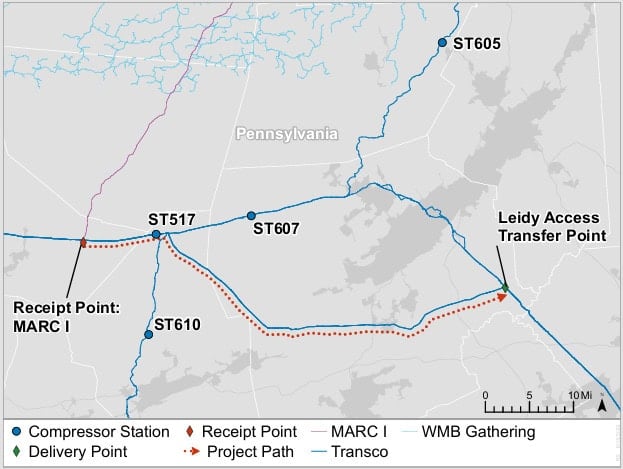
 RBN Energy has published an excellent series of blog posts discussing pipeline projects under development within and beyond the Marcellus/Utica production area that, collectively, will enable at least a few more Bcf/d to reach customers in the Northeast, the Southeast, and the Midwest by 2030. Part 5 of RBN’s Northeast gas series (below) examines pipeline projects moving Appalachian Marcellus/Utica gas westward into Ohio, the Midwest, and to the Mid-South.
  Last week, MDN reported that the Energy Secretary of the very liberal Democrat regime that runs Massachusetts had written a letter to the New England Power Generators Association, asking power generators to get on board and support an expansion of the Algonquin Gas Transmission (AGT) pipeline (see
  Williams’ Transco Southeast Supply Enhancement Project (SESE) is a 55-mile, 42-inch-wide pipeline that will run through Pittsylvania County, Virginia, and Rockingham, Guilford, Forsyth, and Davidson counties in North Carolina. It will provide natural gas to Duke Energy customers. Big Green sued to overturn a federal water quality permit issued by the U.S. Army Corps of Engineers. Big Green wanted the court to block construction until the full case could be heard. In May, a three-judge panel from the U.S. Court of Appeals for the Fourth Circuit (4th Circuit) rejected arguments Big Green put forward that claimed the Army Corps’ decision was “arbitrary and capricious” and refused to block construction (see