
Duke Energy | Electrical Generation | Energy Services | Industrywide Issues | Regulation | South Carolina
SC PSC Approves Duke/Santee Cooper 2.2 GW Gas-Fired Power Plant
 Good news! The Public Service Commission (PSC) of South Carolina approved a joint application by Dominion Energy and Santee Cooper to build Canadys Station, a natural gas combined-cycle facility in Colleton County. The plant will generate approximately 2,200 megawatts (2.2 GW) — enough to power over one million homes — addressing the state’s growing energy demand. It will be built on the site of a former Dominion Energy coal plant, roughly 40 miles northwest of Charleston (the “Lowcountry” region), eliminating the need for new land clearing. Read More “SC PSC Approves Duke/Santee Cooper 2.2 GW Gas-Fired Power Plant”
 It seems that not all of the judges who sit on the U.S. Court of Appeals for the Fourth Circuit (4th Circuit) are clowns, the way the three judges who oversee cases dealing with the Mountain Valley Pipeline (MVP) Southgate project are (see
  Last November, the Pennsylvania Public Utility Commission (PUC) approved a Tentative Order by a 3-2 vote, proposing a statewide model tariff (tax) to manage the growing impact of large-load customers, such as AI data centers, on the electric grid (see
  Pennsylvania Governor Josh Shapiro has been blaming the PJM Interconnection grid for the soaring costs of electricity when his own policies are to blame, even threatening to pull out of the cooperative (see
  The Philadelphia Gas Commission, for a second time, has postponed a vote on Philadelphia Gas Works’ (PGW) $182 million proposal to replace and expand its natural gas liquefier (LNG plant) in Port Richmond. The commission’s staff and the Public Advocate recommend rejecting the project, arguing it is oversized and could burden customers with unnecessary debt. They also cite incomplete plant and project designs. PGW argues the upgrade is crucial for safety and affordability, preventing potential harm to customers during cold winters and avoiding the need to truck in liquefied natural gas (LNG). Instead of approving the project, the Commission voted to spend $1 million on an environmental impact study and $4 million for an engineering study. That is, they voted to procrastinate.
  At a Pennsylvania DEP hearing in Indiana County, environmental extremists opposed a proposed 5.8-mile, 30-inch natural gas pipeline serving Homer City Redevelopment’s planned $10 billion, 4.5-GW gas-fired power plant and hyperscale data center campus. The pipeline would cross streams, wetlands, and floodways, potentially affecting Muddy Run, Blacklick Creek, and various tributaries. Reminding us of Chicken Little in The Sky is Falling, speakers warned of water pollution, setbacks to acid mine drainage restoration, drought-related water stress, and inadequate transparency around the fast-moving project.
  Last December, MDN told you that three anti-shale drilling groups—the PA Council of Trout Unlimited, the Keystone Trails Association, and the Responsible Drilling Alliance—requested the Pennsylvania Department of Environmental Protection (DEP) hold a hearing on the Chapter 105 permit requested for a 3.9-mile shale gas access road and staging area proposed by Pennsylvania General Energy (PGE) in the Loyalsock State Forest (see
  The federal EPA has proposed new rules allowing gas-fired power plants, data centers, and factories to begin constructing non-polluting components like piping, wiring, and cement pads before receiving air emission permits. EPA Administrator Lee Zeldin stated that this aims to streamline critical infrastructure projects and advance technological development, particularly for AI. Critics, including Big Green lawyers, argue these changes undermine the Clean Air Act by making it harder for communities to “protect air quality.” More importantly, Big Green says it will make it harder for regulators to reject permits after significant investment has already been made. Well, duh! That’s the point.
 Kinder Morgan’s Elba Island LNG, which accepts and liquefies Marcellus/Utica molecules just offshore from Savannah, Georgia, received approval from the Federal Energy Regulatory Commission (FERC) in November 2024 to expand the facility to produce an extra 0.4 million metric tons/year (see
  New research by the Commonwealth Foundation finds that Pennsylvania’s foolish pursuit of joining the Regional Greenhouse Gas Initiative (RGGI), a carbon tax scheme, led to a loss of $5 to $8 billion in energy sector investment over six years, stalling power projects and reducing electricity generation capacity. The state’s attempt to join RGGI, initiated by executive order under then-Governor Tom Wolf, was ultimately overturned by the courts and (eventually) by legislative action, citing it as an unconstitutional tax. Meanwhile, neighboring Ohio, not part of RGGI, saw an increase in energy projects, highlighting the differing regulatory environments.
  The European Union’s idiotic methane regulations begin in earnest next year. Domestic (European) oil, gas, and coal companies must monitor, measure, and report their emissions. The same restrictions will apply to energy imports from other countries, including imports from the U.S. (see
  Yet another rankly hypocritical move by the Democrats in the Pennsylvania legislature. Yesterday, every single Democrat in the PA House voted in lockstep (as they typically do, under the leadership’s complete control) to pass House Bill (HB) 2076, titled “Advancing Geothermal Energy Development.” The Dems were assisted by 16 Republicans who were (charitably) hoodwinked. No matter. The bill won’t pass in the Senate. But why point out this vote? Because the “advanced” geothermal energy that the House wants to promote and regulate uses the very same drilling rigs and fracking as is used to drill in the Marcellus shale, revealing the hypocritical lies of the Democrat left in demonizing fracking. But there’s another reason we’re highlighting this news: The environmental left (including House Democrats) is seeking to increase drilling setbacks in the state from 500 feet to 3,281 feet (and, in some cases, 5,280 feet). Do the House Dems realize the new setbacks would not only ban ALL shale fracking in the state but also all geothermal fracking?
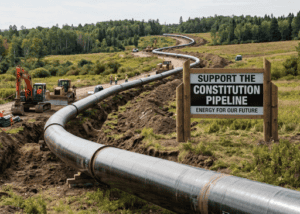 This is a critical moment for reliable, affordable energy in the Northeast, and your voice can make a difference. The Federal Energy Regulatory Commission (FERC) is currently accepting public comments on the Constitution Pipeline, representing an important step toward finally advancing this long-delayed project and a key opportunity for supporters to be heard. If you support building the Constitution Pipeline, please take a few minutes to submit a brief comment to FERC by May 4, 2026, because your input truly matters. We have instructions below on how to file a comment (it takes just a couple of minutes).