
CT DEEP Unnecessarily Delays NatGas Pipe Crossing 2 State Parks
 Connecticut’s Department of Energy and Environmental Protection (DEEP) has determined that Eversource Energy’s plan to install a natural gas pipeline through Hurd State Park and the Connecticut Valley Railroad State Park Trail requires a formal Environmental Impact Evaluation, unnecessarily delaying a tiny portion (1.1 miles) of a critically-important reliability project (34.5 miles long). This 16-inch pipeline, a segment of the Southeast Resiliency Project, is designed to provide energy redundancy and security for the region. Read More “CT DEEP Unnecessarily Delays NatGas Pipe Crossing 2 State Parks”
 The province of Québec, Canada, with a huge supply of Utica Shale gas sitting beneath it, passed a new law in 2022 outlawing all oil and natural gas production throughout the province, called Bill 21 (see
  This is one of those “man bites dog” stories. When was the last time you heard about Democrat state legislators from one of the bluest of blue states voting to roll back funding for “green” programs in order to save money? Yeah, like NEVER. At least, until now. Funny how even Dems will throw their precious green philosophies out the window if their job (getting reelected) is on the line. That’s what is happening in Maryland.
  No one should be surprised that far-left Democrat Josh Shapiro, currently the Governor of Pennsylvania (but with a major passion to become President), joined his fellow radicals from other blue states in launching a lawsuit against the Trump administration for moving to eliminate the extremist “endangerment finding” concocted by Lord Obama and the Obamadroids of the EPA. Trump’s move to overturn the finding will save Americans roughly $3,800 each. Yet Shapiro and his fellow cabal members want to keep Americans poor and subservient (to them).
 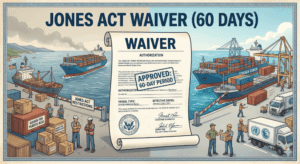 We lead with this story about a government regulatory action because of just how important we see this development. For *years* we have railed against the 106-year-old Jones Act and its requirement that any goods (like LNG) that are transported from one U.S. port to another be on a ship manufactured in the U.S., owned by a U.S. company, and crewed by a U.S. crew. The effect of this law in the modern age is to ban LNG (and other shipments, like gasoline, propane, coal, and other products manufactured in the U.S.) from being shipped cheaply from port to port. The U.S. foolishly allowed its ship manufacturing to slip away years ago to South Korea and other countries. We no longer make cargo carriers for LNG and other energy products. We haven’t made them in decades. Yesterday, President Trump signed a 60-day waiver of the Jones Act, allowing certain goods (such as LNG, fertilizer, and coal) to be transported from U.S. port to U.S. port on foreign-owned, foreign-flagged and crewed ships.
  Just coming to light for us now is that Iroquois Gas Transmission System petitioned the Federal Energy Regulatory Commission (FERC) in February to reissue authorization for the $152 million Wright Interconnect Project in New York State, aiming to revive a critical link for the previously canceled Constitution Pipeline. Originally approved in 2014, the project seeks to establish a new receipt interconnection and compression facilities at the Wright Compressor Station. By creating 650,000 dekatherms per day (650 MMcf/d) of transportation capacity, the initiative intends to alleviate persistent natural gas supply constraints in the Northeast and New England markets. If approved, the project targets a May 2028 in-service date, utilizing existing company-owned infrastructure to minimize environmental impacts.
 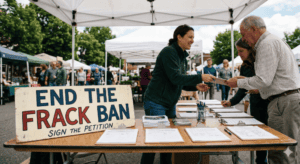 Shale drilling in Wayne and Pike counties in the northeastern tip of Pennsylvania has been blocked since 2010 (16 looooong years), denying landowners in those counties the right to benefit from leasing and drilling on and under their land. Those counties (parts of them) are within the Delaware River Basin, and the Delaware River Basin Commission (DRBC) implemented a moratorium in 2010 to block shale drilling. The moratorium became a full-blown, permanent ban on fracking in 2021. The DRBC added a prohibition on the disposal of oil and gas wastewater to the permanent ban in 2022. It’s time to overturn the ban. We have a
 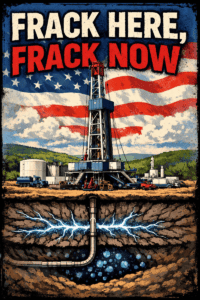 An unidentified natural gas driller has applied to open over 8,300 additional acres of the Egypt Valley Wildlife Area for fracking, potentially making it Ohio’s largest fracking operation on public land. This request follows a January decision that already opened 4,400 acres of the 18,000-acre preserve, which is primarily used for conservation, hunting, and fishing. While the state’s Oil and Gas Land Management Commission (OGLMC) has historically favored industry requests despite significant public opposition, environmentalists and some Democratic lawmakers argue that the expansion exploits public resources and threatens local ecosystems. A public comment period remains open until April 27.
  Here’s a question: Do you want the government to be able to control your thermostat (turning it down in the winter, or up in the summer), controlling your water heater (making it cooler), or controlling your “smart” refrigerator (raising the ambient temp inside), or controlling other so-called smart appliances, bypassing *your* preferred settings? Would you like the government to be able to grab stored electricity from solar panels on your roof or from the battery in your charged-up EV during times of electric grid “stress”? That’s what Democrat members of the Pennsylvania state legislature want to do. It’s called a “virtual power plant,” and it’s being sold as a quick solution to power shortages without having to build new gas-fired power plants (or new windmills, solar farms, etc.). Creating a virtual power plant just takes a little software and a lot of apathy from citizens to make it work.
  Governor Kathy Hochul warns that a recent court ruling requiring New York to meet strict 2030 greenhouse gas mandates could trigger a dramatic spike in energy costs. Justice Julian Schreibman ruled that state agencies must strictly adhere to the Climate Act’s deadlines, despite official concerns regarding feasibility. While state energy officials predict a “cap-and-invest” (better called a cap-and-tax) program could cost households thousands annually, environmental advocates are open to settling the case to avoid “draconian” economic impacts. To reach these goals affordably, Hochul is pushing to adjust emission accounting methods to a 100-year standard, extending the compliance timeline while maintaining the state’s commitment to clean energy.
  In early February, MDN told you about West Virginia Senate Bill (SB) 706, which proposed reducing the state’s severance tax from 5% to 3% for new natural gas and oil wells drilled after June 30, 2026, that meet specific production thresholds (see
  Can we PLEASE now put to bed the pervasive lie spread by anti-shale people that drill cuttings (the leftover rock and dirt that comes out of the ground when drilling a shale well) are somehow glow-in-the-dark radioactive and if disposed of in a landfill will cause people who live near such a landfill to die from radiation poisoning? A two-year study by the Pennsylvania Department of Environmental Protection (DEP) concluded that radium levels in landfill wastewater (leachate) do NOT pose a risk to human health.
  Finally! The White House is seriously considering (and will likely sign) a temporary waiver suspending the Jones Act for 30 days. The Trump administration is considering a temporary suspension of the Jones Act to help lower gasoline prices, with Press Secretary Karoline Leavitt confirming a formal review of the policy. According to reports from Bloomberg and Reuters, the plan involves issuing 30-day waivers that would allow foreign-flagged tankers to transport fuel from the Gulf Coast and other U.S. hubs to East Coast refiners, a move that shipping and oil companies have already been advised to prepare for.
 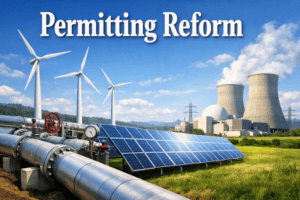 White House officials, including the legislative affairs team and the National Energy Dominance Council, are ramping up engagement in bipartisan congressional talks to reform energy permitting processes (“permitting reform”). Although negotiations recently stalled when Senate Democrats boycotted over a halt on offshore wind projects, formal discussions have, according to super secret sources, resumed following the administration’s progress on onshore wind and solar permits. The White House seeks legislative action to streamline environmental reviews, bolster domestic production, and lower energy costs amid rising electricity demands.
 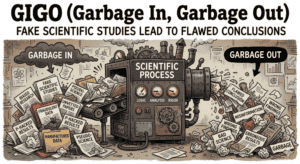 It’s time to make a LOT of noise with the Pennsylvania Department of Environmental Protection (DEP) if you care about Marcellus drilling continuing in the Keystone State. In December, the Pennsylvania Environmental Quality Board (EQB) accepted a petition by radical green groups, including the Clean Air Council and Environmental Integrity Project, to “study” the issue of increasing setbacks for shale drilling so far that it would ban ALL new Marcellus/Utica drilling in the Keystone State, which is no exaggeration (see