
Marietta, OH Without Injection Wells = Economic Catastrophe
 Wastewater injection wells are an essential, safe, and highly regulated component of Southeast Ohio’s fracking industry. Banning these wells would trigger an economic catastrophe, leading to job losses and reduced public funding, without providing any actual environmental benefits. Yet that’s exactly what the political leaders of Marietta, OH, in collusion with virulent anti-fossil fuel groups, are attempting to do. Opposing injection wells while supporting fracking (as Marietta’s “leaders” are doing) is contradictory, as the two are inseparable for regional energy production and the area’s continued economic stability. Read More “Marietta, OH Without Injection Wells = Economic Catastrophe”
 Even a leftist liberal putz like Pennsylvania Governor Josh Shapiro can have a good idea every now and again. (Credit where credit is due.) Shapiro is introducing what he calls GRID (Governor’s Responsible Infrastructure Development) standards to incentivize Pennsylvania data center developers to voluntarily adopt higher environmental and transparency benchmarks. In exchange for committing to water conservation, local hiring, and independent power generation, projects can access “Fast Track” permitting to accelerate construction.
  Thanks to the work of David Hess at the PA Environment Digest Blog in tracking Department of Environmental Protection (DEP) notices published in the Pennsylvania Bulletin, we spotted three new water pipeline projects related to drilling new shale wells in three different northeastern PA counties: Lycoming, Bradford, and Wyoming. Water is used for fracking. New water pipelines mean new fracking is on the way in those locations.
  Just coming to light now, more than a month after it happened, the Pennsylvania Department of Environmental Protection (DEP) is investigating whether there is any connection between a low-level earthquake (“seismic event”) near Murrysville in Westmoreland County, PA, and the Penneco Environmental Solutions LLC Sedat 3A injection well in Plum Borough in Allegheny County. Operators of injection wells in PA are (usually) required to maintain on-site seismometers. On Feb. 7, the seismometer at the Penneco Sedat 3A site registered a “seismic event” about six miles away near Murrysville.
  The 2026 International Energy Agency (IEA) Ministerial Meeting marked a significant turning point as the U.S. demanded a shift from climate-focused advocacy toward “energy realism.” Energy Secretary Chris Wright threatened withdrawal unless the Agency prioritizes energy security over aspirational Net Zero scenarios. And he did so as IEA’s corrupt leader, Dr. Fatih Birol, sat just a few feet away. Wright’s pressure led the IEA to reinstate its “Current Policies Scenario,” acknowledging that fossil fuel demand may grow through 2050 despite transition efforts. As the Agency expands with new members like Colombia, it faces a mandate to align its data-driven research with real-world energy addition rather than idealized transitions, ensuring its continued relevance to global energy investment and security.
  Despite a “public outcry” (of 13 people), the Chesapeake City (Virginia) Council voted 6-3 last July to approve a compressor station for Virginia Natural Gas (see
  In the closing hours of the 2014 West Virginia legislative session, the legislature passed Senate Bill (SB) 373, the Aboveground Storage Tank Act (see
  The U.S. Department of Energy (DOE) has granted non-FTA export authorization for Cheniere Energy’s Corpus Christi LNG expansion, specifically Mid-Scale Trains 8 and 9. This 3.28 MMTPA addition establishes the terminal as the second-largest U.S. LNG export project, with a total authorized capacity of 4.45 Bcf/d. Following a June 2025 investment decision, construction is proceeding alongside the Stage 3 Project, which successfully completed four trains in 2025. As the U.S. leads global LNG exports, Cheniere is already seeking further capacity increases through 2026. This authorization lasts until 2050, securing the facility’s long-term role in international energy markets. Marcellus/Utica molecules help feed this facility, so this is good news for our region!
 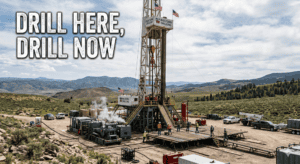 During the Pennsylvania House Appropriations Committee hearing held on March 2, House Republicans advocated for expanded shale gas drilling on state forest lands and beneath state parks to bolster revenue. Department of Conservation and Natural Resources (DCNR) Secretary Cindy Adams Dunn, a radical leftist, noted that current drilling provides an average of $95 million annually but has already caused the “loss” of 30,000 acres of core forest land. Republican members suggested that revising the long-term leasing moratorium could generate an additional $250 million, which fell on deaf Democrat ears.
  Although there are legitimate concerns over data centers locating in populated communities (noise, water use, etc.), make no mistake: The anti-data center movement is nothing more than the anti-fracking movement in new clothes (see
  The proposed $58 billion merger between Devon Energy and Coterra Energy is under scrutiny by the U.S. Department of Justice (DOJ) over “shale market dominance.” The key problem is: how does the DOJ define a “market” that may be dominated? What, exactly, is a market? Critics argue that the DOJ’s narrow market definitions—mirrored in its antitrust case against Visa—ignore broader competitive realities and existing regulations, such as the Durbin Amendment. While the Devon/Coterra merger increases shale concentration, natural gas remains a singular, competitive (much broader) market regardless of extraction methods. By applying outdated antitrust frameworks, the government risks stifling innovation and weakening companies’ ability to compete globally. Ultimately, rational policy must reflect modern market dynamics to avoid economic stagnation and the fragmentation of viable industries. So says author (and lawyer) Daniel Markind.
  PJM Interconnection recently proposed reforms to its retail BTM (behind-the-meter) generation rules to support data center colocation. The filing, responding to a FERC mandate, introduces a 50-MW threshold for BTM facilities and three new transmission service categories. Under the plan, new loads exceeding 50 MW would be ineligible for “netting,” a process that currently lowers grid charges by balancing on-site generation against consumption. While existing contracts are grandfathered, industrial trade groups warn that removing netting rules threatens the economic viability of combined heat and power facilities, potentially discouraging manufacturing investments while aiming to address regional grid reliability and grid cost-shifting concerns.
 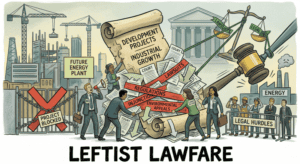 Several Big Green groups, including the Sierra Club, Wild Virginia, Appalachian Voices, and the Center for Biological Diversity, have filed a legal challenge against a permit issued by Virginia for the Mountain Valley Pipeline (MVP) Southgate extension. The Virginia Department of Environmental Quality (DEQ) approved a water permit for the project in January 2026. Big Green radicals argue that the pipeline “threatens” 138 streams, wetlands, and regional drinking water supplies. It’s the typical lawfare tactic used by the left to stall work on projects, hoping to delay them long enough that the builder (EQT in this case) gives up. Or if the builder won’t give up, they have to pay double or triple the price to construct it. That’s the game the radicals are playing.
  West Virginia Attorney General JB McCuskey is leading a 21-state coalition urging the U.S. Supreme Court to overturn Department of Energy efficiency standards adopted during the dark Biden years that effectively ban many natural gas furnaces and water heaters. Challenging a D.C. Circuit ruling, the states argue the mandate violates federal law by eliminating appliances with protected performance characteristics. McCuskey emphasizes that the rule would disproportionately burden low-income and rural families, forcing expensive structural renovations in older homes incompatible with new condensing technology.
  Ohio’s Revised Code Section 5303.34 (part of House Bill 96, recently passed and signed into law) significantly shifts mineral trespass law, favoring oil and gas operators over landowners. Replacing common-law precedent, the new statute limits default damages to net revenue minus production costs, ensuring industry expense credits. Crucially, it creates a high bar for “bad faith,” requiring plaintiffs (landowners and rights owners) to prove an operator’s specific intent to steal minerals or actual knowledge of illegality. Since a “reasonable belief” in a lease or permit now negates bad faith, landowners face a difficult path to full revenue recovery.
  The Texas Eastern Transmission Pipeline (TETCO), operated by Enbridge, is a major 8,580-mile interstate natural gas system connecting Gulf Coast/Texas supplies to the Northeast US. Originally designed for northbound flow, it now heavily supports bidirectional, southbound, and regional supply, including Marcellus/Utica gas. A short 5.3-mile section of TETCO (actually four separate pipelines that make up TETCO) running through Greene County, PA, needs a fix to protect it from coal mining activities set to begin directly underneath the pipeline in that area.