
Virginia DEQ Approves Dominion’s Chesterfield Peaker Plant Project
 Mixed signals are coming from Virginia’s regulatory agencies regarding a gas-fired project in Chesterfield. In June 2023, Dominion Energy announced plans to build four small “peaker” electric generating plants in Chesterfield County near Richmond (see Dominion Plans to Build 1,000-MW Gas Peaker Plant Near Richmond, VA). The Chesterfield Energy Reliability Center (CERC) calls for building four 250-megawatt gas-fired power plants (1,000 MW total) that can jump into action during the coldest and hottest days of the year to help supply enough electricity for 250,000 homes—to keep the lights on because solar and wind are not up to the task. In November 2025, the State Corporation Commission (SCC) finally approved the project. But three weeks later, the SCC canceled its approval so it could consider a last-minute appeal filed by radical green groups (see Va. SCC Unapproves Dominion’s Chesterfield Gas-Fired Plant). However, a day after the SCC withdrew its approval, the Virginia Department of Environmental Quality (DEQ) gave its approval for the project. Read More “Virginia DEQ Approves Dominion’s Chesterfield Peaker Plant Project”
 A big announcement from the Trump Department of the Interior (DOI). Yesterday, the DOI announced an immediate pause on all large-scale offshore wind project leases currently under construction in the United States. There are five such projects along the East Coast, including one off the coast of New York State. The DOI said the decision stems from “national security risks” identified by the Department of War in classified reports, specifically concerning radar interference known as “clutter” caused by massive turbine blades. Trump previously negotiated a deal with NY Governor Kathy Hochul to allow two pipeline projects—the Northeast Supply Enhancement (NESE) project and the Constitution Pipeline—in return for building the offshore Empire Wind 1 project (see
  On July 25, 2025, House Natural Resources Committee Chairman Bruce Westerman (R-AR) and Rep. Jared Golden (D-ME) introduced the Standardizing Permitting and Expediting Economic Development (SPEED) Act to streamline federal environmental reviews for energy and infrastructure projects, addressing delays blamed for hindering U.S. construction (see
  In 2018, Equitrans Midstream, the builder of the 303-mile Mountain Valley Pipeline (MVP), proposed extending the MVP pipeline (after completion) by an additional 75 miles from the current terminus in Pittsylvania County, VA, to Alamance County, NC, to provide natural gas for heating and electric power generation. The 75-mile extension was called MVP Southgate. In December 2023, Equitrans announced it was significantly changing the project, cutting it by more than half and increasing the amount of gas flowing through it (see
  In August 2014, the Marshall County, WV board of commissioners voted to approve a plan to build a Marcellus Shale-powered electric plant in the county (see
  In April, Knighthead Capital Management, Homer City Redevelopment (HCR), and Kiewit Power Constructors Co. announced a plan to convert the former Homer City Generating Station, previously the largest coal-fired power plant in Pennsylvania (Indiana County, 50 miles east of Pittsburgh) into a more than 3,200-acre natural gas-powered data center campus, designed to meet the growing demand for artificial intelligence (AI) and high-performance computing (see
  In June 2023, Dominion Energy announced plans to build four small “peaker” electric generating plants in Chesterfield County near Richmond (see
  Ohio already has 217 data centers with more on the way. Data centers are warehouses filled with computer equipment that generates a lot of heat. To cool down the computers, data centers use massive amounts of water. If data centers want to get rid of that water after it’s been used, they have to apply for a permit called the National Pollutant Discharge Elimination System (NPDES) through the Ohio EPA. Currently, data centers must apply for an individual NPDES permit, which is detailed and unique to their operations. The OEPA is looking to streamline the process to make it faster and easier. That’s a good thing.
  MDN was among the first to tell readers that so-called environmental groups were quickly morphing from anti-fracking to anti-data center. Over the past several months, we’ve observed in various posts how opposition to data centers (from the same people who oppose fracking and shale energy) has gone from local and regional anti groups (see
 In June, Duke Energy announced that it plans to apply to the Public Service Commission of South Carolina (PSCSC) to build a 1,400 megawatt gas-fired power plant in Anderson County (see
  U.S. Secretary of Energy Chris Wright yesterday signed an amendment order granting an additional 44 months for Woodside Energy to commence LNG exports to non-FTA countries from the Woodside Louisiana LNG Project under construction in Calcasieu Parish, LA. The project was formerly called Driftwood. Once fully constructed, the project will be capable of exporting up to 3.88 billion cubic feet per day (Bcf/d) of natural gas as LNG.
  Eastern Gas Transmission and Storage (EGTS), a wholly owned subsidiary of Berkshire Hathaway Energy Company (Warren Buffett’s company), filed a new project with the Federal Energy Regulatory Commission (FERC) in July (see
 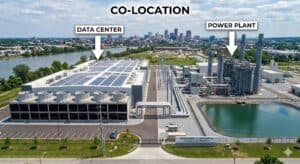 Earlier this year, the Federal Energy Regulatory Commission (FERC) and PJM Interconnection, the country’s largest electric grid operator (covering PA, WV, and OH, among other states), began to grapple with the issue of co-locating power plants with data centers (see