
PA PUC Publishes Marcellus Impact Tax Hike – Older Wells Up 116%

Marcellus drillers who have drilled new wells over the past three years in Pennsylvania are going to get hit by an increase in the state’s impact fee. However, older shale wells (drilled 11 to 15 years ago) will get hit the hardest by the 2025 impact fee/tax. Drillers must pay the impact fee (PA’s equivalent of a severance tax) once per year, based on the wells they drilled or operated during the previous year. The fee is a complex calculation based on (a) how long a well has been drilled, (b) the average NYMEX Henry Hub price for natural gas from the previous year, and (c) a cost adjustment for inflation. The fees PA drillers will pay this year, depending on how long a well has been drilled, range from 3.8% higher to 116.1% higher. Read More “PA PUC Publishes Marcellus Impact Tax Hike – Older Wells Up 116%”
 Last Thursday, the Trump administration announced it is restructuring or terminating approximately $84 billion in clean energy projects (boondoggles) initiated during the Biden era, reflecting a sharp pivot toward “energy dominance” through fossil fuels and nuclear power. Rebranded as the Office of Energy Dominance Financing (EDF), the agency has canceled $30 billion in “green” loans, including major wind and solar transmission projects, while revising another $53 billion in loans. Under Energy Secretary Chris Wright, the office—which holds $290 billion in lending power—will prioritize coal, oil, and gas over renewables, marking a significant reversal of previous climate-focused infrastructure investments.
  Last Friday, the Trump administration officials joined several governors from the 13 states that are part of the PJM Interconnect grid to outline a broad plan they say will ensure customers of the grid will not face skyrocketing electric prices due to new AI data centers getting built in the region (see
  There are two universal, unavoidable truths of life: (1) death, and (2) Democrats love to tax anything and everything. Pennsylvania Democrats are urging state lawmakers to tax data centers to shield residents from rising energy bills. During a hearing held by PA House Democrats on January 20, so-called experts argued that data centers must “pay their own way” for grid upgrades necessitated by their high demand, rather than passing those costs to households. With grid operator PJM Interconnection warning that surging demand could cause blackouts, Democrats proposed legislation to protect ratepayers from price spikes. Although some officials value the industry’s job creation, tax proponents insist that ordinary consumers should not subsidize the infrastructure needed to support the state’s expanding and energy-intensive digital industry.
  On Friday, the White House joined with the 13 governors whose states in whole or in part are served by the PJM Interconnection electric grid, the largest grid in the country, to propose a solution that “protects consumers” from soaring electric rates due to the addition of new AI data centers (see
 Wow, talk about strange bedfellows! On Friday, the White House joined the 13 governors whose states in whole or in part are served by the PJM Interconnection electric grid, the largest grid in the country, to propose a solution that “protects consumers” from soaring electric rates due to the addition of new AI data centers. While some of the ideas discussed were good, others (such as an anti-capitalist price cap) were not. We’ll explain.
  Last week, the EPA proposed a new rule (copy below) to restrict states’ and Native American tribes’ ability to block major projects, such as pipelines and data centers, by abusing the Clean Water Act. By narrowing Section 401 reviews to focus solely on direct water pollution, the Trump administration seeks to accelerate fossil fuel infrastructure and AI development through increased regulatory predictability. This move reverses Biden-era policies that allowed for never-ending environmental evaluations. While administration officials argue these constraints prevent unnecessary delays, environmental radicals contend the proposal undermines local authority to protect drinking water and ecosystems. A final rule is expected this spring.
  The U.S. Energy Information Administration (EIA) predicts U.S. electricity generation will reach 4,423 billion kilowatthours by 2027, driven by steady annual growth. That’s up 3.7% from 4,260 billion KWH in 2025. While natural gas remains the primary power source, its market share is slipping alongside coal, which is declining 5% annually due to plant retirements. Dispatchable (on-demand) sources of electricity generation (natural gas, coal, and nuclear) accounted for 75% of total generation in 2025, but EIA expects their share to fall to about 72% in 2027. EIA expects the combined share of generation from solar and wind power (unreliable renewables) to rise from about 18% in 2025 to about 21% in 2027. Renewables are still minuscule compared to dispatchable natural gas and coal—which is as it should be if you care anything about energy security.
  One of the significant stories of 2024 in the Ohio Utica was about Austin Master Services (AMS), a radiological waste management solutions company in Martins Ferry, Ohio, that processes and transports fracking waste for disposal. AMS ran into trouble when it ran out of money. The Martins Ferry facility in Belmont County, where waste is temporarily stored, had vastly exceeded its permitted limit of 600 tons (storing over 10,000 tons), resulting in a permit violation. The Ohio Attorney General’s office filed a lawsuit against the company in March 2024 to compel compliance and require the company to clean up the facility. After the company didn’t perform, the Ohio Department of Natural Resources (ODNR) stepped in to handle the cleanup (see
  Ohio State Representatives Gary Click and Kellie Deeter have introduced legislation to establish a 13-member bipartisan Ohio Data Center Study Commission. This initiative responds to the rapid expansion of approximately 200 data centers across the state, which has sparked community concerns regarding agricultural land use, noise pollution, water consumption, and energy demands. The commission aims to provide a platform for public dialogue and develop a comprehensive report to guide future development. By evaluating these impacts, lawmakers hope to encourage smart, balanced growth that potentially prioritizes brownfield redevelopment over rural green spaces while ensuring long-term resource stability.
 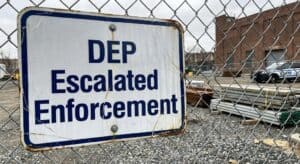 On August 17, Eureka Resources’ Williamsport Second Street facility (one of the three wastewater treatment plants previously operated by Eureka) leaked some of its stored untreated frack wastewater, which ended up in the nearby Susquehanna River via a storm drain (see
  In November of last year, both New York and New Jersey issued the required federal water permits for the Williams Transco Northeast Supply Enhancement (NESE) natural gas pipeline project (see
  Yesterday, the Ohio Oil & Gas Land Management Commission (OGLMC) met in a public forum in Columbus and voted to open another 6,570 acres of state-owned wildlife land (in Belmont and Harrison counties) to allow bids to frack under (not on top of) those areas. The Commission also awarded a contract to Grenadier Energy to drill under another wildlife area in Carroll County, 172 acres of the Leesville Wildlife Area. The state is getting an amazing $6,000 signing bonus, equaling $1.03 million, plus big royalties!
  Last October, the Maryland Public Service Commission (PSC) accepted applications for large-scale power projects, also known as “dispatchable” generation, that can provide energy quickly during periods of peak demand under the state’s Next Generation Act (see
  We spotted a short article alleging EQT has “abandoned” a shale well in Washington County, PA, and thought it would be a good opportunity to (once again) discuss the misnomer of “abandoned” oil and gas wells in Pennsylvania. Let’s begin with the news as reported…