
Antero Resources | Arsenal Resources | Ascent Resources | Doddridge County | Energy Companies | Gulfport Energy | Harrison County | Indiana County | INR/Infinity Natural Resources | Monroe County | Noble County | Ohio | Pennsylvania | Weekly Permits | West Virginia
17 New Shale Well Permits Issued for PA-OH-WV Feb 16 – 22
 The Marcellus/Utica region received a combined 17 new drilling permits last week, Feb. 16 – 22, way down (by 26) from the 43 permits issued two weeks ago. To be fair, 43 permits was one of the highest in recent months, so a slide was expected. What wasn’t expected was that Pennsylvania issued just a single (1) new permit. Ohio issued 8 permits, and West Virginia issued 8 as well. The drillers receiving new permits last week included: Antero Resources, Arsenal Resources, Ascent Resources, Gulfport Energy, and Infinity Natural Resources. Read More “17 New Shale Well Permits Issued for PA-OH-WV Feb 16 – 22”
 West Virginia Attorney General JB McCuskey is leading a 21-state coalition urging the U.S. Supreme Court to overturn Department of Energy efficiency standards adopted during the dark Biden years that effectively ban many natural gas furnaces and water heaters. Challenging a D.C. Circuit ruling, the states argue the mandate violates federal law by eliminating appliances with protected performance characteristics. McCuskey emphasizes that the rule would disproportionately burden low-income and rural families, forcing expensive structural renovations in older homes incompatible with new condensing technology.
 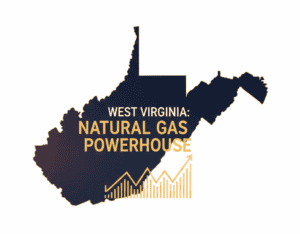 West Virginia continues to cement its status as a national energy powerhouse, ranking as the fifth-largest natural gas producer in the U.S. and providing 10% of the country’s total natgas supply. The 2025 “Gas Facts” report (copy below) from the Gas and Oil Association of WV (GO-WV) highlights a record production of 3.27 trillion cubic feet, fueling an industry that supports 73,000 jobs and contributes $14.7 billion to the state economy. The sector generates hundreds of millions in tax revenue for schools and infrastructure, alongside $1 billion in landowner royalties. Driven by counties like Wetzel and Tyler, the state remains vital to national energy security.
  On Friday, Baker Hughes reported that the U.S. rig count remained unchanged at 551 active rigs. That’s three weeks in a row at the same number (pretty much unheard of). Two weeks ago, the Pennsylvania Marcellus added another rig, bringing the total to 20 active rigs, the most it has operated in well over a year. PA kept its new/higher total last week. Both Ohio and West Virginia remained at 13 and 7, respectively. The combined M-U count was 40 rigs last week, the most operated rigs in well over a year, now for a second week in a row. The M-U’s primary competitor (for attention and money), the Haynesville, added 2 rigs two weeks ago and kept them last week, operating 52 rigs (12 more than the M-U).
  This is disappointing. The United Mine Workers of America (UMWA) held a press conference yesterday in Charleston, WV, to oppose new natural gas power plants in West Virginia, citing concerns over coal job losses and community instability. UMW International President Brian Sanson criticized proposed projects by Mon Power and FirstEnergy, arguing that these gas-fired facilities threaten thousands of mining careers while providing only “temporary” construction jobs and minimal permanent staffing. He is urging state and federal lawmakers to enact codified legal protections for the coal industry.
  Another new gas-fired power plant is on the way in West Virginia! FirstEnergy subsidiaries Mon Power and Potomac Edison have selected a 35-acre site in Maidsville (Monongalia County), West Virginia, for a new 1,200-megawatt natural gas power plant. Located adjacent to the existing Fort Martin Power Station, the facility is designed to provide reliable, affordable energy for approximately 500,000 homes. Pending approval from the WV Public Service Commission, construction could begin in 2027 with operations starting in 2031.
  Antero Resources Corporation has reached a proposed settlement with the U.S. Department of Justice (DOJ) and the state of West Virginia to resolve Clean Air Act violations at 242 oil and gas facilities in West Virginia and Ohio. To address unauthorized volatile organic compound (VOC) emissions, Antero will invest approximately $5.8 million in system improvements and monitoring, reducing annual emissions by over 1,100 tons. The company will also pay a $3.8 million civil penalty and spend $1.5 million to permanently plug and remediate abandoned wells in WV. Total price tag: $11.1 million.
  Antero Resources, the largest Marcellus/Utica (M-U) driller in West Virginia, released its Q4 2025 update yesterday. In 2025, Antero Resources underwent a “transformational expansion” highlighted by the acquisition of HG Energy, the largest acquisition in Antero’s history, which the company closed on just last week (see
  Evolution Well Services, headquartered in Houston with a regional office in Pittsburgh, specializes in “electric” fracking — using natural gas from the well pad (instead of diesel fuel) to power turbines to create electricity that drives fracking pumps. We’ve written about Evolution’s e-fracking work in the Marcellus/Utica for years (
 In December, MDN brought you the news that Antero Resources, the country’s fifth-largest natural gas producer and largest producer in West Virginia, had cut a deal to buy WV driller and midstreamer HG Energy II for a combined $3.9 billion, paying $2.8 billion for upstream and $1.1 billion for midstream (see
  West Virginia Senate Bill (SB) 706 proposes reducing the state’s severance tax from 5% to 3% for new natural gas and oil wells drilled after June 30, 2026, that meet specific production thresholds. This reduction applies only to future projects, leaving existing wells at current rates. While severance taxes provide vital but volatile revenue—ranging from $98 million to $588 million in recent years—this legislation seeks to adjust the fiscal landscape for one of the state’s most profitable resources. The bill is currently under review by the Senate Committee on Energy, Industry, and Mining and awaits further legislative approval.