 On again, off again, on again, off again. Mountain Valley Pipeline (MVP), EQT Midstream’s 303-mile pipeline from Wetzel County, WV to the Transco Pipeline in Pittsylvania County, has had its share of ups and downs. A myriad of lawsuits have been filed against the project. Wacky radicals took to sitting in trees and poles to try and stop it. Most of the illegal protests and lawsuits only served to slow down the project, not stop it. But then a lawsuit filed by the Sierra Club (and a few other colluding Big Green groups) yielded fruit in July when a federal court pulled permits for 3.5 miles of the pipeline where it runs through Jefferson National Forest (see Court Cancels Permits for Mountain Valley Pipe on Fed Land). Based on that court action, in early August the Federal Energy Regulatory Commission told MVP to stop work everywhere, on all 303 miles (see FERC Shuts Down ALL Work on Mountain Valley Pipeline in WV, VA). FERC’s stop-work order resulted in thousands of layoffs (thank you, jobs-destroying Sierra Club). A few weeks later, FERC reversed itself and allowed work to restart everywhere, except for the 3.5 miles in JNF (see FERC Lifts Mountain Valley Pipe Stop-Work Order, Rehiring). And now, here we go again. This time a county judge ordered MVP to stop work at the Greenbrier River. Yes, it’s just one isolated location and the stoppage is “temporary”–at least until the next hearing on Oct. 23. But given the way antis have leveraged such minor incidents in the past into larger work stoppages, we’re always weary when it happens. Here’s the latest in the MVP soap opera…
Read More “WV County Court Judge Orders MVP to Stop Work at River Crossing”

 We’ve seen this movie before. The U.S. Court of Appeals for the Fourth Circuit (quickly becoming the Fourth Circus) has once again listened to the arguments of anti-fossil fuel groups including the Sierra Club and Chesapeake Climate Action Network and has overturned a recently re-issued permit that allows Mountain Valley Pipeline (MVP) to use certain methods to build the pipeline across streams and rivers in West Virginia. The court action pretty much shuts down all work on MVP in WV.
 We’re not quite sure how to tackle this story as there are so many aspects to it. Let’s start here: Two years ago lawsuits filed by some 200 West Virginia residents against Antero Resources were combined into a class action lawsuit. The lawsuits are called “nuisance” lawsuits because, according to the plantiffs, Antero is a nuisance to them (truck traffic, noise, lights at night, etc.). That massive class action lawsuit, filed in early 2016, is about to be heard by the WV Supreme Court–a court in disarray after all of its sitting justices were impeached and removed.
 It’s this kind of story that makes our blood boil–we won’t lie. EQT tried to shaft an elderly couple in Ritchie County, West Virginia out of royalty money by slipping in not only post-production deductions never agreed to in the contract, but also by slipping in a deduction for WV severance taxes owed by EQT itself. Maddening!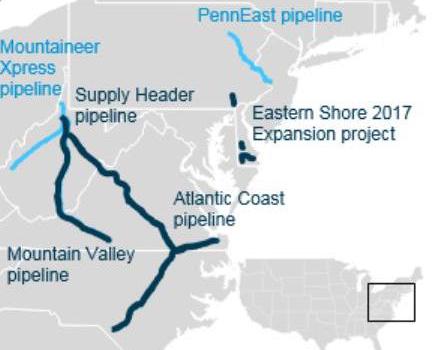
 Anti-fossil fuelers are on a holy mission to stop a 3.5-mile, 8-inch pipeline from being built under the Potomac River by Columbia Gas (see
  In July MDN said it’s time to reveal who is blocking new gas-fired electric plants in West Virginia (see
  What is it about teachers’ unions that makes them so greedy for other people’s money? We’ve told you, for years, about the quest by Pennsylvania’s teachers’ unions (most of them in the Philadelphia area) who want to raid the coffers of Marcellus drillers via a confiscatory severance tax slapped on top of an existing impact tax slapped on top of corporate income taxes. You can never have too many taxes in education-land. That’s the only way they get paid. In West Virginia it’s the same routine. WV already has a severance tax, a nosebleed-high severance tax of 5% (one of the highest in the country). And yet teachers want to increase it–so they can grab that money for moi (see
  Although the push is on to get Marcellus/Utica molecules to new markets where they can fetch higher prices, there is a group who has benefited in a major way from an abundance of cheap, clean-burning shale gas. That would be the residents and businesses located in West Virginia. Industry group Consumer Energy Alliance (CEA) has just published a new report that reveals WV residents and businesses have saved a cumulative $4 billion from 2006-2016 as a result of the decreasing price of natural gas in the state. You may recall not long ago CEA published a similar study for Pennsylvania (see
 SECUR, a privately owned company headquartered in Pittsburgh that (among other things) cleans up radioactive waste from shale drilling, has just opened a new 10-acre branch facility in Tyler County, WV to do just that–to clean up NORM (naturally occurring radioactive materials) and TENORM (technically-enhanced naturally occurring radioactive material). The facility cleans up both liquids (wastewater) and solids (drill cuttings) that contain a tiny bit of radiation in them, making them suitable for safe disposal. No, there is no permanent storage at the facility–the site, located in Friendly, WV, is only used to clean up the stuff coming in. SECUR then repackages the material and sends it back out to licensed disposal facilities. And did we mention…SECUR is a woman-owned, small business? Nice. Here’s the good news of yet more jobs and an essential service have come to the WV part of the Marcellus/Utica…

 Some exciting news to share. Southwestern Energy, headquartered in Texas, has cut a deal to sell all of their Fayetteville Shale (Arkansas) assets to Flywheel Energy for $1.865 billion in cash. The sale makes Southwestern a pure play, 100% focused driller on the Marcellus/Utica region (i.e. Appalachia). What will Southwestern do with an extra $1.865 billion? According to their announcement: (1) Spend $900 million of it on retiring IOUs (“notes”) previously issued. That is, debt retirement. (2) Buy back up to $200 million in outstanding shares of stock. (3) Spend $600 million of it over the next two years (2019 & 2020) on more Marcellus/Utica drilling. But not just any M-U drilling. Southwestern owns acreage in both northeastern PA and the northern panhandle of WV (with a some acreage in Washington County, PA). According to Southwestern’s announcement, the extra $600 million will go to drilling in the company’s “liquids-rich Appalachia assets.” Northeastern PA is dry dry dry–no liquids. WV landowners brace yourselves–Southwestern will soon bring an extra $600 million (over half a billion dollars) worth of drilling to your area. If you’re signed with Southwestern and haven’t yet seen drilling, you now stand a much better chance! Here’s the exciting news, along with extra resources we’ve located to better help you understand the news…
 In an act still befuddling for us, West Virginia Gov. Jim Justice fired Commerce Secretary Woody Thrasher in June (see