• |

    WV Driller Northeast Natural Energy Gets $300M Investment

    Northeast Natural Energy (NNE) is a midsize driller headquartered in Morgantown, WV. NNE owns 49,000 net acres of leases “in the heart of the Marcellus Fairway,” and operates 27 Marcellus wells and over 100 conventional oil and gas wells. In 2011 NNE fought Morgantown for the right to drill a couple of wells just outside the city limits (see our stories here). NNE won that fight. Yesterday two investment firms–Trioloma EIG Energy Income Fund and EIG Global Energy Partners–announced they have joined forces to infuse $300 million into NNE. Looks like a very active drilling program is just ahead for the WV driller…
    Read More “WV Driller Northeast Natural Energy Gets $300M Investment”
  • | | | | | |

    MarkWest Spending $300M+ This Year in WV Expansion Projects

    Click for larger version

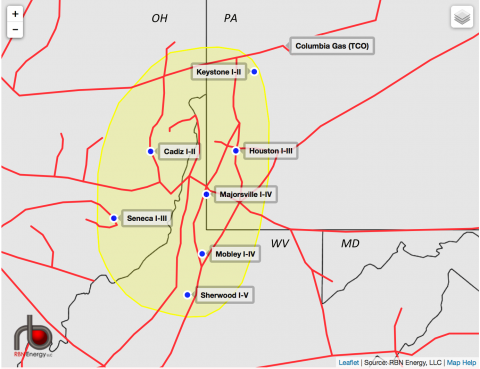
    MarkWest Energy, formerly a standalone company but bought out by MPLX (i.e. Marathon Petroleum) in December 2015, continues its aggressive expansion in the Marcellus/Utica. Particularly in West Virginia. MarkWest owns a number of processing plants in the Mountain State. This year, the company will spend $200 million to expand and upgrade its facilities in Doddridge County (Sherwood facility) to process natural gas and separate out ethane, and $110 million to expand and upgrade facilities in Marshall County (Majorsville facility) to process ethane. Folks, that’s nearly one-third of a BILLION dollars–in just two counties. Talk about economic stimulus! Last year MarkWest spent $120 million on upgrades in Wetzel County. MarkWest’s WV customers include: Antero, EQT, Southwestern, CNX, Chevron, Range Resources, and Eureka Hunter. Here’s more details on what to expect from the mighty MarkWest in WV this year…
    Read More “MarkWest Spending $300M+ This Year in WV Expansion Projects”

  • | | | | | | |

    Rover Pipeline Paying $2.3M for Knocking Down Historic OH House

    On Feb. 3, the Federal Energy Regulatory Commission (FERC) gave its final approval to Energy Transfer’s Rover Pipeline project–a $3.7 billion, 711-mile Marcellus/Utica natural gas pipeline that will run from PA, WV and eastern OH through OH into Michigan and eventually into Canada (see ET Rover Pipeline Gets Final Approval by FERC). Normally when FERC approves such a project, they issue a “blanket certificate” that allows the pipeline company to move forward with construction without getting “Mother May I?” permission for every step along the way. But FERC denied ET a blanket certificate for Rover. Why? Because Rover demolished a house that was under consideration for a national registry of historic homes, without first telling FERC (see Rover Pipeline in Hot Water Over Demolishing Historic House in OH). In May 2015, Rover purchased a house in Carroll County, OH, located near where the pipeline, and a compressor station for that pipeline, is due to run. Rover bought the house to use for offices for several Rover affiliate companies. After buying it, Rover determined the house was “ill-suited for its intended purpose” and decided to demolish it. Problem was/is, that house was under consideration to be added to the National Register of Historic Places. The house was not yet on the list of Historic Places, but was on a list of properties under consideration. FERC says Rover should have reported their decision to demolish the house, which has Rover in hot water with FERC and the Advisory Council on Historic Preservation. That’s the last we had heard about the “historic” house–until we spotted an article that makes reference to a deal Rover agreed to, to pay out $2.3 million “to a fund administered by the Ohio History Connection Foundation and the State Historic Preservation Office. A total of $1 million is for preservation work in the 18 counties crossed by the pipeline. The rest of the money will be used for projects across the state.” So Rover didn’t pay a fine. Instead, they paid hush money. A shakedown, with money going to a PRIVATE nonprofit organization…
    Read More “Rover Pipeline Paying $2.3M for Knocking Down Historic OH House”

  • | | | | | |

    NETL Researchers Find Tiny Earthquakes Help Marcellus Production

    Broadband seismometer used for surface seismic monitoring

    We hesitated to use the headline that we did, given the way virulent anti-drillers bastardize the issue of fracking and earthquakes. But we used it to make a point. Quick history: The headline-grabbing “fracking causes swarms of earthquakes” in places like Oklahoma is about frack wastewater that is injected in special saltwater injection wells, deep below the surface. There are, literally, hundreds of thousands of such wells across the country. Unfortunately, when such a well is located directly over or very close to an underground fault (large crack), the fluid getting injected acts like grease, allowing rock layers to slip and slide–in some cases causing low level earthquakes–typically earthquakes under 2.0 on the Richter scale (can’t be felt on the surface). Is fracking itself ever the cause? Statistically, no. But it has been documented to happen in a handful of cases–under 10 times in the entire world, out of millions of fracked wells. And again, it only happened because of fracking directly over an underground fault. However, any time you explode charges underground, which is what fracking is, if you have equipment sensitive enough, you can detect it. Is that an “earthquake”? We’d say no. Perhaps it is considered an “earthquake” according to a technical definition, but those extremely low vibrations are brief–typically 30-60 seconds–and they never cause any kind of harm on the surface. In fact, the vibrations can’t be felt at the surface. So our headline referring to “tiny earthquakes” is somewhat tongue-in-cheek, a way to tweak antis. Researchers at the National Energy Technology Laboratory (NETL) have discovered that those vibrations from fracking–what they call “low frequency tremors”–can be measured and used to figure out how to get more production out of Marcellus Shale wells in PA and WV…
    Read More “NETL Researchers Find Tiny Earthquakes Help Marcellus Production”

  • | | | | |

    Michigan AG Schuette Wishy-Washy on Support of NEXUS Pipeline

    Bill Schuette

    NOTE: MDN corrected the story below. In a previous version we had confused Rover with NEXUS. We regret the mistake. However, the gist of our story was/is correct–that Schuette appears to support NEXUS, but has also filed comments against it with the MPSC.

    Last fall MDN speculated Michigan Attorney General Bill Schuette’s (Republican) keynote speech at the Michigan Oil and Gas Association’s Annual Meeting was likely an effort to repair the damage he had done to his reputation in aggressively attempting to shake down Chesapeake Energy over supposed lease collusion (see Michigan Succeeds in Shaking Down Chesapeake for Measly $25M). During his speech, Schuette gave his full support to the NEXUS Pipeline project (see Michigan AG Lends His Full Support to NEXUS Pipeline). Yet Schuette is also on record opposing a key request needed by one of the partners to build the pipeline. One of the partners in NEXUS is DTE Energy. DTE’s electric customers will benefit from NEXUS (cheaper natural gas to power electric plants, giving them cheaper electricity), so DTE Electric will charge those customers a small fee in their electric bill to help build the project. Schuette, at the prompting of Michigan Environmental Council and the Sierra Club, filed a brief with the Michigan Public Service Commission opposing DTE Electric’s plan to begin assessing the charge this year, in 2017. Why? Schuette says with the delays at the Federal Energy Regulatory Commission (FERC) due to lack of a quorum, there’s no way NEXUS will go online this year. NEXUS disagrees and maintains it will be online by November. So essentially Schuette took a swipe at NEXUS, after he had lauded them last fall. And what caused us to investigate and write about all of this is because two days ago MDN (and presumably other media outlets) got a brief statement from Schuette’s office, once again praising and expressing support for the project, admitting it “will be moving forward.” Whaaaat? He loves it, then he sides with antis against at it, then he loves it again. What’s going on?…
    Read More “Michigan AG Schuette Wishy-Washy on Support of NEXUS Pipeline”

  • | | |

    23 Drillers Sign Up to Complete Against M-U via TransCanada Pipe

    Click for larger version

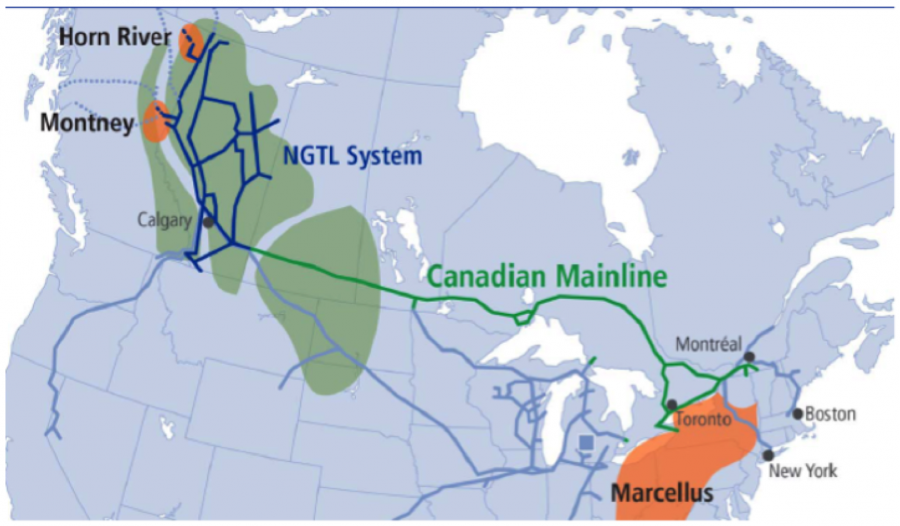
    TransCanada, one of Canada’s leading midstream/pipeline companies, cooked up a deal last year to pipe natural gas from Canada’s West Coast to the East Coast in order to fend off cheap supplies of Marcellus/Utica gas that will flow into Canada when/if the NEXUS and Rover pipelines get built (see TransCanada Pipe Drops Price 42% to Compete with Marcellus/Utica). TransCanada dropped their pipeline price to lure drillers by (theoretically) making it less expensive to get gas from Western Canada, some 2,400 miles away, than from the Marcellus, just 400 miles away. In October, TransCanada launched an open season to lock up customers for the new, lower-priced option. The open season was a bust because TransCanada insists on a 10-year commitment (see TransCanada Plan to Lowball M-U Gas Using Canada Pipeline a Bust). TransCanada rejiggered the terms being offered and reopened the open season. This time it worked (see TransCanada Says Plan to Lowball M-U Gas Worked, Shippers Sign Up). Thanks to a filing TransCanada has made with the Canadian National Energy Board (NEB), we now know who has signed up to use the lowball service from Canada’s West Coast to Ontario. Some 23 Canadian drillers, with some big names in the list, are waiting to use the service. TransCanada is begging/pleading/cajoling the NEB to issue a final approval–so TransCanada and these drillers can preemtively strike a blow at the cheap natgas that will come to the Dawn Hub in Ontario once Rover and NEXUS are built. Below is the list of 23 that plant to go head to head with cheap M-U gas…
    Read More “23 Drillers Sign Up to Complete Against M-U via TransCanada Pipe”

  • |

    Webinar: Will New Gas-Fired Power Plants Solve the M-U Gas Glut?

    MDN is excited to partner with NGI to present a VERY important webinar on Thursday, May 4th: “Super Power: Will New Gas-Fired Plants Solve the Appalachian Gas Glut?” NGI has assembled an all-star cast of speakers to discuss where natural gas-fired plants fit into the “generation stack,” with specific emphasis on the PJM Interconnection markets in the Marcellus/Utica. PJM is a regional transmission organization (RTO) coordinating the movement of wholesale electricity in all or parts of 13 states and the District of Columbia (including PA, OH and WV). PJM, like other RTOs, faces challenges with ensuring there will always be enough electricity produced to meet demand. Over the past several years coal-fired electric generating plants have been closing. Natural gas, and in a much smaller sense renewables (wind and solar) have taken up the slack. Wind and solar are notoriously unreliable. The wind doesn’t always blow and the sun doesn’t always shine. But natural gas needs pipelines to get it to the plants. So what’s the scoop with natgas electric generation in our neck of the woods? How important are new power plants to the capacity-constrained Marcellus/Utica? Jump on this free 1-hour webinar to find out…
    Read More “Webinar: Will New Gas-Fired Power Plants Solve the M-U Gas Glut?”

  • |

    ENSERVCO Starting Up Water Transfer Service in Marcellus

    ENSERVCO is an oilfield services company headquartered in Denver, CO. ENSERVCO’s services include: hot oiling, acidizing, frac water heating, water transfer, bacteria and scaling treatment, water hauling and oilfield support equipment rental. The company says it serves customers in various shale basins across the country, and in states including Colorado, Kansas, Montana, New Mexico, North Dakota, Oklahoma, Pennsylvania, Ohio, Texas, Wyoming and West Virginia. So yeah, they have customers in the Marcellus/Utica. Yesterday ENSERVCO issued an update for first quarter 2017–preliminary financials and an operational update. The thing that caught our eye was this statement: “We’re also moving forward with plans to begin offering water transfer in the Marcellus Shale, where we’re hiring staff and gearing up our marketing plans.” We’re not quite sure what they mean. Yet another trucking outfit with a parade of tankers trundling down the road (like we saw last weekend when visiting Hop Bottom, PA, in Susquehanna County). Or water pipelines? Or both?…
    Read More “ENSERVCO Starting Up Water Transfer Service in Marcellus”

  • | | |

    OH & PA NatGas Production Increased More Than Other States in ’16

    Would it surprise you to learn that Pennsylvania and Ohio had the largest increase in natural gas production in 2016–larger than any other natgas-producing states? If you read MDN regularly, perhaps not. Old news. However, it may surprise you to learn that from 2012 to 2016, 85% of the growth in our country’s enormous natural gas output came from the Marcellus/Utica. Yeah, 85%. That’s huge. More old news: Pennsylvania passed Louisiana back in 2013 to become the second highest-producing natgas state in the country. More new news: Last year, in 2016, Ohio passed West Virginia to become the seventh highest producing natgas state in the country. Here’s some more facts about PA & OH from our favorite government agency, the U.S. Energy Information Administration…
    Read More “OH & PA NatGas Production Increased More Than Other States in ’16”

  • | | | | | | |

    New PA Bill an Overreaction to Court Ruling on Strippers

    As previously reported, liberal Pennsylvania House of Representatives Democrat Pam Synder has now introduced a bill (HB 1283, copy below) to “clear up” what the state Public Utility Commission (PUC) is a loophole in the Act 13 law that may allow some drillers to avoid paying impact fees (i.e. drilling taxes) on some Marcellus Shale wells (see PA Lib Dem Introducing Bill to “Fix” Strippers Once and for All). In 2012 Pennsylvania passed the Act 13 law that includes a fee on wells targeting shale layers, including the Marcellus. Snyder Brothers, headquartered in Kittanning, PA, drills mostly conventional (vertical only) wells in southwestern PA. In 2011-2012 they drilled 45 vertical-only wells, targeting the Marcellus–all of the wells fracked. Initially those wells produced more than 90 Mcf/day, but by December of the year they were drilled, they produced less than 90 Mcf/day. The way the 2012 Act 13 law is written, if a well produces less than 90 Mcf/day during “any” month it is considered a stripper well and exempt from paying the impact fee. The state’s Public Utility Commission (PUC) assessed the fee anyway because for 11 months the wells produced more than 90 Mcf/day. Snyder Bros. sued and after an appeal of the case, won their case in March, exempting those wells from paying impact fees (see PA Court Says Snyder Bros Wells are Strippers, No Impact Fees Due). That sent the state Public Utility Commission (PUC) into a tizzy. The PUC and the PA Democrat Party is using the court case to try and accomplish two things they haven’t been able to accomplish heretofore: (1) claim this is a prime example of why a nosebleed high severance tax is needed, in this year’s budget, and (2) fundamentally change the intent of the Act 13 law by passing a “clarification” as introduced by Snyder’s HB 1283 bill. Below we explore this issue in depth and tell you why the Snyder case win is NOT a way for drillers to avoid paying impact fees. In fact, the court’s decision makes it clear that drillers cannot simply reduce production for one month and then claim it’s a stripper well under the 90 Mcf/day definition. Snyder’s bill is an overreaction and does not clear up anything. Instead, it changes everything…
    Read More “New PA Bill an Overreaction to Court Ruling on Strippers”

  • | | | | | | |

    Seneca Resources Fined $375K by PA DEP for “Multiple Violations”

    The Pennsylvania Dept. of Environmental Protection has just fined driller Seneca Resources $325,000 for a series of violations that occurred between 2013 and 2015. It seems in moving dirt around when building drill pads, Seneca caused erosion to occur. They also spilled ~100 barrels of crude oil in one location, and ~500 barrels of wastewater at another location. The violations happened in Forest, McKean, and Elk Counties. Here’s the notice issued by the PA DEP…

    Read More “Seneca Resources Fined $375K by PA DEP for “Multiple Violations””

  • | | | | | | |

    Anti-Govt Radicals Begin 24/7 Tree Sit in PA to Block ME2 Pipe

    Click for larger version

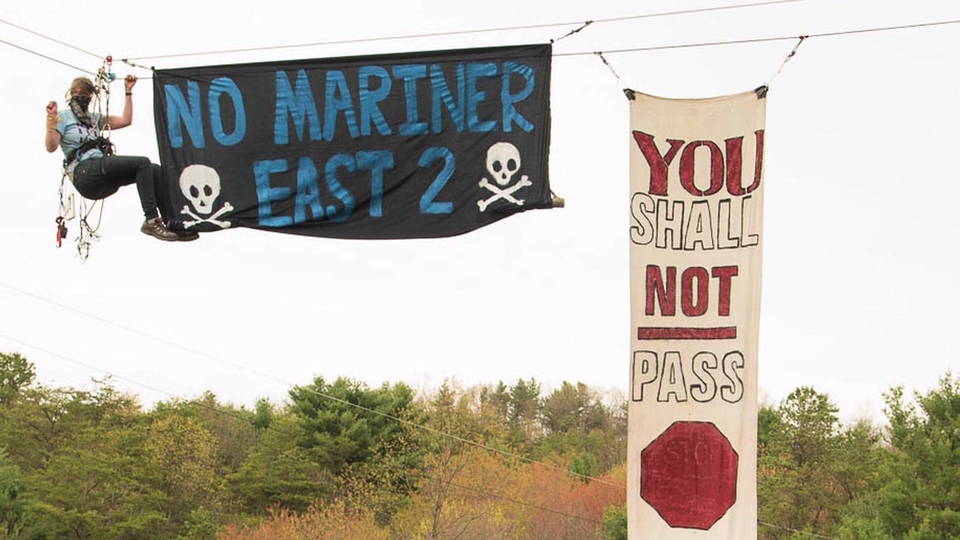
    A group of radical (we’d call them criminal) environmentalists–some of the same ones who broke the law in North Dakota while “protesting” the Dakota Access Pipeline (DAPL)–are now trying to replicate the DAPL “protest” (i.e. illegal action) against Sunoco Logistics’ Mariner East 2 pipeline in Pennsylvania. The radical group Earth First! recently issued a “call to action”–their version of ringing the dinner bell for hungry dogs to come running from all other the country (even from other countries). The “call to action” invites hippies and hippie wannabes (those who can put down their bongs for five minutes) to come to Huntingdon County, PA–to Camp White Pine–to stretch wires and ropes from tree to tree and sit, suspended, to prevent crews from clearing trees in the path of the pipeline. According to Mob Rule Now! (aka Democracy Now!), the nutters have now “launched ongoing 24-hour tree-sits” to stop Mariner East 2…
    Read More “Anti-Govt Radicals Begin 24/7 Tree Sit in PA to Block ME2 Pipe”

  • | | | | | | |

    PR Campaign Gets Atlantic Sunrise Pipe to Change Course in PA

    Nesbitt Memorial Hospital – click for larger version

    If you’re a landowner and want to dissuade a pipeline, like, say, the Atlantic Sunrise Pipeline, from crossing your property–what can you do? It helps if your property belongs to one of the local dynasties (i.e. BIG money) and if you can hire high-priced lawyers and issue a blizzard of press releases via Business Wire at $500 a pop. Apparently that’s what it takes to convince a pipeline company to change its course. At least, that’s the lesson we take away from Geraldine Nesbitt, landowner of The Nesbitt Parcel in Dallas Township (Luzerne County, near Wilkes-Barre), PA. Nesbitt has been 100% against the Atlantic Sunrise project since learning its proposed route would cross her big-monied estate. Nesbitt’s heir, Abram Nesbitt, once built a hospital in Kingston, PA that reminds of Downton Abbey (see the picture). Atlantic Sunrise is a $3 billion, 198-mile pipeline project running through 10 Pennsylvania counties to connect Marcellus Shale natural gas from northeastern PA with the Williams’ Transco pipeline in southern Lancaster County. In February the Federal Energy Regulatory Commission (FERC) gave its final seal of approval for the project (see Atlantic Sunrise Pipeline Gets Final Approval by FERC). After FERC’s approval, Ms. Nesbitt’s lawyers began an aggressive publicity campaign to try and convince FERC to stop the project. Last week Williams (builder of Atlantic Sunrise) filed a request with FERC to adopt an alternative route around the Nesbitt estate–and all of a sudden Ms. Nesbitt “has never been opposed to natural gas pipelines.” What disgusting hypocrisy. If Joe Farmer wants the pipeline rerouted around his prized hay field–good luck with that. But if an old-line establishment family with BIG MONEY like the Nesbitts wants a reroute, they get it. We don’t like it…
    Read More “PR Campaign Gets Atlantic Sunrise Pipe to Change Course in PA”

  • | | | | | | | | | | |

    New 3.5 Mile Pipeline Project to Drill Under the Potomac River

    Click for larger version

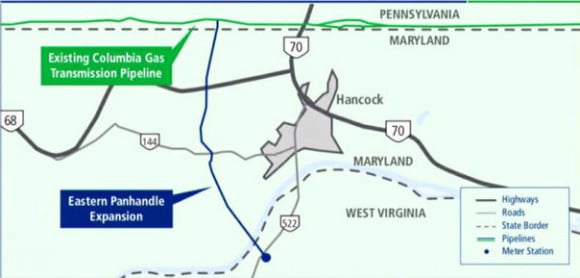
    Columbia Pipeline, now owned by TransCanada, recently (in March) filed an application with the Federal Energy Regulatory Commission (FERC) to build a 3.5 mile, 8-inch pipeline that will carry natural gas from Pennsylvania to connect the Mountaineer Gas system in West Virginia with the Columbia Gas Pipeline in Pennsylvania. The purpose of the Eastern Panhandle Expansion project is to deliver natural gas via local distribution channels to a new industrial facility in Berkeley County, WV (scheduled to open in Fall 2017), and to provide gas to other local businesses and residents in the Tri-State area. Most of the pipeline crosses through a tiny sliver of Washington County, Maryland. The main issue with the project is that the pipeline will be drilled underneath the Potomac River, which serves as the border between WV and MD. That has antis in an uproar. The good news is that FERC has agreed to prepare an environmental assessment (EA) for the project. That is, this is now a real project with a high degree of likelihood it will get built…
    Read More “New 3.5 Mile Pipeline Project to Drill Under the Potomac River”

  • | | |

    OH Gov. Kasich’s Severance Tax Hike is Dead, Again

    As in previous years when Ohio’s RINO Gov. Kasich has proposed a super-high boost to the state’s severance tax, calm-headed Republicans (people from his own party!) have come to the rescue. Ohio House Republicans have removed Kasich’s boost in the severance tax rate from the budget. Meaning, it’s dead…
    Read More “OH Gov. Kasich’s Severance Tax Hike is Dead, Again”

  • | | | |

    NY Landowner Group Asks Pres. Trump for Help Battling Gov. Cuomo

    The Joint Landowners Coalition of New York (JLCNY), a group representing over 70,000 landowners with a collective 1 million acres of land that could be leased for oil and gas drilling, only if, has just sent off a letter to President Trump asking for his help. The JLCNY, via the letter, alerts Trump to Gov. Andrew Cuomo’s shenanigans in blocking natural gas pipelines. The letter also asks Trump to support legislation we’ve previously highlighted by Congressman Tom Reed to protect landowners in New York (and other states) from government actions that block oil and gas development (see JLCNY Rally in NY to Support Defense of Property Rights Bill). Here’s what the JLCNY sent along to The Donald…
    Read More “NY Landowner Group Asks Pres. Trump for Help Battling Gov. Cuomo”