
PA PUC Publishes Marcellus Impact Tax Hike – Older Wells Up 116%

Marcellus drillers who have drilled new wells over the past three years in Pennsylvania are going to get hit by an increase in the state’s impact fee. However, older shale wells (drilled 11 to 15 years ago) will get hit the hardest by the 2025 impact fee/tax. Drillers must pay the impact fee (PA’s equivalent of a severance tax) once per year, based on the wells they drilled or operated during the previous year. The fee is a complex calculation based on (a) how long a well has been drilled, (b) the average NYMEX Henry Hub price for natural gas from the previous year, and (c) a cost adjustment for inflation. The fees PA drillers will pay this year, depending on how long a well has been drilled, range from 3.8% higher to 116.1% higher. Read More “PA PUC Publishes Marcellus Impact Tax Hike – Older Wells Up 116%”
 In December, MDN brought you the great news that a long-dead natural gas-fired power plant project in Moundsville (Marshall County, WV) was back from the dead (see
  Last November, Accomack County, Virginia, secured a $6.5 million state grant to expand piped natural gas to the Eastern Shore, a move aimed at stabilizing the local economy (see
 Last Thursday, the Trump administration announced it is restructuring or terminating approximately $84 billion in clean energy projects (boondoggles) initiated during the Biden era, reflecting a sharp pivot toward “energy dominance” through fossil fuels and nuclear power. Rebranded as the Office of Energy Dominance Financing (EDF), the agency has canceled $30 billion in “green” loans, including major wind and solar transmission projects, while revising another $53 billion in loans. Under Energy Secretary Chris Wright, the office—which holds $290 billion in lending power—will prioritize coal, oil, and gas over renewables, marking a significant reversal of previous climate-focused infrastructure investments.
  Enverus
 MARCELLUS/UTICA REGION: US DOE issues order allowing PJM power plants to run without regard to air quality; OTHER U.S. REGIONS: Will Governor Spanberger return to common sense and moderation?; NATIONAL: U.S. natural gas adds to gains in choppy trade; Winter weather to disrupt U.S. gas production, increase prices; INTERNATIONAL: Crude closes higher on Iran, cold weather; SLB predicts worst is behind global oil market.
  A nice bump up in permit numbers last week, mainly due to Pennsylvania. The Marcellus/Utica region received a combined 27 permits last week, Jan. 12 – 18. Pennsylvania issued 21 new permits, Ohio issued 5, and West Virginia issued just 1. Among the drillers receiving new permits last week: Antero Resources, Coterra Energy, EQT, Expand Energy, Gulfport Energy, and Seneca Resources.
  Last Friday, MDN reported that the rumor mill was in overdrive with chatter that Devon Energy and Coterra Energy are exploring a potential merger “that would be among the biggest oil and gas deals in years” (see
  As we point out in a companion post today, potential merger talks between Devon Energy and Coterra Energy are in an “advanced” stage (see Devon Energy/Coterra Energy Said to be in “Advanced Merger Talks”). One of the reasons (perhaps THE reason) why Coterra is considering a merger is ongoing pressure from “activist” investor Kimmeridge, which launched a public campaign last November to force Coterra to split the company, to sell off its Marcellus (and Anadarko) assets, and focus 100% on oil drilling in the Permian (see
  As we predicted may happen in a post yesterday, the NYMEX “front month” natural gas futures price closed above $5 yesterday (see
 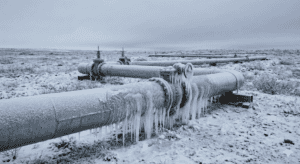 On January 22, Mount Pleasant Township Police (in Washington County, PA) reported that extreme winter temperatures caused an aboveground water pipeline serving Range Resources’ shale gas operations to freeze and rupture near the Yonker Tank Pad. In response to the infrastructure failure, the Township Zoning Officer granted a temporary permit modification, allowing the company to bypass the damaged pipeline by hauling water via dozens of trucks over the next two weeks.
  There’s just no other way to say this: Pennsylvania is on the cusp of flushing $92 billion down the toilet because resistance is preventing new data centers from being built. We’ve been warning about this danger for months (see
  Venture Global’s Calcasieu Pass (CP) LNG export facility in Louisiana began operations in March 2022 (see
  For the second day in a row, the “front month” NYMEX natural gas futures contract was firmly attached to a rocketship. Yesterday, the NYMEX contract for February delivery gained 96.80 cents per million British thermal units (MMBtus), or 24.78%, to close at $4.8750. That’s up $1.772 (or 57%) over the last two trading sessions. It is the largest two-day dollar gain since Thursday, Jan. 27, 2022 (four years!). Early trading this morning was hovering between $5.35 and $5.50. It’s all to do with the current Arctic freeze in the eastern half of the country and a massive snowstorm due this weekend. But, bear this in mind: What goes up must come down.