
EQT Asks Fed Court to Dismiss Health Lawsuit Filed by 4 WV Kids
 In August, the parents of four children under the age of 18 (from three families) filed a lawsuit on their kids’ behalf against EQT subsidiaries EQT Production Company and EQT XL Midstream Operating, claiming that emissions from a nearby compressor station and nearby shale wells operated by EQT have led to severe health-related problems for the kids (see 4 WV Kids Sue EQT Claiming Compressor, Wells Caused Illness). The families used to live in the rural hamlet of Knob Fork in Wetzel County, WV. They all have since moved. The lawsuit seeks unspecified damages and money for ongoing monitoring of the kids’ health. In November, EQT filed a motion to dismiss the case. In December, the plaintiffs (parents/kids’ lawyers) filed a response opposing the motion to dismiss. EQT quickly followed with its own response, replying to their opposition to the dismissal of the case. Read More “EQT Asks Fed Court to Dismiss Health Lawsuit Filed by 4 WV Kids”
 Ohio State Representatives Gary Click and Kellie Deeter have introduced legislation to establish a 13-member bipartisan Ohio Data Center Study Commission. This initiative responds to the rapid expansion of approximately 200 data centers across the state, which has sparked community concerns regarding agricultural land use, noise pollution, water consumption, and energy demands. The commission aims to provide a platform for public dialogue and develop a comprehensive report to guide future development. By evaluating these impacts, lawmakers hope to encourage smart, balanced growth that potentially prioritizes brownfield redevelopment over rural green spaces while ensuring long-term resource stability.
  MDN was among the first to tell readers that so-called environmental groups were quickly morphing from anti-fracking to anti-data center. Over the past three months, we’ve observed in various posts how opposition to data centers (from the same people who oppose fracking and shale energy) has gone from local and regional anti groups (see
  MARCELLUS/UTICA REGION: Gov. Shapiro, lawmakers tout benefits of PA’s natural gas impact fee; Woman arrested for incident outside Utica Shale Academy; NATIONAL: U.S. natural gas futures sink ahead of storage report; Climate activists push insurance bills that hike costs for consumers; State of American energy 2026; Blocking the sun – the folly of solar geoengineering; When it comes to C3, think in thirds; 2026 Energy Outlook: grid strains, price pressure, geopolitical shifts; Congress can predict our energy future by creating it; Trump says tech giants must bear cost of data center electricity; INTERNATIONAL: Oil slips after Trump signals Iran de-escalation; BP sees up to $5B impairments tied to low-carbon assets.
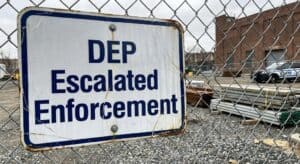 On August 17, Eureka Resources’ Williamsport Second Street facility (one of the three wastewater treatment plants previously operated by Eureka) leaked some of its stored untreated frack wastewater, which ended up in the nearby Susquehanna River via a storm drain (see
  In November of last year, both New York and New Jersey issued the required federal water permits for the Williams Transco Northeast Supply Enhancement (NESE) natural gas pipeline project (see
 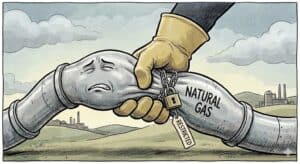 As we’ve often noted, the NYMEX futures price and spot (physically traded) prices often move in tandem. It’s not a direct, one-to-one relationship, but when futures prices fall, spot prices tend to fall too. Most often, the reason is the weather. However, other factors can influence regional spot prices. In the Marcellus/Utica region, pipeline constraints sometimes contribute to lower prices. If we can’t get our molecules to other markets, they pile up, and the price goes down. There seems to be some of that at play right now.
  The bidding war for Ascent Resources continues and gets more complex. Law firm Kirkland & Ellis has been drawn into a dispute between Ascent Resources investors and the private equity firm Energy & Minerals Group (EMG). Mason Capital Management is questioning Kirkland & Ellis’s role representing the Ascent board while also advising EMG in its legal fight with the Abu Dhabi Investment Council. The dispute concerns EMG’s plan to put Ascent into a “continuation vehicle,” which Mason Capital and other investors have opposed. Other companies have since jumped in to make bids to take over Ascent.
 Yesterday, the Ohio Oil & Gas Land Management Commission (OGLMC) met in a public forum in Columbus and voted to open another 6,570 acres of state-owned wildlife land (in Belmont and Harrison counties) to allow bids to frack under (not on top of) those areas. The Commission also awarded a contract to Grenadier Energy to drill under another wildlife area in Carroll County, 172 acres of the Leesville Wildlife Area. The state is getting an amazing $6,000 signing bonus, equaling $1.03 million, plus big royalties!
  The current (until this week) Chief Operating Officer (COO) of major Marcellus/Utica driller Seneca Resources (a subsidiary of National Fuel Gas Company) is leaving not only Seneca but also the country to become the Chief Executive Officer (CEO) of Australian driller Tamboran Resources Corporation.
  In 2015, a group of landowners in northeastern Pennsylvania who had leased their land for fracking filed a lawsuit against Chesapeake Energy, Anadarko, Statoil (now Equinor), Mitsui E&P, and Access Midstream (later bought by Williams), alleging the companies had improperly deducted post-production costs (e.g., gas gathering and transportation expenses) from royalties owed to the landowners in breach of their respective leases. The lawsuit also alleged collusion and conspiracy to defraud the landowners (antitrust violations). The lawsuit was on hold for many years while other lawsuits played out. In 2024, a federal court in Scranton unpaused the lawsuit, and the judge ruled, tossing out the landowners’ royalty claims (see
  Last October, the Maryland Public Service Commission (PSC) accepted applications for large-scale power projects, also known as “dispatchable” generation, that can provide energy quickly during periods of peak demand under the state’s Next Generation Act (see
  We spotted a short article alleging EQT has “abandoned” a shale well in Washington County, PA, and thought it would be a good opportunity to (once again) discuss the misnomer of “abandoned” oil and gas wells in Pennsylvania. Let’s begin with the news as reported…