Drilling the Utica Shale in PA & WV – Leveraging Stacked Plays
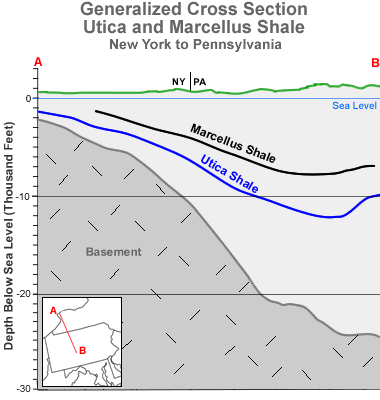 Last week MDN friend and ace reporter Rick Stouffer from Kallanish Energy hosted a one-day event in Pittsburgh called “Kallanish New Horizons: Appalachin Basin.” One of the speakers was Tom Murphy, director of Penn State’s Marcellus Center for Outreach and Research (MCOR). MDN editor Jim Willis had the pleasure of presenting on the same panel with Tom at the National Association of Royalty Owners (NARO) Pennsylvania Chapter annual convention in State College, PA last March. Tom never disappoints! He certainly didn’t at last week’s Kallanish event. Tom spoke on the topic of Utica drilling–in PA and WV. Normally you think “Ohio” when you think Utica. And indeed, Ohio has the vast majority of Utica wells drilled (2,080 and counting). But there’s a fascinating trend of drilling Utica wells in both PA and WV. How many?
Read More “Drilling the Utica Shale in PA & WV – Leveraging Stacked Plays”
 The liberal PA Gov. Tom Wolf administration continues to tinker with (i.e. destroy) the Marcellus miracle in the Keystone State. In August the Wolf Dept. of Environmental Protection (DEP) finally, after years of work, implemented onerous new regulations to cut down on so-called fugitive methane emissions from *new* drilling and pipelines (see
 Yesterday Kinder Morgan, one of (perhaps THE) country’s largest midstream company, issued guidance (their best guess) for how much money the company will make in 2019. Aimed at investors, of course. Usually these types of things are dry as toast, but we happened to notice the third sentence in the update which says Elba Island, Kinder’s LNG export facility on the coast of Georgia, along with the Gulf Coast Express pipeline project, will both enter service in 2019 and will help lead the company to record revenue–about 10% more revenue next year than was generated this year. Which got us to thinking once again about Elba Island, and the Marcellus molecules that will get exported from it. It also reminded us of a recent email exchange we had with a subscriber who swears that LNG shipments are already departing from the facility.
 The “best of the rest”–stories that caught MDN’s eye that you may be interested in reading: Exelon generation to retire nine economically challenged generation facilities within PJM; Auditor General DePasquale announces plans for special report on climate change in PA; Westmoreland Transit to roll out two new natural gas-powered buses on Tuesday; Capstone Turbine announces order for expanding oil and gas projects in Utica shale; Those French fuel riots and the “Great Wall of Cuomo”; Tight supply-demand balance brings back natural gas price volatility; Perry again calls for US energy infrastructure plan, cites national security; New Brunswick legislature narrowly OKs lifting ban on unconventional natural gas drilling; Is Qatar’s OPEC exodus a blow to Saudi Arabia’s dominance?
 A truck hauling produced water–naturally occurring water from the depths that continues coming out of a drilled well long after it’s been fracked–overturned and spilled approximately 4,200 gallons of that wastewater. The wastewater, often called “brine” due to its minerally or salty composition, came from Pennsylvania General Energy (PGE) shale wells and was being hauled by Stallion Oilfield Services. It spilled on the ground “adjacent” to a “native trout stream” in the Pine Creek area in Lycoming County, PA.
 The evidence continues to pour in that the addition of Williams’ Atlantic Sunrise Pipeline, a 200-mile greenfield pipeline from northeastern to southeastern PA where it joins the Transco Pipeline, is having a dramatic and ongoing effect on natural gas prices in northeastern PA. As in, the price drillers get for their gas has doubled. Atlantic Sunrise went online in early October (see
 How much “diligence” is required when trying to locate the heirs of mineral rights owners in Ohio, as stipulated by the Ohio Dormant Minerals Rights Act (DMA)? That issue was addressed, once again, last week–this time by Ohio’s 7th District Court of Appeals. The DMA requires a surface owner to exercise “reasonable due diligence” to ascertain the names and addresses of mineral holders and their heirs prior to serving notice of abandonment by publication. The question is, what is “reasonable due diligence”? Is there a common standard? The 7th District decided there is no common standard, and what’s reasonable in one case may not be reasonable in another. In other words, it all depends–and is unique in each case.
 In May of this year, Elizabeth Barnes, an administration law judge for the Pennsylvania Public Utility Commission (PUC), unilaterally ordered Sunoco Logistics Partners to “cease and desist all current operation, construction, including drilling activities on the Mariner East 1, 2 and Mariner East 2X pipeline” in West Whiteland Township in Chester County, PA (
 Last week the Ohio Environmental Protection Agency held an information session (to give out info) along with a public hearing (to accept comments) on the draft air pollution permit for PTT Global Chemical’s proposed ethane cracker plant complex in Belmont County, OH (see

 Events related (or of interest) to the Marcellus and Utica Shale, primarily pro-drilling events. To have your event included (or if you are aware of a worthy event you believe should be on this page), please send the details and/or a link to have it included to the calendar@marcellusdrilling.com email address.
 Well this wasn’t supposed to happen. The Delaware County (PA) Council hired a company in July of this year at a cost of $115,000 to conduct an independent risk assessment study of both the Mariner East 2 (ME2) and Adelphia Gateway pipeline projects (both running through Delaware County), to assess just how much risk each pipeline poses to residents in the county, a heavily populated Philadelphia suburb. A group of antis paid $50,000 to Quest Consultants for the same thing. The antis released their “report” in October (see
 Each year (for the 12th year running) the Canadian-based Fraser Institute surveys petroleum industry executives and managers (256 of them for 2018) asking them their opinions on the barriers to investing in exploration and production in various geographies across the globe. That is, what makes them more likely or less likely to spend money drilling in a particular location? The Global Petroleum Survey (full copy below), tallies the survey responses and ranks each geography from most desirable place to invest, to least desirable. Last year West Virginia was ranked as the fifth most desirable place to invest (see