
PA DEP Grants Williams NE Supply Enhancement Pipe Key Permit
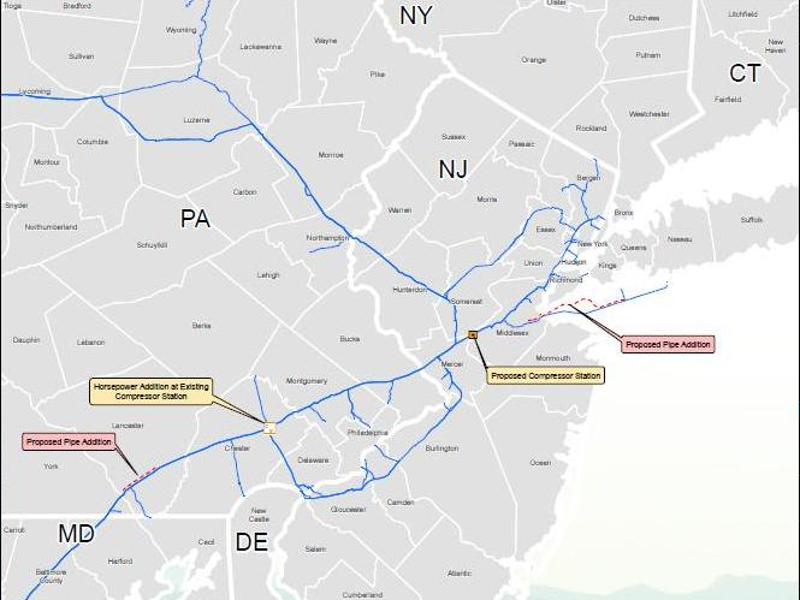
The Northeast Supply Enhancement (NESE) is a Williams Transco Pipeline project meant to increase pipeline capacity and flows heading into northeastern markets (see Time to Support Transco’s Northeast Supply Enhancement Project). Transco wants to provide more Marcellus natural gas to utility giant National Grid beginning with the 2019-2020 heating season. National Grid operates in New York City, Long Island, Rhode Island and Massachusetts. There are a number of components to the project, but the key component, the heart of the project, is a new 23-mile pipeline from the shore of New Jersey into (on the bottom of) the Raritan Bay–running parallel to the existing Transco pipeline–before connecting to the Transco offshore. After an initial rejection by the New York Dept. of Environmental Conservation (DEC), Williams refiled an application for the project in May with the DEC (see Williams Refiles Application with NY DEC for Transco NESE Project). Meanwhile, there are portions of the project in Pennsylvania that have already been approved by the PA’s Dept. of Environmental Protection. In a notice published in the June 16 Pennsylvania Bulletin, the DEP issued the project a Section 401 Water Quality Certification for work being done in Lancaster and Chester counties. According to the PA Environment Digest Blog: “The Project facilities consist of approximately 10.17 miles of new 42-inch diameter natural gas pipeline in Drumore, East Drumore, and Eden Townships, Lancaster County and the addition of one 21,902 horsepower motor-driven compressor at the existing Compressor Station 200 in East Whiteland Twp., Chester County.” Too bad the dysfunctional NY DEC couldn’t be more like the mostly-functional PA DEP…
Read More “PA DEP Grants Williams NE Supply Enhancement Pipe Key Permit”
 We write about Boardwalk Pipeline Partners every now and again. They don’t have a lot of pipelines in the Marcellus/Utica region–but what they do have is important. One of the pipelines operated by Boardwalk is the huge Texas Gas Transmission (TGT)–originally built from the Louisiana Gulf Coast to the upper Midwest to supply Illinois, Indiana and Ohio with natural gas. But then the Marcellus/Utica Shale happened and TGT needed to change strategies. Through a series of projects, TGT made the pipeline system bidirectional, so it could flow gas from the Marcellus/Utica to points south, going as far as the Gulf Coast. In May 2016 TGT began to flow up to 626 million cubic feet per day of Marcellus/Utica gas as far away as the Gulf Coast (see
 The Goldboro LNG export facility in Nova Scotia continues its march (shuffle?) toward construction. As we reported in February, Pieridae Energy (the builder) has enlisted the help of Morgan Stanley and Société Générale to help raise $10 billion to build it (see
  Oil and gas giant BP recently released its annual Statistical Review of World Energy–the 67th edition! (Full copy below.) A number of big energy companies, like Exxon Mobil, as well as government agencies, publish similar reports that characterize current and future world energy trends. However, one analyst we read says BP’s report is the best: “I have relied upon the BP World Energy report for years. It is not a report to be viewed with a partisan eye, but as merely one of the best, if not the best, energy trend device available anywhere. In comparison to government agencies like the U.S. Energy Information Administration (EIA) the global International Energy Association (IEA) or OPEC’s own World Oil Outlook, the BP report has proven itself to be far more valuable in finding investable trends. I would never recommend any oil sector without having the statistical evidence of the BP World Energy Report behind me.” This year’s report finds that oil and natural gas consumption increased significantly in 2017. It also finds the U.S. best-positioned to meet that increasing demand, thanks to the shale miracle. Below we have some of the key highlights from the report, followed by a full copy…
 The “best of the rest”–stories that caught MDN’s eye that you may be interested in reading: Cabot pays a visit to Loudonville Council to discuss Ohio drilling; cracker plant takes shape in Beaver, PA; with pressure from corp. raider Carl Ichan, SandRidge looks to sell; Rhode Island stupidly sues major oil companies for global warming; natgas shortages coming this winter?; US Chamber continues drumbeat against Trump tariffs; Canada competes with Gulf Coast for petchems; and more!
 Last Thursday, Ascent Resources, a company founded by Aubrey McClendon after he left Chesapeake Energy, announced it is buying 113,400 Utica Shale acres along with 93 operating wells located in eastern Ohio for $1.5 billion. The new acreage tips Ascent over the 300,000 Utica acre line and catapults the company into one of the largest privately owned drillers (exploration and production) in the U.S. The companies doing the selling are CNX Resources and Hess (selling a joint venture they co-owned, each selling their share for $400 million each, for a total of $800 million), Utica Minerals Development (a subsidiary of First Reserve, a private equity firm headquartered in Greenwich, CT, and EMG), and a fourth, unnamed mystery seller. The CNX/Hess acreage (78,000 net acres of the 113,400 acres) is located in the wet gas window of Belmont, Guernsey, Harrison and Noble counties. We’re not sure about the location of the other acreage. The CNX/Hess jv sale marks Hess’ total exit from the Utica Shale. So how will Ascent pay for all of their new shiny new assets?
  Rover Pipeline has violated one of the sacrosanct rules of life (and of pipeline construction): “Say what you’ll do, then do what you say.” Rover told the Federal Energy Regulatory Commission it would restore areas previously dug up to lay the pipeline by certain dates (primarily June 30th). In return, based on those promises from Rover, FERC allowed the company to begin service on certain sections of the $3.7 billion, 711-mile natural gas pipeline that runs from PA, WV and eastern OH through OH into Michigan and on to Canada via the Vector Pipeline. Rover has been pressuring FERC to allow two of the laterals–the Burgettstown and Majorsville laterals, that reach into western Pennsylvania–to begin service (see
  MDN told you last week that Sierra Club lawyers are attempting to bamboozle a court into halting construction of the Mountain Valley Pipeline (MVP) in Virginia, as they were able to do in West Virginia (see
  MDN exclusively brought you the news, on June 19, that Diversified Gas & Oil had purchased EQT’s Huron Shale assets in Kentucky, Virginia and West Virginia for $575 million (see
 Sunoco Logistics Partners was drilling horizontally underneath Snitz Creek in Lebanon County, PA for its Mariner East 2 Pipeline project when it experienced yet another “inadvertent return”–nontoxic drilling mud leaking out of a place where it shouldn’t. Sunoco spilled five gallons of nontoxic drilling mud. This is the third time it’s happened in June, and the sixth time it’s happened at the Snitz Creek location in total. Predictably, antis were hysterical. Hysterical, not as in funny, but hysterical as an insane, out-of-control overreaction. Theatrics. Drama. That kind of hysterical. The reaction from antis is organized by “green” groups–in particular by one person from a local green group calling itself Concerned Citizens of Lebanon County. Five gallons of nontoxic drilling mud (the same stuff used to make kitty litter and lipstick) is, quite literally, NOTHING. We’ve seen 5 gallon spills of very toxic gasoline at the local gas station that went unnoticed. Gasoline is far more “toxic” to the environment than what’s happening at Snitz Creek. Why do drilling mud spills keep happening at the Snitz Creek location? Obviously the ground in that area is porous. Every time Sunoco drills under the creek another few feet, drilling mud pops out and drilling activity gets shut down, yet again. This is a recurring situation. We don’t know what the solution is, but not building the pipeline (which is 99% done) is not one of the options. Hopefully Sunoco can find a solution quickly so we can put this ongoing, manufactured, and tiresome drama queen theatrics behind us…
 Events related (or of interest) to the Marcellus and Utica Shale, primarily pro-drilling events. To have your event included (or if you are aware of a worthy event you believe should be on this page), please send the details and/or a link to have it included to the calendar@marcellusdrilling.com email address.
 Below is an audio recording (“podcast”) featuring the Top 5 stories most read over the past week on MDN. Just click on the green button to listen. Below the recording is a list of the Top 5 with links to click to read the full stories (available only for subscribers). This list is meant as a way for folks to quickly catch up on the most essential news of the week–“essential” as determined by MDN’s audience of readers. Enjoy!