
Accidents | Energy Companies | Indiana County | Industrywide Issues | INR/Infinity Natural Resources | Pennsylvania | Regulation | Wastewater
DEP: 336,000 Gallons of Frack Water Spilled at INR Indiana Co. Pad
 We finally have a number. Two weeks after a casing failure sent frack water gushing across the Infinity Natural Resources (NYSE: INR) Cooper well pad in Young Township, Indiana County, PA, the Department of Environmental Protection (DEP) has put an estimate on it: 336,000 gallons of frack flowback water released during the incident. An “undetermined amount” of that reached Whiskey Run, the small stream below the pad. Here’s what that number actually means — and what it still doesn’t tell us. Read More “DEP: 336,000 Gallons of Frack Water Spilled at INR Indiana Co. Pad”
 Appalachian drillers just got a hard lesson in how fast the money can vanish. New analysis from RBN Energy shows pre-tax profits at gas-weighted producers cratered 75% in the second quarter — and nine of the ten companies in RBN’s gas-weighted peer group are Marcellus/Utica operators. This is an M-U report card, whether RBN calls it one or not. The piece, written by Nicholas Cacchione and published August 26, covers second quarter results for 37 publicly traded exploration and production companies (E&Ps). RBN sorts them into three buckets: Oil-Weighted, Diversified, and Gas-Weighted. Every company in that last bucket except Comstock Resources — a Haynesville player — has major operations in the Marcellus or Utica.
  A group of North Fayette Township (Allegheny County, PA) residents who tried to block a Range Resources well pad has lost its appeal — not because a court weighed their evidence, but because they live too far away to sue. The Pennsylvania Commonwealth Court ruled August 25 that Stephen Bates and Heather Forster, who share an address more than two miles from the proposed pad, lack “standing” — the legal right to bring a case — to challenge the township’s approval in court.
  The Marcellus/Utica region received 19 new drilling permits last week, August 17 – 23, down from the 27 permits issued two weeks ago. For the second week in a row, Pennsylvania issued the fewest new permits, with 2 (after issuing just 4 two weeks ago). What’s up with PA? Ohio issued 4 permits. And West Virginia took the prize last week, issuing 13 new permits. The drillers who received new permits were: Expand Energy (6), Infinity Natural Resources (1), Northeast Natural Energy (1), Pennsylvania General Energy (2), Tiburon Oil & Gas (3), and Vickery Energy (6).
 Sixty-two days after a wastewater pipeline let go at Equitrans’ Richter impoundment in Aleppo Township, Greene County, the Pennsylvania Dept. of Environmental Protection (DEP) went back out to look at the site on August 18 — and didn’t like what it found. Contaminated water is still moving, soil is still dirty, and DEP says the cleanup has largely stalled. Quick refresher for those just tuning in. On June 17, 2026, Equitrans Water SVC (PA) LLC — the water-handling arm of EQT — reported a wastewater release from a pipeline tied to its Richter Shale Gas Water Impoundment while the site was being reclaimed. DEP issued a cleanup order on June 30 requiring the company to stop contaminated water from migrating off site and from reaching ground or surface water.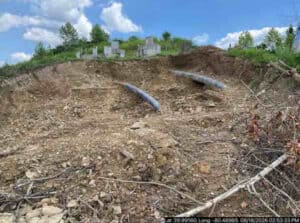

 A press release from BKV Corporation (NYSE: BKV) last week announced that a Form S-3 registration statement covering 5.3 million shares held by its Thai parent’s power arm had taken effect. It sounds like news. It isn’t. But it sent us back through BKV’s second quarter numbers, and those tell a story northeastern Pennsylvania landowners ought to hear: the Marcellus assets that launched this company are now 10% of its reserves, and they’re getting essentially none of BKV’s growth money.
  A federal appeals court has handed XTO Energy (ExxonMobil’s shale subsidiary) a win in a long-running Western Pennsylvania royalty lawsuit, ruling Monday that XTO did NOT give up its right to push some landowners into private arbitration — even though it spent 55 months litigating the case before it asked. The case is Salvatora v. XTO Energy Inc., a cousin of the Kriley case MDN has also followed. Same defendant, same Pittsburgh courthouse, same plaintiffs’ firm, same complaint: landowners say XTO shaved too much off their royalty checks for “post-production costs” — the gathering, compression, and processing charges that move gas from the wellhead to a buyer.
 The highly functional and responsible Susquehanna River Basin Commission (SRBC), unlike its dysfunctional and irresponsible counterpart, the Delaware River Basin Commission (DRBC), continues to support the shale energy industry by approving water withdrawals and consumptive use requests for responsible, safe shale drilling. The SRBC published a notice in the August 22nd Pennsylvania Bulletin that the SRBC approved and/or renewed 35 general water use permits in July for individual shale gas well drilling pads in Bradford, Centre, Clearfield, Clinton, Lycoming, Susquehanna, Tioga, and Wyoming counties.
  Epsilon Energy (NASDAQ: EPSN) keeps calling its Susquehanna County, PA, acreage a “legacy” asset — and then keeps telling investors it’s sitting on up to 200 billion cubic feet of gas it hasn’t produced yet. At the EnerCom Denver energy investment conference on Tuesday, Epsilon’s VP of Finance put hard numbers on the northeast Pennsylvania position for the first time, disclosed pad-level economics that are rare to see in public, and dropped the news item that matters most to anyone with a lease inside the Auburn dedication: the company is reviewing an expansion of the Auburn Gas Gathering System to handle drilling coming in 2028 and beyond.
  Six days after WhiteHawk Minerals (NYSE: WHK) filed its first quarterly report as a public company, CEO Daniel Herz took the stage at EnerCom Denver and did something CEOs usually avoid: he put a dated natural gas price forecast on the record. He thinks $4 gas is the number that unlocks the next wave of supply, he doesn’t think the Haynesville gets where people expect, and he thinks the back half of this decade is going to be a roller coaster.