
M-U Rig Count Stays @ 39 But PA & OH Swap 1 Rig; Nat’l Count @ 546
 The Marcellus/Utica rig count gained 1 rig eight weeks ago in the Ohio Utica, bringing the regional total to 39 rigs. The combined number of 39 remained the same last week, however, there was an important change. The Pennsylvania Marcellus picked up one rig last week, while the Ohio Utica lost a rig. PA is now operating 19 rigs, OH is operating 13 rigs, and WV maintains its 7 rigs, which it has operated since May of last year. There were 25 rigs targeting the Marcellus and 14 targeting the Utica last week. The national count gained 2 rigs last week, bringing the national total to 546 active rigs. Read More “M-U Rig Count Stays @ 39 But PA & OH Swap 1 Rig; Nat’l Count @ 546”

 Last September, MDN told you that two major Kinder Morgan pipeline projects that will flow Marcellus/Utica molecules in the southeastern U.S. took a big step forward at the Federal Energy Regulatory Commission (FERC) with FERC actively working on an environmental impact statement (EIS) for both projects (see
  About six years ago, Dominion Energy announced the River Neck to Kingsburg project, a short 15-mile 16-inch natural gas transmission main line that would run in an existing right-of-way alongside another pipeline along Old River Road near Pamplico in Florence County, SC. It was supposed to be built and flowing in 2022. Dominion still hasn’t built a square inch, thanks to the lawfare launched by the anti-fossil fuelers of the Blue Ridge Environmental Defense League (see
  National Fuel Gas Company (NFG) is an integrated natural gas company with a regulated utility business, a shale drilling business (Seneca Resources), and a pipeline business (NFG Midstream, Empire Pipeline). The company issued its fiscal first quarter update yesterday, which is everyone else’s calendar fourth quarter update. The company reported that Seneca produced 109 Bcf of natural gas, an increase of 11 Bcf, or 12%, from the prior year, due to new Utica pads that came online in Tioga County.
 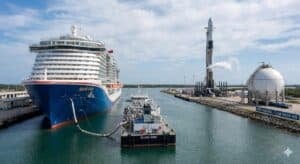 In December, representatives from Chesapeake Utilities and BHE GT&S, a subsidiary of Berkshire Hathaway Energy, presented a proposal to the Port Canaveral Authority to construct a new liquid natural gas (LNG) liquefaction facility in Brevard County, FL (see
  Reverting back to true form by obsequiously bowing to environmental extremists, New York Governor Kathy Hochul ordered her lapdogs at the state Department of Environmental Conservation (DEC) to log an objection with the Federal Energy Regulatory Commission (FERC) to a request by Williams to resurrect the Constitution Pipeline project. Even though Hochul bartered a deal with President Trump to allow this pipeline (see
  Oilfield services giant Baker Hughes (BKR), a company with its fingers in many different energy pies (not just OFS) and operations in over 120 countries worldwide, issued its fourth-quarter 2025 update last week. We scoured the update, the conference call, and the latest slide deck. The company did not explicitly mention the Marcellus or Utica shale regions. However, several items from the update directly impact the outlook for the M-U region.
  In an op-ed appearing in the Jamestown Post-Journal, New York State Senator George Borrello argues that New York’s energy crisis, marked by potential blackouts and high costs, stems from the politically motivated closure of facilities like the Dunkirk NRG plant. Initially promised a natural gas conversion, the plant was shuttered, forcing the state to import power and damaging the local economy. Borrello contends that while nuclear energy is a viable long-term goal, the state must immediately embrace natural gas to restore energy independence. He urges Governor Hochul to bypass radical interests and reopen the Dunkirk plant to provide reliable, affordable power and vital tax relief for Chautauqua County.
  Last November, Accomack County, Virginia, secured a $6.5 million state grant to expand piped natural gas to the Eastern Shore, a move aimed at stabilizing the local economy (see
 Based on the fourth quarter 2025 earnings call transcript and the accompanying press release, Kinder Morgan (KMI) reported record financial results driven largely by its natural gas business. While much of the growth came from the Gulf Coast and Southeast, several updates were specifically relevant to the Marcellus and Utica shale regions and the pipeline projects that transport Marcellus/Utica molecules. We’ve sifted through the release and earnings call to bring you the latest updates that impact the M-U region.
  Gulf South Pipeline Company, a subsidiary of Boardwalk Pipelines, announced the launch of an open season for new natural gas storage capacity at its flagship Petal Gas Storage complex in Mississippi. In addition to the Petal open season, Boardwalk also highlighted significant expansion potential across two cornerstone assets: Choctaw Storage in Louisiana and the Midland Storage Complex in Kentucky. All three storage facilities are used to store Marcellus/Utica molecules.