
Federal Judge Strikes Down NY’s $75B Climate Superfund Law
 A federal judge in Syracuse dropped a legal anvil on New York’s $75 billion climate shakedown yesterday, ruling that the state’s Climate Change Superfund Act is preempted by federal law and cannot be enforced. It’s a complete win for West Virginia AG J.B. McCuskey, the 21 other state AGs who joined him, and the industry groups that piled on. We’ve been following this one since Gov. Kathy Hochul signed the bill in the waning days of 2024 (see NY Gov. Hochul Goes Nuts: Signs Law Billing O&G Companies $75B). We laid out why the law was unconstitutional (see The Legal Case Against NY Law Taxing O&G $75B for Global Warming). In February 2025, McCuskey led 22 states into federal court to kill it (see WV Leads 22 States in Suing NY Over $75B Climate Superfund Law). Last summer, McCuskey went so far as to publish an op-ed in Hochul’s backyard telling New York exactly where to stick it (see WV AG Fires New Warning Shot at New York Climate Law via NY Post). Read More “Federal Judge Strikes Down NY’s $75B Climate Superfund Law”
 The government of New Brunswick, Canada, granted conditional approval last Friday for a 500-megawatt natural gas power plant that provincial officials say is needed to keep the lights on and prevent rolling blackouts within two years. The Canadian Press story that broke the news never asked the obvious question — the one a half-dozen readers asked in the comments section instead. Where does the gas come from? Answer: Appalachia. Or Qatar. Anywhere, really, except New Brunswick, which has outlawed fracking since 2014.
  Five Senate Democrats have escalated their fight over Cheniere Energy’s $370 million IRS “alternative fuel” tax payout, formally asking Treasury’s internal watchdog to investigate. Sen. Jeff Merkley (D-OR), joined by Senate Democratic Leader Chuck Schumer (D-NY) and Sens. Chris Van Hollen (D-MD), Edward Markey (D-MA), and Sheldon Whitehouse (D-RI), sent an Aug. 20 letter to Acting Treasury Inspector General for Tax Administration (TIGTA) Heather Hill. The letter asks TIGTA to determine how and why the IRS decided LNG tankers qualify as “motorboats” under the Alternative Fuel Excise Tax (AFET) credit—and, notably, whether the call was made to reward President Trump’s campaign donors.
 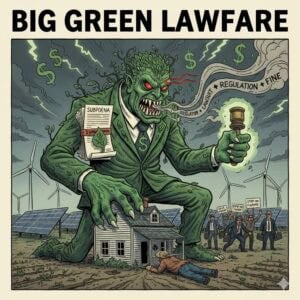 Something happened over the past ten days that ought to look awfully familiar to anyone who was around Marcellus country in 2009. A single advocacy shop dug a permit out of a state filing cabinet, handed it to a friendly reporter at the New York Times, and within a week roughly two dozen outlets were running the same three sentences about Amazon becoming “the largest single source of pollution in the United States.” It’s not a coincidence, it’s not organic, and it’s not staying in Texas. Big Green has told us, in print, that the data center fight is the anti-fracking playbook run a second time — and one of the projects already on their list belongs to Williams, in Ohio, burning Utica gas.
  Pennsylvania got off easy in the 2026-27 budget. Only one data center bill made it into law, and it was a toothless one. But the Pittsburgh Business Times reports Harrisburg is loading up for another round this fall — and this time the antis have a working blueprint to copy. It’s called New York, where Gov. Kathy Hochul banned new hyperscale data centers last month, and where the anti-fracking crowd has already spent a decade proving what happens when a state tells industry to go away.
 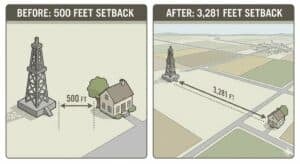 Every so often the antis tell you exactly what they’re up to, and you just have to sit back and enjoy it. On Saturday, Inside Climate News ran a story on the ongoing campaign by the Environmental Integrity Project (EIP), Clean Air Council, and their friends to jack up setbacks — the required distance between a well pad and the nearest building — from the current 500 feet to distances that would end new shale drilling in Pennsylvania. The new twist? They’ve hitched the campaign to the data center boom. More data centers means more gas, and more gas means (in their telling) more danger, so hurry up and pass the rules. It’s the same petition MDN has been tracking since 2024, dressed in a 2026 outfit.
  Back in May we brought you the news that NextEra Energy is buying and merging with Dominion Energy in a deal valued around $66.8 billion (see
  Back in May we told you about FERC’s proposal to modernize its natural gas “blanket certificate” program (see
  In March, we brought you the news that a Connecticut Superior Court judge tossed a lawsuit filed by Big Green group Save the Sound and the colluding Town of Brookfield, telling them their attempt to stop the state Department of Energy and Environmental Protection (DEEP) from ruling on the Iroquois compressor permit was premature (see
  The Federal Energy Regulatory Commission (FERC) is close to issuing an environmental assessment for the Constitution Pipeline, a 125-mile greenfield pipeline from the Marcellus gas fields of Susquehanna County, PA, to Schoharie County, NY (see
  Last week, New York Governor Kathy Hochul had the ignominious distinction of signing an Executive Order establishing the nation’s first statewide moratorium on new hyperscale data centers, temporarily pausing state environmental permit issuance for up to 1 year (see
  Last November, New Jersey (and New York) issued a federal Clean Water Act permit to build the Williams Northeast Supply Enhancement (NESE) pipeline project (see
  In June, members of the South Carolina Public Service Commission (PSC) approved a revised project proposal to build a 1,020-megawatt (MW) gas-fired power plant in the state’s Lowcountry, in Colleton County (see