
Energy Services | Industrywide Issues | Litigation | New York | North Carolina | Pipelines | Statewide NY | Transco | Williams
NC Strikes Out – US Supreme Court Won’t Overturn 3 Pipe Approvals
 In April, the D.C. Circuit Court of Appeals slapped down both New York and North Carolina regulators who tried to block three important Williams pipeline projects, all related to the mighty Transco Pipeline (see DC Circuit Court Slaps Down NY, NC Request to Block 3 Pipelines). North Carolina regulators appealed the dismissed case to the U.S. Supreme Court and on Tuesday the high court refused to hear the case, meaning NC has fully and completely struck out.
Read More “NC Strikes Out – US Supreme Court Won’t Overturn 3 Pipe Approvals”
 We’ve seen this movie before. The radical fringe leftists from the Sierra Club (disgusting organization) convinced the clown judges of the U.S. Court of Appeals for the Fourth Circuit (i.e. Circus) to block construction of Dominion Energy’s 600-mile Atlantic Coast Pipeline (ACP) pipeline by getting the court to toss U.S. Fish and Wildlife Service permits that allow the project to kill a couple of bats along a few miles of the project (see
  Here’s a cautionary tale for landowners who think they can go court-shopping on the other side of the country to settle their differences with pipelines that cross their land. Don’t do it. A Pennsylvania landowner in Schuylkill County, PA thought he could force Williams’ (Transco Pipeline) into arbitration to compensate him for allowing the Atlantic Sunrise pipeline crossing his land. Except the landowner filed for arbitration in California! Williams/Transco refused to participate in the arbitration since Cali has NOTHING to do with Pennsylvania when it comes to arbitrating compensation for eminent domain.
 Global warming fundamentalists have struck out yet again. In May, the U.S. Supreme Court refused to hear a case appealed from a lower court by a group of Lancaster County landowners who claim Williams and their Atlantic Sunrise Pipeline project abused eminent domain authority by building the pipeline before litigating (for years) how much money landowners should receive (see
  In September MDN brought you news of the U.S. Court of Appeals for the Third Circuit ruling that disallows PennEast Pipeline from using the delegated power of eminent domain to cross properties either owned by, or with easements granted to, the state of New Jersey (see
  National Fuel Gas Company (NFG), the utility and midstream giant based in Buffalo, NY, remains committed to building it’s Northern Access Pipeline project, a $500 million project that includes building 97 miles of new pipeline along a power line corridor from northwestern Pennsylvania up to Erie County, NY. The project also calls for 3 miles of new pipeline further up, in Niagara County, along with a new compressor station in the Town of Pendleton. Although New York State (under the profoundly corrupt Andrew Cuomo) continues to try and block the project, NFG says they will build it–in the 2022-23 time frame.
 Dominion Energy’s Atlantic Coast Pipeline (ACP) previously filed a request with the U.S. Supreme Court to overturn a decision by the U.S. Court of Appeals for the Fourth Circuit that judicially creates a new law stipulating pipelines can’t cross under the Appalachian Trail without (no kidding) an Act of Congress. The Supremes get 8,000 such requests each year, and accept maybe 80 (or 1%). Lightning struck. The ACP case was accepted by the Supremes on Friday. This is *seriously* good news!
 For the past several years we’ve reported on the case of Grant Township, PA, a town that passed an ordinance cooked up by the radical Community Environmental Legal Defense Fund (CELDF) to try and block a state-approved injection well. Part of the ordinance was tossed, and earlier this year a judge ordered the town to pay $102,000 in legal fees incurred by the operator the town has harmed by its action (see
  It’s hard to keep track of the multiple lawsuits filed against every single new natural gas pipeline project in the Marcellus/Utica. But we try! Take the PennEast Pipeline, for example. PennEast is a $1 billion (or $1.2 billion, depending on the source) new greenfield pipeline project from Luzerne County, PA to Mercer County, NJ. PennEast will flow PA Marcellus gas to markets in NJ. The project has faced numerous lawsuits and regulatory blockades, much of it in NJ. There are two different lawsuits of current interest, with one affecting the other.
 A group of Ohio landowners sued Chesapeake Energy in 2015 in a class action, alleging that Chesapeake had shorted them on royalty payments (see
  Two very important (perhaps we should say critically important) cases now sit before the U.S. Supreme Court–cases that have a direct bearing on the Marcellus/Utica region. Both cases deal with pipelines. The first case we’ve written about before: Dominion Energy’s Atlantic Coast Pipeline case to overturn a nutty decision by the U.S. Court of Appeals for the Fourth Circuit that judicially creates a new law that pipelines can’t cross under the Appalachian Trail without (no kidding) an Act of Congress. The other case involves the Hoopa Valley Indian Tribe in California–a case that has profound implications for the Constitution Pipeline from Pennsylvania into New York.
 Here’s a story that slipped under our radar for the past few months, but is now out in the open for all to see. In June Blue Racer Midstream, a gathering and processing system with 700 miles of pipelines in Ohio and West Virginia in the “heart” of the Marcellus/Utica, began the process to file for an initial public offering (IPO)–to become a publicly traded company. Blue Racer hopes to raise $600-$750 million with an IPO, money to expand. Midstream giant Williams, which owns roughly 29% of Blue Racer, sued in July to block the IPO.
 Chester County, PA District Attorney Thomas P. Hogan famously announced to the world last December he would investigate Sunoco Logisitcs and their Mariner East (ME) pipeline projects for “crimes” (see
 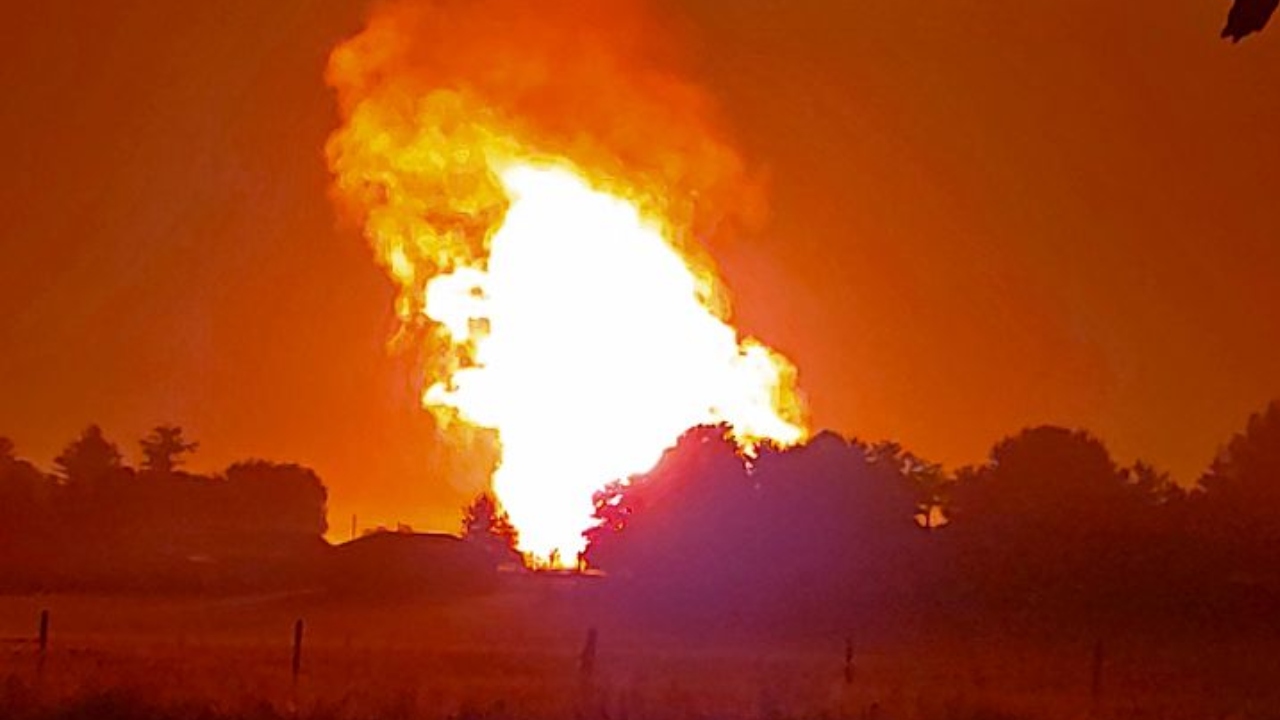 On August 1, Enbridge’s Texas Eastern Pipeline Company (TETCO) pipeline exploded in Lincoln County, Kentucky–killing one and sending six to the hospital (see