
PA DEP Proposes Revision to Erosion & Sediment Permit for O&G
 The Pennsylvania Department of Environmental Protection (DEP) published proposed revisions to its Chapter 102 Erosion and Sediment Control permit. The DEP is now accepting comments on the changes until January 20. The primary goal of the revision is “regulatory alignment.” Since the original policy was written in 2012, Pennsylvania passed the Chapter 78a (Unconventional) regulations (in 2016) and updated the ESCGP-4 permit (in 2024). The new draft updates the policy to match these legally binding rules rather than creating entirely new standards. The most significant change coming is an increase in setbacks to”support facilities” from 900 feet to 1,320 feet. Read More “PA DEP Proposes Revision to Erosion & Sediment Permit for O&G”
 We are checking in as we regularly do on the price of natural gas—both the futures price and the spot price in the Marcellus/Utica. Yesterday, the NYMEX futures price for natural gas got clobbered, falling 37.7 cents (-7.13%) to $4.9120 per million British thermal units (MMBtus). We’re still delighted that the price is so high! Don’t be bummed. But why did it fall? In a word, a new weather forecast showed U.S. temperatures warming mid-month, potentially curbing natgas heating demand. It can’t stay cold forever. (We woke up to 0 on the thermometer here in the Southern Tier of New York. We’re ready for warmer weather!) What about the spot (physical) price at various trading hubs in the M-U region? They’ve gone down a bit since last week, but we’re still thrilled where they are, too.
  The left is so amusing when it turns against one of its own. New York Governor Kathy Hochul is a card-carrying leftist. She has done her best to phase out the use of fossil fuels, including natural gas, throughout the state. She tried to force the state to abandon using natural gas and oil for heating and cooking in new construction (currently on hold in the courts). Under her direction, the Department of Environmental Conservation (DEC) rejected permits for multiple existing (and new) gas-fired power plants. She’s forcing anyone who does connect to natural gas to pay the cost of running the pipeline to the house (or business). She signed a law banning the use of CO2 for fracking. She hates oil and gas! Yet by allowing two gas pipelines and vetoing a bill last week that would have banned the use of brine on roads during winter, the left turns against her and labels her “gassy Kathy.” Hilarious!
  Did we call it, or did we call it? MDN was among (perhaps THE) first to tell readers that so-called environmental groups were quickly morphing from anti-fracking to anti-data center (
 Antero Resources, the country’s fifth-largest natural gas producer and largest producer in West Virginia, is growing its WV operations. This morning, the company announced a deal to buy privately held WV driller and midstreamer HG Energy II for a combined (upstream & midstream) $3.9 billion. The deal will add a massive 385,000 net acres to Antero’s existing ~475,000 net core Marcellus acreage position, bringing with it another 850 MMcfe/d in production. The upstream part of the deal will fetch $2.8 billion, while the midstream will get $1.1 billion. HG Energy is a West Virginia corporation with its headquarters office located in Parkersburg.
  The second round of big news coming from Antero Resources today is the sale of the company’s Utica Shale assets. We told you in November that Antero, the largest Marcellus/Utica (M-U) driller in West Virginia, officially began to market its Ohio Utica assets for sale (see
  The highly functional and responsible Susquehanna River Basin Commission (SRBC), unlike its highly dysfunctional and irresponsible counterpart, the Delaware River Basin Commission (DRBC), continues to support the shale energy industry by approving water withdrawals and consumptive use requests for responsible and safe shale drilling. The SRBC published a notice in the December 6 Pennsylvania Bulletin that the Executive Director of the SRBC approved and/or renewed 76 general water use permits from September 1 through October 31 for individual shale gas well drilling pads in Blair, Bradford, Cameron, Centre, Clearfield, Clinton, Elk, Huntingdon, Lycoming, McKean, Sullivan, Susquehanna and Tioga counties in Pennsylvania and one permit to withdraw water in Steuben County, New York.
  In January, Constellation Energy (a huge power-generating company) announced a deal to buy out and merge with Calpine (another huge power-generating company). Calpine owns 79 energy facilities across the country, generating some 27 gigawatts (GW) of electricity, with a significant number located in the eastern U.S. Many of Calpine’s facilities use natural gas to produce electricity. The two companies combined would own almost 60 GW of nuclear, natural gas, geothermal, hydro, wind, solar, cogeneration, and battery storage. The Federal Energy Regulatory Commission (FERC) signed off on the deal in July, with conditions (see
  Last week, the Baker Hughes U.S. national rig count recovered some of the previous week’s losses. The count increased by five after losing 10 rigs in the previous week. The national count went from 544 to 549. Rigs in the Marcellus/Utica remained the same last week—now for three weeks in a row. Pennsylvania has held at 18 for three consecutive weeks. Ohio was the same at 13 rigs, which it has operated since September 26. West Virginia maintained its 7 rigs, which it has operated since May 30. There were 24 rigs targeting the Marcellus and 14 targeting the Utica, for a combined 38 rigs in the M-U.
 Here we go again. The environmental left is attacking the shale industry by accusing it of shipping drill cuttings (the leftover rock and dirt that comes out of a borehole) to local landfills in the Buckeye State (Ohio), where it will irradiate everyone and everything close to it. According to the left, drill cuttings “could be contaminated with radioactivity and other chemicals.” And, according to the same people, lack of regulations in Ohio “allows it [radioactive drill cuttings] to slip by regulators, especially in Ohio,” and end up in the same landfills as “household trash.” Is there anything to the claim that drill cuttings are radioactive and a threat to those who live near landfills?
  In October 2024, the Bidenistas announced seven hydrogen hub projects (from 33 finalists) that would receive a collective $7 billion in federal funding (see
  A commentator writing for Reuters warns that soaring U.S. natural gas prices and falling global values are squeezing profit margins for American LNG exporters, threatening future exports. The narrowing price gap between U.S. and European markets, driven by high domestic demand and global oversupply, has reached its lowest point since 2021. The prognosticator postulates that while immediate production cuts are unlikely, a surge in new global capacity by 2027 could force reductions in U.S. LNG exports. Furthermore, rising domestic prices pose a political challenge for President Trump, as his promise to lower consumer energy costs conflicts with market tightening driven by increased LNG exports and energy-intensive data centers.
 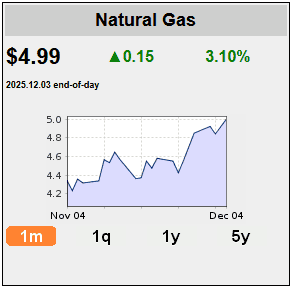 Yesterday, the NYMEX “front-month” futures price for natural gas closed up 15 cents at $4.995 (call it $5), which is the highest closing price for NYMEX in nearly three years (since Dec. 27, 2022). Intraday trading of the front-month contract floated above $5 at points. Weather forecasts of impending frigid weather were the main reason for the increase. Futures prices are now up more than 60% compared with a year ago. “Forecasts for the coldest December since 2010 may tip storage into a deficit by Christmas,” trading firm EBW Analytics wrote in a note to clients. Fewer molecules with more demand equals higher prices. As for the spot price at trading hubs in the Marcellus/Utica region, averaging all of them together, the price closed yesterday at $4.74, nearly at parity with the Henry Hub spot price of $4.87. That’s unheard of!
  Yesterday, the Pennsylvania Independent Fiscal Office (IFO) released its latest quarterly Natural Gas Production Report for July through September 2025 (full copy below). There were 116 new horizontal wells spud (drilled) in 3Q25, a huge increase of 53 wells (+84%) compared to 3Q24. Natural gas production volume was 1,934 billion cubic feet (Bcf) in 3Q25, up 93 Bcf (+5%) from 1,841 Bcf produced in 3Q24. The average Pennsylvania spot hub price was $2.18, an increase of $0.74 (+51%) from the prior year’s $1.44. All in all, it was a great third quarter for the PA Marcellus. The numbers are going in the right direction.
  Wondering how your business can profit from the Marcellus/Utica with production and drilling on the increase once again? A