
Empire Pipe Plans 2 Compressors in PA & NY to Move Marcellus Gas
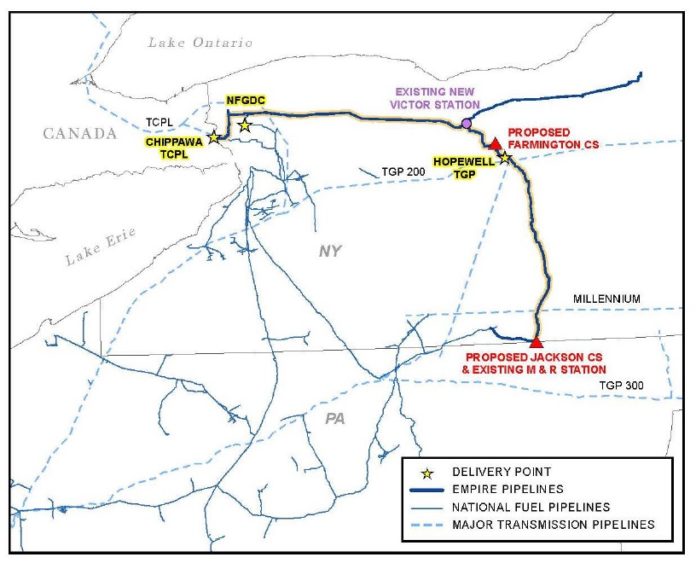
Empire Pipeline, the midstream (pipeline) subsidiary of National Fuel Gas Company (based in Buffalo, NY), earlier this month filed an application with the Federal Energy Regulatory Commission (FERC) to build two new compressor stations along the Empire Pipeline–one in Tioga County, PA, the other in Ontario County, NY. Without building any new pipeline, the addition of these two compressor stations will allow an extra 205,000 dekatherms per day (or 205 million cubic feet/day) of PA Marcellus gas to flow through the Empire Pipeline system. The project, called Empire North Project, will provide much-needed natural gas for Upstate NY and Canada. It will also connect to the Tennessee Gas Pipeline, so who knows? Maybe some Marcellus molecules will find their way into New England too. The gajillion dollar questions is, will the Andrew Cuomo-corrupted NY Dept. of Environmental Conservation try to stop this project as they have just about all other Marcellus-to-NY projects?…
Read More “Empire Pipe Plans 2 Compressors in PA & NY to Move Marcellus Gas”
 In April 2016, three Obama-appointed Federal Energy Regulatory Commission (FERC) commissioners approved the $116 million Williams Transco Garden State Expansion pipeline project (see
 There’s a number of threads to the ongoing saga of Constitution Pipeline, a $683 million, 124-mile pipeline from Susquehanna County, PA to Schoharie County, NY to move Marcellus gas into New York State and from there, into New England. The Andrew Cuomo-corrupted NY Dept. of Environmental Conservation (DEC) refused to grant the pipeline necessary federal stream crossing permits, blocking construction, in April 2016 (see
  Anti-fossil fuel nutters have been on a holy mission to stop a 3.5-mile, 8-inch pipeline from being installed under the Potomac River (see
  Last week MDN told you about two radical anti-fossil fuel activists who built tree houses in the Jefferson National Forest and are living in them (for now) in an attempt to prevent the trees and the trees around them from being cut to make way for the legally permitted Mountain Valley Pipeline (see
  We’re not quite sure what to make of this story. North Carolina has been, as we’ve long pointed out, nitpicking in an attempt to slow down (or stop) the Atlantic Coast Pipeline (ACP) from traversing the state (see
  Rover Pipeline is in hot water again. This time it’s not Captain Craig “Ahab” Butler from the Ohio EPA, but the West Virginia Dept. of Environmental Protection. In a letter just released publicly (dated March 5), WVDEP slapped Rover with a “cease-and-desist” order, stopping all construction of Rover in the state, because of inspections in February that found 14 violations of water pollution regulations. The violations occurred in Doddridge, Tyler and Wetzel counties. Violations ran the range of leaving trash behind at construction sites to improper perimeter controls (no erosion devices installed) to failure to clean up the roads they used. In addition to trouble in WV, Rover is also facing new issues in both Ohio and Pennsylvania. In February heavy rains in the region caused “slippage issues” where the pipeline is being installed. Rover filed a report with the Federal Energy Regulatory Commission (FERC) last week to say it has eight crews working to correct slippage issues at six locations along its 51-mile Burgettstown Lateral. Here’s the latest on WV shutting down Rover, and Rover’s work to fix slippage issues…
 Last week MDN reported that due to underground horizontal direction drilling (HDD) in Chester County, PA for the Mariner East 2 (ME2) Pipeline project, a third sinkhole had developed. ME2 is being built close to the existing Mariner East 1 (ME1) pipeline. The sinkhole exposed a portion of the ME1 pipeline to the open air, which is why the head of the state Public Utility Commission (PUC) temporarily shut down the propane and ethane flowing through ME1 (see
  Big Green groups opposed to Dominion Energy’s $6.5 billion (up from $5 billion due to delays) Atlantic Coast Pipeline (ACP) from West Virginia through Virginia and into North Carolina are about out of options in their holy mission to stop the project. They’ve tried multiple lawsuits, protests, bullying state environmental agencies–the whole bag of nasty tricks. And yet ACP is now under construction. What’s left to try to stop it? The Southern Environmental Law Center and Appalachian Mountain Advocates, on behalf of a mishmash of second tier radical groups, have filed a “hail Mary” request with the Fourth Circuit Court of Appeals to stop construction of ACP until a lawsuit sitting before the Fourth Circuit questioning the validity of the permits granted for the project is played out. In other words, back to the tried-and-true playbook: delay, delay, delay–until eventually you deny…
 It’s been a while since we’ve heard anything from the so-called “more than 1,000” protesters willing to get themselves arrested in Lancaster County in their holy mission to stop the Williams Atlantic Sunrise Pipeline. As of last November, the unofficial tally we could determine is that 45 people who belong to Lancaster Against Pipelines (LAP) have gotten themselves arrested for illegal actions in attempting to stop the pipeline (see
  A third sinkhole related to Mariner East 2 pipeline work and the uncovering (and subsequent shutdown) of the Mariner East 1 pipeline has some folks in Chester County, PA stirred up and rather grumpy (see
 MDN reported yesterday that due to underground horizontal direction drilling (HDD) in Chester County, PA (near Philadelphia) for the Mariner East 2 (ME2) Pipeline project, a third sinkhole had developed (see