
Atlantic Sunrise Pipe Rally: ‘Time to Kick Politicians in the Ass’
 Last Thursday some 450-500 supporters, oil and gas industry workers and politicians gathered at the Shadowbrook Golf Course in Wyoming County, PA to express support for Williams’ $3 billion, 198-mile Atlantic Sunrise Pipeline project, most of which will get built in northeast Pennsylvania. The event was organized and sponsored by Cabot Oil & Gas, one of the major beneficiaries of the pipeline, and Williams, which will build and operate the pipeline. The overall purpose of the event was to give a metaphorical kick in the rear-end of Gov. Tom Wolf and his Dept. of Environmental Protection (DEP), which appears to be intentionally dragging its feet with granting stream crossing permits–about the only thing left before the backhoes fire up and start digging. The event, held from noon to 2pm, began with lunch–barbecue pulled pork and chicken–followed by a series of short speeches by political leaders from the region. With people gathered at tables, and some standing, a half dozen speakers stood on a giant flatbed trailer underneath what has to be the biggest American flag MDN editor Jim Willis has ever seen, hoisted and held between two large cranes (see the pic). The upshot of the speeches can best be summarized in a single statement delivered by Alan Hall, Chairman of the neighboring Susquehanna County Board of Commissioners, when he said: “It’s time to kick the politicians in the ass and get this [pipeline] done.” There were some other great one-liners too…
Read More “Atlantic Sunrise Pipe Rally: ‘Time to Kick Politicians in the Ass’”
 Apparently under pressure from environmentalist wackos, last Friday the Pennsylvania Dept. of Environmental Protection (DEP) issued a statement that says, in essence, we’re on the back of Sunoco Logistics over problems with construction the Mariner East 2 Pipeline. Gov. Wolf and DEP Secretary McDonnell both felt it necessary to voice their “concerns” over some of the episodes that have happened with construction the twin Mariner East 2 NGL pipelines that will stretch from eastern OH to the Philadelphia area. According to the announcement, the DEP has so far issued 4 “Notices of Violation” and 1 “Consent Order and Agreement” with a fine of $87,600 for “inadvertent returns” (what we call leaks) of drilling mud and water at an underground horizontal directional drilling (HDD) location in Cumberland County, PA. To the best of our knowledge, this is the first we’ve heard of that spill. It was actually a series of spills (or leaks) over a number of different days. All told, some 160,000 gallons of drilling fluids came out of the ground at that location. In addition, the DEP released a table outlining 49 incidents–some just a few gallons, others several hundred (or several thousand) gallons of drilling fluid leaks. We have the list of 49 problem areas below, the details on the Cumberland County leaks, and the DEP announcement…
 In May MDN brought you the news that the Ohio Environmental Protection Agency (OEPA) was going after Rover Pipeline for failing to properly plan storm water management which resulted in heavy storm water runoff into farmers’ fields where Rover is digging trenches (see
  The CORNballs of Ohio continue to try and shut down the $2 billion, 255-mile NEXUS interstate natural gas pipeline that will run from Ohio through Michigan and eventually to the Dawn Hub in Ontario, Canada. CORN stands for Coalition to Reroute NEXUS. CORNballs is what we affectionately call the group–as a way of pointing out their nutty true purpose–to try and shut the NEXUS project down. Period. Their aim has nothing to do with “rerouting” and everything to do with shutting it down. In May 2017, the CORNballs revealed their true colors when they filed a lawsuit in federal court in Akron, OH (see
  The “most serious remaining legal challenge” to Sunoco Logistics’ Mariner East 2 Pipeline project is a challenge by the odious Big Green group, the Clean Air Council, based in Philadelphia. CAC claims in a court case in Common Pleas Court in Philly that ME2 violates the federal and state constitutions. The case takes up constitutional claims that have “not yet been addressed in other litigation.” It dawned on us when reading an account of the case and who says what about whether or not Sunoco has the right to use eminent domain and whether or not ME2 is a public utility, is why does the CAC even care? Why are they the ones bringing the lawsuit? After all, pipelines don’t pollute the air! Well, technically that’s not 100% true–pipeline compressor stations do emit some air pollution, depending on how they are powered (diesel engines). But at the end of the day, pipelines pollute the air far less than other forms of transportation, like trucks and trains. How does CAC even have “standing” to bring such a lawsuit? Of course the fact that CAC is litigating is a tip-off that there is Big Green money behind the effort–and CAC is just a tool being used in a wider collusion (conspiracy?) to stop the pipeline…
 Anti fossil fuelers believe they have a new angle in their years-long war to prevent Sunoco Logistics Partners from building the Mariner East 2 twin pipelines across the state: drilling mud spills. When a pipeline company installs a new pipeline, the vast majority of pipe is laid in trenches. However, there are places (creeks, rivers, wetlands, roadways) where you can’t just dig a trench to lay the pipe. In those cases, you drill underground horizontally, something called horizontal directional drilling (HDD). When you drill through rock, you need drilling mud to cool the drill bit as it chews away. Drilling mud is typically bentonite, a non-toxic clay substance used to manufacture things like toothpaste, cosmetics and kitty litter. The only threat from bentonite is that it can smother aquatic life if enough is spilled. Or it can foul a water aquifer–making the water in your well cloudy for a period of time, until it settles. Such an instance recently happened in Chester County, when Sunoco’s drilling for ME2 fouled an aquifer, causing well water for some 15 homes to become temporarily unusable (see
  We spotted an outrageously fake news story published in something called the Public News Service that quotes an organic farmer in northern Ohio who is opposed to the NEXUS Pipeline–a pipeline that won’t even cross her property. NEXUS is a $2 billion, 255-mile interstate pipeline that will run from Ohio through Michigan and eventually to the Dawn Hub in Ontario, Canada. It is a critically needed pipeline to move Utica and Marcellus Shale gas from an over-saturated market in the northeast to markets in the Midwest and Canada. It is a joint venture between DTE Energy and Spectra Energy. The Ohio organic farmer claims a NEXUS compressor station a mile from her property “will create a toxic cloud” and ruin her crops. She also claims “toxins” leak from pipelines, and that compressor stations “contain dangerous cancer-causing chemicals.” Yes, any time you want to oppose something, throw out the “c” word, to make sure they get good and scared. Other problems caused by pipelines: livestock illness and death; spontaneous explosions; fires; mini-earthquakes. To which we say, what a load of organic bullcrap…
 Here at MDN we’ve always found the issue of using eminent domain for pipeline projects to be thorny. We see both sides of the issue, although we tend to favor the sacredness of one’s property. We tackled the issue back in May (see
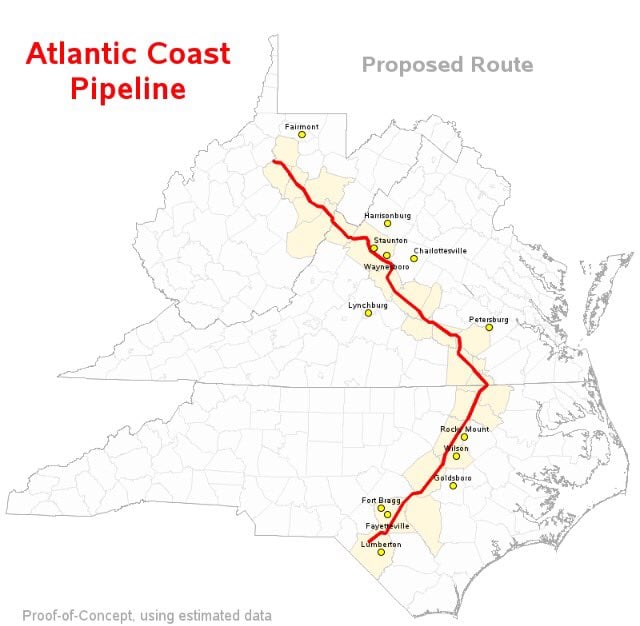
  A very small group of anti-fossil fuelers recently gathered in Samson County, NC to spread lies about the Dominion’s Atlantic Coast Pipeline (ACP) project. ACP is a $5 billion, 594-mile natural gas pipeline that will stretch from West Virginia through Virginia and into North Carolina, bringing Marcellus and Utica Shale gas to the south. The meeting, which local media said had “more than 20” people in attendance, seemed to be mostly representatives from outside Big Green groups pedaling the same tired old lies about pipelines in general, and ACP in particular. Try as they might to spin the meeting as some sort of “movement” among the little guy, the picture accompanying the Dunn (NC) Daily Record can’t cover up the fact there were perhaps a dozen people in the audience–and it looked pathetic…
 A group of Catholic nuns who prefer to worship Mother Nature rather than Jesus Christ (the Person they pledged to serve) is suing the Federal Energy Regulatory Commission (FERC) for approving the $3 billion, 198-mile Atlantic Sunrise Pipeline project–because it will run through their cornfield. Perhaps the sisters consider themselves Sisters of the Corn? We previously told you about this small group of nuns–who use the same natural gas that will flow through Atlantic Sunrise Pipeline to heat their own property (see
  An article published in the anti-drilling Pittsburgh Post-Gazette is quite bizarre–even by Post-Gazette standards. The article reports concerns expressed by residents in Beaver County, PA at a recent meeting of the Ambridge Water Authority. The opener quotes one resident this way: “‘No one knows what’s going to happen when the explosions are set off,’ said Bob Schmetzer, 70, of South Heights, referring to the underground blasting required in the fracking process. ‘God forbid that the dam would breach and take out human lives down Raccoon Valley … that would be a national catastrophe.'” Uh, Mr. Schmetzer sir…and “reporter” Eliza Fawcett…there IS NO FRACKING involved with installing a pipeline. Perhaps they’re both a bit confused? Mr. Schmetzer’s confusion likely comes from working with a local anti-fracking group, the Beaver County Marcellus Shale Awareness Committee. The meeting appeared to have gone downhill from there, with wild claims that “volatile compounds” from the Shell cracker plant will “settle” in the Ambridge Reservoir, endangering everyone who drinks water from it. And that the area will become “Cancer Valley”…
 In March of this year, Williams filed a full, official application for the Northeast Supply Enhancement project (see
  [begin political rant] Massachusetts Gov. Charlie Baker is a RINO–Republican in Name Only–and not all that different from another RINO who was once governor of the Bay State: Mitt Romney. We personally find RINOs disgusting. Why don’t they just switch parties and be done with it? Join the Democrats, or if the lib Dems are too far to the left, join the Establishment Party, which is really what they all belong to anyway, regardless of the D or R after their name. [end political rant] Gov. Baker has (surprise!) caved to pressure from radical, insane environmentalists in his state who want to stop a compressor station from getting built in Weymouth, MA. The compressor is part of Spectra Energy’s (now Enbridge) federally-approved Atlantic Bridge project (see
  As recently as July 7th, Energy Transfer Partners, builders of the mighty 711-mile Rover Pipeline project that will run from PA, WV and eastern OH through OH into Michigan and eventually into Canada, said that a portion of Phase 1–from Cadiz, OH to Defiance, OH–will be completed and go online this month, in July (see