
Lack of FERC Confirmations Now Critical – $25B & 75K Jobs at Risk
 The lack of a quorum (enough voting members) for the Federal Energy Regulatory Commission (FERC) is has gone beyond amusing and angering–it’s now critical. Early in the new Trump presidency we noted the curious behavior of liberal Democrats, who are also virulent anti-drillers, in their hammering of Trump over lack of nominating people to FERC (see Anti-Drilling Democrats Ask Pres. Trump to Fill Up FERC and Senate Democrats Send Letter to Trump Requesting New FERC Members). We said at the time it doesn’t make sense. If FERC is out of action and can’t approve new pipeline projects, that’s a good thing, for lib Dems who hate fossil fuels. So why would they want FERC back up and running? We finally figured it out. They simply wanted nominees so they could grandstand and try to stop the nominees they demanded in the first place from actually getting confirmed (see Now We Know: Lib Dems Wanted FERC Nominees for Grandstanding). After the nominees came through and were approved by the appropriate Senate Committee, Senate Democrat Minority Leader Chuck “the schmuck” Schumer pledged to hold up a final Senate vote. And since that time, he has. Energy company CEOs are now warning if FERC commissioners are not confirmed by the August break, it will jeopardize up to $25 billion in investments, and 75,000 jobs. The money is going to disappear, and along with it, many vitally important pipeline projects waiting for approval. It’s time to tell the Dems to allow the vote to proceed, or find a way around their sleazy blockade…
Read More “Lack of FERC Confirmations Now Critical – $25B & 75K Jobs at Risk”
 Sounding eerily like a Borg drone from Star Trek (“YOU WILL COMPLY, RESISTANCE IS FUTILE”), the Ohio EPA (OEPA) has asked Ohio’s Attorney General, Mike DeWine, to force Rover to pay the Ohio EPA $914,000 in so-called fines it has unilaterally levied (with no apparent authority to do so) to punish Rover for a series of accidents while constructing the pipeline. Rover has not agreed to the fines and is challenging the OEPA’s authority to levy them. So the OEPA is asking DeWine to use the full weight and force of his office to force Rover to comply. Rover has had the pedal to the metal since receiving a go-ahead from the Federal Energy Regulatory Commission (FERC) in March to begin construction to build a 711-mile natural gas pipeline from PA, WV and eastern OH through OH into Michigan and eventually into Canada (see
  Last November MDN brought you the delicious news that Pennsylvania would shift $24 million away from a boondoggle program called the PA Alternative Energy Investment Act and into a new program called the Pipeline Investment Program, or PIPE (see
 A young, brainwashed 17-year old woman was one of the headline speakers at a recent anti-Rover Pipeline rally in Michigan–apparently because she’s an Indian (i.e. Native American). However, her heritage really has nothing to do with her opposition to the Rover Pipeline. Her opposition is rooted in what we would call a break with reality–a psychosis. At a rally held in Dexter Township, MI near where Rover is scheduled to be built, the teenager said this to the “about 100” assembled: “‘We’re fighting extraction industries all across the country. It’s not just here. It’s not just Standing Rock,’ said…an Ypsilanti resident, urging other protesters to divest from fossil fuel companies and take their money out of big banks and put it in local banks and credit unions so they’re not supporting the extraction industry.” We hate to burst the young protester’s bubble, but “extraction industries” are the reason she even exists. “Extraction industries” not only provide energy (oil, gas coal), but “extraction industries” mine the metals that make up the innards of her expensive cell phone. “Extraction industries” provide the raw materials to produce plastics, which is in just about everything everyone touches these days–including the clothes on her back and the sneakers on her feet. To call for divestment, and to oppose “extraction industries” is a call to crawl back into a cave and die a very young death. It is, in a word, insane…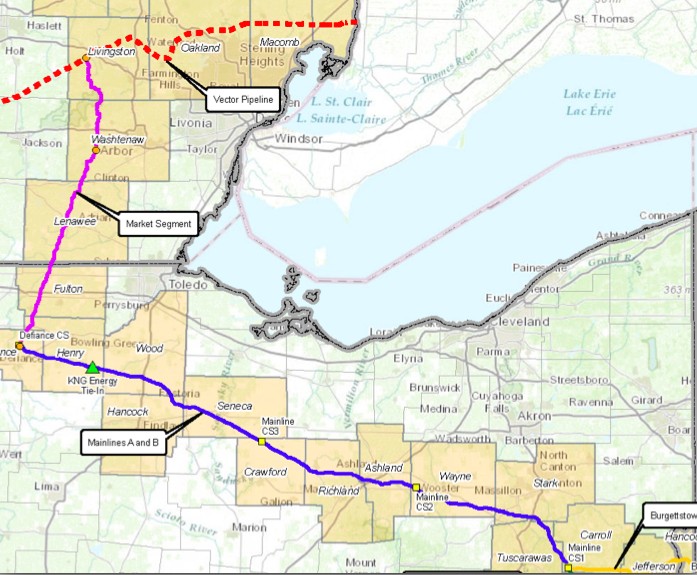

 Here’s not something you read every day, especially in Lebanon County, PA where local media seems only too interested in covering negative stories about pipelines: “What I have heard has all been positive – that the workers were willing to go beyond anything that might be expected of them and do little special things for the landowners.” That statement is from a town official in Lebanon County, talking about Mariner East 2 pipeline construction workers who are busy in the Lebanon County installing the first of two ME2 pipelines. Of course, not everyone is happy. But then, not everyone is always happy with anything–even a sunshiny day! Here’s what’s happening in Lebanon County with ME2…
 While the construction of the Mariner East 2 natural gas liquids (NGL) pipelines in Lebanon and Lancaster Counties appears to be sailing along with very few issues (see today’s companion story), the project did hit a small bump in the road in nearby Chester County, PA. A dozen families reported their water wells became cloudy–or lost pressure–after underground horizontal directional drilling (HDD) by Sunoco Logistics Partners in attempting to install pipes underground in places where digging trenches will not work. The company put up five families in local hotels for several nights. Sunoco also provided bottled water for all of the affected families. The working theory is that bentonite clay (i.e. drilling mud) is the source of the cloudiness. Fortunately, bentonite is non-toxic and used to manufacture many products, including toothpaste and kitty litter. The incident, while troubling and inconvenient for the families involved, has not set back the project–at all. Drilling and construction of the pipeline resumed on Saturday…
 In April MDN told you that the Virginia Dept. of Environmental Quality (DEQ) had succumbed to political pressure from the MANY lib Dems in the state that oppose benign pipeline projects, like the Atlantic Coast Pipeline (ACP) and Mountain Valley Pipeline (MVP), and changed their minds about the process they will use in issuing water quality certifications under Section 401 of the federal Clean Water Act (see
  Here’s a story of some Catholic nuns who have forsaken their vow to serve Christ, and instead have taken up a vow to serve radical environmentalism–which is apparently their new religion. A group of nuns in Lancaster County, PA invited the radical group Lancaster Against Pipelines (whose organizer participated in the illegal blockage of the Dakota Access Pipeline) to build a “prayer chapel” in the middle of a cornfield that belongs to the Adorers of the Blood of Christ (as they are called). The chapel is meant to stand in the way of Williams’ Atlantic Sunrise Pipeline, slated to go through that field. The so-called prayer chapel is little more than a few portable benches and a pop-up shelter like the one you would use when camping–just about big enough to cover a gas grill and leave enough room for two or three people to stand under it. The “prayer chapel” is obviously a statement thing. Knowing it will get torn down at some point, the sisters and their radical friends didn’t want to waste a lot of money on the project. Essentially this is a setup for a photo op when the bulldozers come through. It’s truly a shame to see how those who have dedicated themselves to the work of Jesus Christ have been co-opted and distracted from their far higher, and much better, calling. Unfortunately, the nuns are rank hypocrites. They themselves use–and promote the use of–natural gas for their own ministry on the very same parcel of property…
 Phase I of the 711-mile Rover Pipeline project that will run from PA, WV and eastern OH through OH into Michigan and eventually into Canada is supposed to be completed by July 2017, while Phase II is supposed to be done by November 2017. Will Phase I be done by the end of this month? We sure wouldn’t want to take that bet, but we suppose there’s still a slim chance. While building the $3.7 billion pipeline project, Energy Transfer (or more correctly its contractors) hit some snags, including spilling 2 million gallons of non-toxic drilling mud near the Tuscarawas River (see
  Totally biased, Big Green-backed mouthpiece StateImpact Pennsylvania, funded in part by taxpayers via PBS (a travesty), as well as funded in part by anti-drilling organizations like the Heinz Endowments and the William Penn Foundation (which appear to control StateImpact’s “reporting”), is targeting a PR agency because the agency has the audacity to do good work for Sunoco Logistics and the Mariner East 2 Pipeline project. You see, in liberal anti-drilling land, it’s OK for antis to smear and lie and fabricate all sorts of falsehoods about pipeline projects–but it’s not OK for the object of those smears (i.e. Sunoco LP) to fight back and to present its side of the issue. As soon as you fight back and tell your side of the story, you’re “targeting” innocent people, you’re attempting to bully the little guy. You’re mean. You’re pedaling fossil fuel death. That’s how it works in Big Green land. A recent article on StateImpact PA attempts a smear job on PR agency Bravo Group because Bravo has the gonads to say this on their website: “We’re helping Sunoco Logistics build public and policyholder support for its Mariner East projects, an infrastructure investment of more than $3 billion. The goal: secure regulatory approvals, neutralize opposition and develop the Mariner East projects on budget and without capital losses.” The “neutralize opposition” phrase in particular set off the anti-pipeline crazies, so StateImpact created an entire story focused on that phrase. You know you’re being effective when they attack you with a smear campaign…
 Here on MDN we talk a lot about big interstate natural gas pipelines–like Rover and NEXUS, Atlantic Sunrise and Atlantic Coast. But we don’t talk so much about the tiny (in diameter) gas pipelines that connect to people’s homes. In oil and gas industry parlance, those pipelines belong to the “downstream”–or the end users of natural gas. From time to time we’ve covered stories about NiSource and other utilities spending big money to replace aging local distribution pipelines (see