
Elizabeth Twp Unanimously OKs EQT Wells Near HS; Data Center Next?
 It took three years, two conditional use applications, one appellate court loss, a subdivision, a three-hour hearing, and a deadline extension — but EQT finally got its vote. On Monday night (Sept. 14), Elizabeth Township’s (Allegheny County, PA) Board of Commissioners voted unanimously to approve two conditional use permits for EQT’s six-well Heracles project: one for the well pad, and one for the interconnect pad (the spot where gas from the wells hands off to a pipeline). The pad sits less than a half-mile from Elizabeth Forward High School, so the approvals come with a long list of strings attached, including a 10-year “emergency preparedness fund” EQT must pay into. Big Green group Protect Elizabeth Township (PET) says it will keep fighting in court. In a surprise twist, the commission president revealed that someone has approached the township about building a data center. Read More “Elizabeth Twp Unanimously OKs EQT Wells Near HS; Data Center Next?”
 Yesterday the U.S. Environmental Protection Agency (EPA) finalized a rule that rips out the heart of the Biden administration’s 2024 power plant carbon regulations. Gone is the requirement that new “base load” natural gas-fired power plants and long-lived coal plants capture 90% of their carbon dioxide (CO2) by 2032. EPA says the repeal will save $310 billion. At the same time, EPA proposed scrapping every remaining greenhouse gas standard for power plants, which it says would save another $370 million. For the Marcellus/Utica, where a parade of big gas-fired power plants is lining up to feed AI data centers, this is very good news.
  Remember Synapse Energy Economics? That’s the Massachusetts consulting outfit that, back in 2023, was paid by two Big Green groups to produce a “report” claiming Pennsylvania’s RGGI carbon tax would lower your electric bill (see
  Pittsburgh-based Alcoa says it’s “very close” to selling its shuttered Massena East aluminum smelter in New York’s North Country to a data center developer. Here’s the part that other reporting left out: the buyer has been sitting on that site since 2017, wants to build a 635-megawatt (MW) computing campus there — and Gov. Kathy Hochul froze the whole thing two months ago with her data center moratorium (see
  Eastern Gas Transmission and Storage (EGTS), a wholly owned subsidiary of Berkshire Hathaway Energy (Warren Buffett’s company), got the last piece of paper it needed yesterday for an important new pipeline project. FERC’s Office of Energy Projects issued a notice to proceed (NTP) on Sept. 10, authorizing EGTS to start building the Appalachian Reliability Project (ARP) — the 550,000 dekatherms/day expansion that will push more Marcellus and Utica gas from western Pennsylvania into Ohio. Even better, the approval comes in roughly six months ahead of the company’s own published timeline.
  Last week we told you Dominion Energy cleared its first hurdle for the monster 3,000-megawatt (3 gigawatt) Cumberland Energy Center in Cumberland County, Virginia (see
  Virginia Democrats have spent the summer hammering the proposed $67 billion NextEra-Dominion merger — letters to regulators, a 64-question interrogation, a statewide listening tour, a demand for a special session. Last week the pile-on reached the very top when House Speaker Don Scott (D-Portsmouth) filed his own letter with the State Corporation Commission (SCC). Here’s the twist: the same Democrat leaders doing the loudest complaining just refused to do the one thing that would actually slow this deal down.
  Big Green scored a win yesterday — but not the win they’re telling you they got. On Tuesday, September 8, a three-judge panel of the U.S. Court of Appeals for the Third Circuit vacated the Clean Water Act Section 401 water quality certification (WQC) that the New Jersey Department of Environmental Protection (NJDEP) issued last November for Williams/Transco’s Northeast Supply Enhancement (NESE) project — the $1 billion, 400,000 Dth/d expansion that carries Marcellus gas from Pennsylvania, across New Jersey, under Raritan Bay, and into New York City (see
  West Virginia has sued the Pennsylvania Public Utility Commission in federal court, arguing that two Pennsylvania laws — Act 40 of 2017 and Act 114 of 2020 — built a wall around the state’s “alternative energy credit” market and locked out every power producer outside Pennsylvania’s borders. West Virginia Attorney General JB McCuskey filed the 54-page complaint on September 3 in the U.S. District Court for the Middle District of Pennsylvania, and here’s the kicker: the PUC’s own annual report, published seven months earlier, told the legislature that these very rules needed a second look.
  Devon Energy’s Coterra unit is asking Pennsylvania regulators for permission to lay 18.4 miles of 20-inch freshwater pipeline across three Susquehanna County townships — which is a strange thing to spend money on if you’re about to sell the place. The Department of Environmental Protection (DEP) published the notice in the September 5 Pennsylvania Bulletin, opening a comment window that closes October 5. The project is the Brooks to Forwood Temporary Waterline, running through Springville, Lathrop, and Lenox townships.
  Shell Chemical Appalachia signed a consent order and agreement (COA) with the Pennsylvania Dept. of Environmental Protection (DEP) last Friday, Sept. 4, agreeing to hand over $15 million to settle three years’ worth of air, storage tank, and water violations at its Monaca (Beaver County) ethane cracker. Half of it — $7.5 million — is an actual civil penalty. The other half is a “contribution” to a brand-new community fund. If that arrangement sounds familiar, it should. It’s the same two-bucket structure the Shapiro administration used to squeeze nearly $10 million out of Shell back in May 2023.
 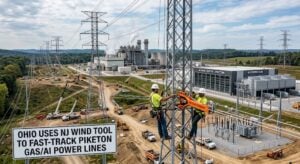 Ohio has asked PJM to dust off a rarely used piece of grid-planning machinery — a tool invented to string wires to offshore wind farms — and use it instead to speed up $4.2 billion in new high-voltage power lines to the 10-gigawatt SoftBank data center and gas plant complex at Piketon. We got our hands on the letter. It’s dated June 15, 2026, from PUCO Federal Energy Advocate Sarah J. Parrot to PJM President and CEO David E. Mills, and it’s been sitting quietly for nearly three months. It surfaced this week because PJM is briefing its Transmission Expansion Advisory Committee (TEAC) on the request today, Sept. 8, to use the “state agreement approach.”
  Pennsylvania’s utility regulators just told the General Assembly what Marcellus drillers have been saying for two years: the electricity business is about to get very busy, and natural gas is going to be the one doing the heavy lifting. On Tuesday, September 1, the Pennsylvania Public Utility Commission (PUC) released its annual Electric Power Outlook for Pennsylvania, this one covering 2025 through 2030. The report is required by state law — the PUC has to collect demand forecasts from the state’s 11 electric distribution companies (EDCs, the utilities that run the poles and wires to your house) and hand a summary to the Legislature and the Governor every September. Usually it’s a snoozer. Not this year.
 We finally have a number. Two weeks after a casing failure sent frack water gushing across the Infinity Natural Resources (NYSE: INR) Cooper well pad in Young Township, Indiana County, PA, the Department of Environmental Protection (DEP) has put an estimate on it: 336,000 gallons of frack flowback water released during the incident. An “undetermined amount” of that reached Whiskey Run, the small stream below the pad. Here’s what that number actually means — and what it still doesn’t tell us.