Accidents | Energy Companies | Indiana County | Industrywide Issues | INR/Infinity Natural Resources | Pennsylvania | Regulation | Wastewater
Split Casing at INR Pad Spills Frack Water into Indiana Co. Stream
 A frack job gone sideways in Indiana County, PA, kept 14 volunteer fire companies on scene for more than 12 hours last month — and, according to a Pennsylvania Department of Environmental Protection (DEP) inspection report, sent an unknown quantity of frack flowback water off the pad and into a nearby stream. We don’t sugarcoat things at MDN, so let’s walk through what actually happened, what DEP says it found, and — just as important — what nobody has established yet. Read More “Split Casing at INR Pad Spills Frack Water into Indiana Co. Stream”
 Back in May we told you Dominion Energy had brass you know what announcing a monster 3,000-megawatt (3 gigawatt) gas-fired power plant in Cumberland County, Virginia, while its much smaller Chesterfield peaker project was still stuck in the mud after three years of green lawfare (see
  In April, we told you the Federal Energy Regulatory Commission (FERC) was taking a fresh look at the revived Constitution Pipeline and the associated Wright Interconnect project, and that the agency had to decide whether a relatively quick Environmental Assessment (EA) would do the job — or whether it would drag the projects through a full-blown, years-long Environmental Impact Statement (EIS). We got our answer on August 21. FERC staff issued the EA for both projects — 79 pages plus appendices — and the bottom line is the one supporters have been waiting on: building Constitution “would not constitute a major federal action significantly affecting the quality of the human environment.” In plain English — no significant impact. No years-long supplemental EIS is needed.
  Iroquois Gas Transmission System’s Enhancement by Compression (ExC) project has cleared FERC. It has cleared New York. The one thing standing between it and a shovel is a state air permit for two gas-fired compressor units in Brookfield, Connecticut. The Hartford Courant checked in on that fight yesterday — and buried the two most important facts halfway down the story. Quick refresher for anyone joining late: ExC is a $272 million upgrade that adds horsepower at three existing compressor stations — Dover and Athens in New York, Brookfield in Connecticut. No new pipe. Just more compression, squeezing an additional 125 MMcf/d (125 million cubic feet per day) through the existing 414-mile line into New York City and New England. That’s roughly a 10% throughput gain on a line that already exists, feeding two of the most gas-starved, highest-priced energy markets in the country. (The Courant puts the project at $275 million; we’ve used the $272 million figure Iroquois has cited. Small gap, worth pinning down.)
  When we covered DTE Energy’s second quarter results in July, we grumbled that the company was throwing $10 billion at unreliable renewables and only $2.5 billion at a single new gas plant to replace a retiring coal fleet (see
  Back in June, we praised South Strabane Township in Washington County, PA, for doing the hard, unglamorous work of writing data center rules instead of slamming the door shut (see
  South Carolina’s utility regulators voted unanimously yesterday to let a $2.8 billion artificial intelligence data center in Spartanburg County build and run its own 457-megawatt natural gas power plant without asking the state’s permission first. The decision is a big win for the “behind-the-meter” model — where a data center brings its own generation instead of leaning on the grid — and it’s a model that is going to burn a lot of molecules. Possibly some of ours.
  Sixty-two days after a wastewater pipeline let go at Equitrans’ Richter impoundment in Aleppo Township, Greene County, the Pennsylvania Dept. of Environmental Protection (DEP) went back out to look at the site on August 18 — and didn’t like what it found. Contaminated water is still moving, soil is still dirty, and DEP says the cleanup has largely stalled. Quick refresher for those just tuning in. On June 17, 2026, Equitrans Water SVC (PA) LLC — the water-handling arm of EQT — reported a wastewater release from a pipeline tied to its Richter Shale Gas Water Impoundment while the site was being reclaimed. DEP issued a cleanup order on June 30 requiring the company to stop contaminated water from migrating off site and from reaching ground or surface water.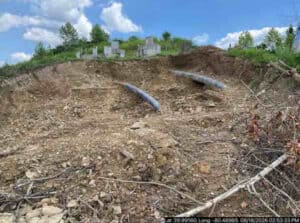
 The PJM market monitor asked federal regulators to kill Hull Street Energy’s purchase of two gas-fired peaking plants unless Hull Street promised not to point them at data centers. On August 13, FERC said no — and said the monitor hadn’t supported its argument. Thirteen days later, the deal closed. Hull Street Energy (HSE), a private equity firm in the Washington, D.C. area, announced yesterday that it completed the acquisition of the Lee County Generating Station in Dixon, Illinois, and the Tait Electric Generating Station near Dayton, Ohio, from Rockland Capital. HSE calls the pair the “GridFlex Portfolio” and has folded it into Milepost Power, its thermal generation platform.
  Eureka Resources sold the business at all three of its shuttered Pennsylvania frack wastewater plants. What it did not sell — and legally could not sell — is the obligation to finish hauling the waste out. The Department of Environmental Protection (DEP) put that in writing last week, and added five words that ought to get somebody’s attention in Williamsport: DEP “is considering alternative enforcement measures.” The news comes, again, not from Eureka and not from a DEP press release, but from the Middle Susquehanna Riverkeeper Association, which keeps sending the agency questions and publishing the answers. DEP Northcentral communications manager Megan Lehman replied by email Aug. 20; the Riverkeeper posted the exchange Aug. 24.
 The highly functional and responsible Susquehanna River Basin Commission (SRBC), unlike its dysfunctional and irresponsible counterpart, the Delaware River Basin Commission (DRBC), continues to support the shale energy industry by approving water withdrawals and consumptive use requests for responsible, safe shale drilling. The SRBC published a notice in the August 22nd Pennsylvania Bulletin that the SRBC approved and/or renewed 35 general water use permits in July for individual shale gas well drilling pads in Bradford, Centre, Clearfield, Clinton, Lycoming, Susquehanna, Tioga, and Wyoming counties.
  PJM Interconnection — the grid operator that keeps the lights on for 67 million people across 13 states and DC, including most of the Marcellus/Utica region — dropped its new five-year strategy last Wednesday (Aug. 19). Most of the coverage focused on the four bullet-point priorities, which read like every corporate strategy document ever written. But if you skip to page 5, PJM says two things out loud that our industry has been shouting for a decade: pipeline constraints are choking the grid, and the grid is getting less reliable as it gets more intermittent.
  Score one for the good guys. The Ohio Power Siting Board (OPSB) voted yesterday (Aug. 20) to hand Chestnut Run Energy LLC its Certificate of Environmental Compatibility and Public Need — the golden ticket needed to build a 1,300-megawatt (MW), $2 billion natural gas-fired power plant in Washington Township, Carroll County. That’s smack in the middle of Utica Shale country. MDN first told you about this project back in April (see