
FERC Grants Portland XPress Project Environmental Approval
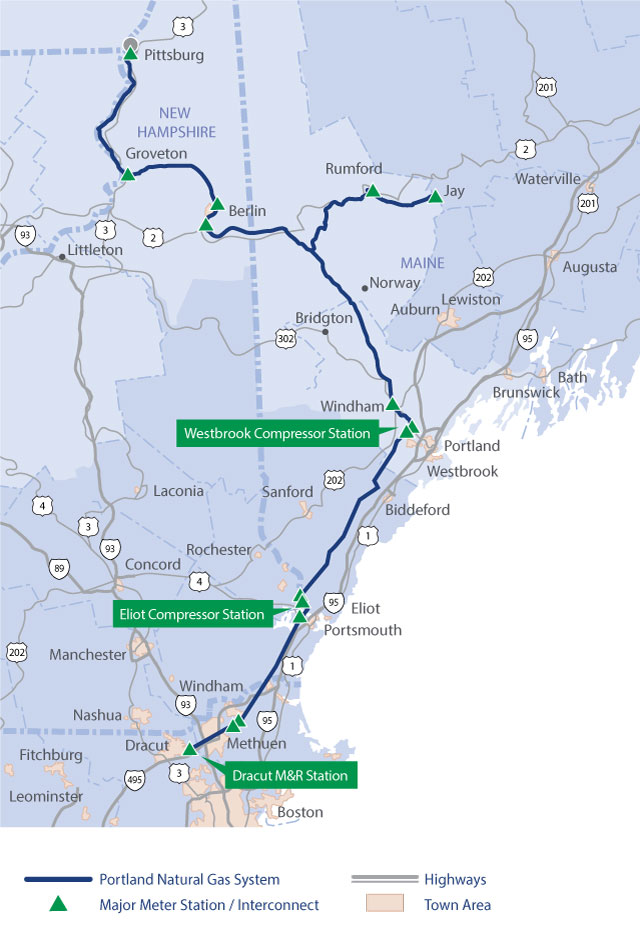
TransCanada is attempting to do what so far, no one else has been able to accomplish: Increase flows of Marcellus/Utica gas into New England. The way they’re doing it is via the Portland Natural Gas Transmission System (PNGTS), a 295-mile pipeline that spans New England from the Canadian border to pipeline connections in New Hampshire, Maine and Massachusetts. No, TransCanada is not proposing to build any new pipelines as part of their plan. In fact, there is very little construction in what TransCanada is calling its Portland XPress Project (PXP). Phase I is now under construction and Phase II will soon be under construction. TransCanada filed for Phase III in June. Earlier this week FERC issued a favorable environmental assessment (EA) for Phase III of the project, which is prelude to issuing a final approval.
Read More “FERC Grants Portland XPress Project Environmental Approval”
 In early October MDN reported that the U.S. Court of Appeals for the Fourth Circuit had “vacated” (canceled, overturned) a permit issued by the U.S. Army Corps of Engineers in West Virginia that would allow Mountain Valley Pipeline (MVP) to use a more environmentally friendly form of crossing four rivers in the state than is technically allowed under federal Clean Water Act regulations (see
  In August, the Pennsylvania Commonwealth Court handed PA drillers a partial victory in their quest to block onerous new drilling regulations, part of something called Chapter 78a (see
 MDN previously told you about a natural gas-fired electric plant planned for the socialist paradise of Rhode Island, home to old money and people who oppose change of any kind (see
 In a pattern that has repeated itself with both the Mountain Valley Pipeline and (now) the Atlantic Coast Pipeline (ACP), a key permit that allows ACP to build under and through streams and rivers and wetlands has been, for now, revoked. The permit is called a Nationwide Permit (NWP) 12 and was previously issued by the U.S. Army Corps of Engineers to allow ACP to build through streams, etc. in all three states where it runs–West Virginia, Virginia and North Carolina. Earlier this month the U.S. Fourth Circuit Court of Appeals put a temporary stop on constructing the pipeline across/under/through streams and rivers in WV (see
  Seven antis from Greater Philadelphia, with money and lawyers from Big Green groups backing them, on Monday asked the Pennsylvania Public Utility Commission to shut down Mariner East 1 pipeline (which has operating for more than a year), and to block the startup of Mariner East 2 pipeline. The chutzpah of these people is breathtaking. To put it in perspective, Chester and Delaware Counties, which is where the seven antis hail from, has a combined population of 1,083,989 people (as of 2017). Seven people represents .0006% of the population. Meaning 99.999% of the population either don’t care, or are not against these pipeline projects. Both ME1 and ME2 carry natural gas liquids (NGLs)–meaning ethane and propane–from the western side of PA across the state to Delaware County and the Marcus Hook refinery. From the very beginning there have been a committed few (with the help of Big Green) fighting the ME2 project every inch of the way. They’ve thrown everything they have at it–multiple lawsuits, pleas to regulatory agencies, legislative hearings, illegal protests–you name it, they’ve done it. This latest action appears to be a last gasp, “Hail Mary” attempt at convincing a regulatory agency to stop both pipelines. Which isn’t going to happen.
 There is a political mess brewing in North Carolina–a mess that has made for some strange bedfellows. Rabid anti-fossil fuelers are supporting Republicans in a bid to target NC’s Democrat governor because his administration granted a permit for Dominion Energy’s Atlantic Coast Pipeline (ACP) in the state. We first reported on this developing situation back in September (see

 There is a fascinating bit of politics playing out in Virginia. The state’s previous governor, Terry McAuliffe, favored pipeline projects like EQT’s Mountain Valley Pipeline (MVP) and Dominion’s Atlantic Coast Pipeline (ACP). What’s strange about McAuliffe’s support is that he’s a far-left Democrat. Yet he resisted calls from his nutroots base to shut both pipeline projects down. McAuliffe was replaced in January 2018 by Ralph Northam, another liberal Democrat (lib Dems get elected in Virginia because of a high population of libs who live around the D.C. area). Once again the nutters came out in force to pressure the new governor to oppose MVP and ACP. And once again, the new governor is not caving to the pressure. In fact, Gov. Northam has just canned two board members who voted to delay a vote on an ACP compressor station!
 PTT Global Chemical announced in April 2015 they want to build a $6 billion ethane cracker plant complex in Belmont County, OH (see
  If there’s one more black person living in a given rural community than white, and if a pipeline company wants to put a compressor station in that community as the best location to push gas through the line, the very act of building that compressor station in that community is racist. That’s the horse manure being pedaled in Buckingham County, Va. Last week the State Air Pollution Control Board held two days of public hearings where antis, detecting they may lose the battle to stop a compressor station for Dominion Energy’s 600-mile Atlantic Coast Pipeline, trotted out their so-called “environmental justice” argument. Last Friday the board decided to delay a vote on whether to approve the compressor station, until their meeting on Dec. 10.
 In early October the Federal Energy Regulatory Commission (FERC) granted TransCanada permission to begin service on part of its Columbia WB XPress pipeline project, the “Western Build” portion of the project (see
  It’s been almost a year since the Federal Energy Regulatory Commission (FERC) granted final approval for the PennEast Pipeline project, a $1 billion, 120-mile natgas pipeline that will stretch from northeast PA to the Trenton area of New Jersey (see