
Small WV Driller Looks for $30M to Drill 20 New Wells
 Drilco, a small West Virginia drilling company, is looking to land 23 investors who are willing to plunk down a $1.3 million each (for a cumulative $30 million) to help the company drill more wells. According to the Drilco prospectus (below), Drilco wants to fund their 2016 1H Drilling Program with $30 million to drill 10 vertical and 10 horizontal wells throughout five crude oil and natural gas producing zones. The formations Drilco is targeting include: the Big Lime formation, the Big Injun Sandstone, Berea Sandstone, and Upper Devonian Shale and the Marcellus Shale. The ten vertical wells will be completed using multi-stage frac methods through the use of lateral jet perforating and bridge plug completion. Each of the ten vertical wells and ten horizontal wells will be drilled on various leaseholds held by Drilco in West Virginia. Please note: MDN has permission to share the prospectus below (called a private placement memorandum). MDN does not endorse the offering (nor do we not not endorse it). We simply bring it to you to highlight what one small driller is doing to raise money to keep on drilling, and to point out there may be more drilling on the way in the seven counties where Drilco currently has some 15,000 acres under lease…
Read More “Small WV Driller Looks for $30M to Drill 20 New Wells”
 The Federal Energy Regulatory Commission (FERC) has given a preliminary thumbs up to the Mountain Valley Pipeline, a $3.5 billion, 301-mile pipeline that will run from Wetzel County, WV to the Transco Pipeline in Pittsylvania County, VA. The project, which filed an official application with the Federal Energy Regulatory Commission last October, is being built by EQT, NextEra Energy and several other partners (see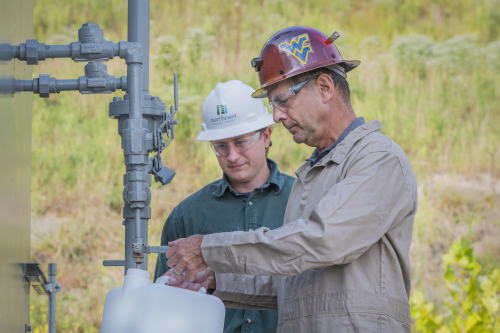
 Yesterday MDN reported the story that Dominion Transmission has decided to lock out union members from working at their jobs in Dominion installations over a contract dispute (see
  Over the years, MarkWest Energy, now a part of MPLX, has built a number of natural gas processing plants in Wetzel County, WV, collectively called the Mobley plant. In September 2014 MarkWest signed a contract with paving and construction company J.F. Allen to design and build a retaining wall so MarkWest could then build the Mobley V plant (in Smithfield). MarkWest says, in a lawsuit they’ve filed against J.F. Allen and other subcontractors, that they didn’t do the job right and it resulted in long delays and millions of dollars in extra costs for MarkWest. Which MarkWest is now trying to recover, requesting a jury trial…
 Two weeks ago MDN provided an update on the new Antero state-of-the-art frack wastewater treatment plant and landfill being built in West Virginia (see
  In June MDN told you about an economic development group of business and government leaders from Ohio and West Virginia (the Mid-Ohio Valley) called Shale Crescent (see
  In January, three liberal Democrat county commissioners from Fayette County, WV, with the backing and help of the radical WV Mountain Party, voted to ban injection wells in the county (see
  A West Virginia University engineering prof has just been awarded $110,000 to study methane aromatization. What’s that? It’s the process of turning methane, or natural gas, into “higher value products” like benzene and hydrogen. It’s not as easy as it may sound. If the good prof is successful, it may open up new markets in the northeast for our overabundant natural gas supplies. Here’s the lowdown…
 Last week MDN was the first to share the news that the California-based US Methanol is building at least two, rumored up to five, methanol plants in the Mountain State (see
  In April 2014 MDN brought you the exciting news that a father and son team, Andrew and Matthew Dorn (based in Buffalo, NY) would build a 549-megawatt electric generating plant, powered by Marcellus Shale, in Moundsville (Marshall County), WV (see
  All the way back in February MDN brought you exclusive news that Shell had begun approaching landowners in Beaver County to get them to sign easements for two ethane pipelines to feed the mighty cracker plant they plan to build in the county (see
  Brooke County, WV makes it four for four in denying Statoil’s request to refund tax overpayments made by the company. Statoil, based in Norway, is a big player in the West Virginia Marcellus Shale. Statoil paid property taxes to Brooke, Marshall, Ohio and Wetzel counties (all in WV) in 2015 and later found, during an audit/review, that they had overpaid those counties. They overpaid Brooke by $1.8 million, Ohio by $2.9 million, Wetzel by $1.6 million and Marshall by $342,000. We previously reported on Marshall’s refusal to refund the money (see
  We’d never heard this before, but apparently the Marcellus/Utica has been known for some time as the “Beast of the East.” Fitting! However, our region has gone from “Beast of the East” to “Beast on a Leash.” Very true. Low prices have suppressed new drilling projects. But according to experts on a recent webinar held by S&P Global Platts, new Marcellus/Utica drilling “is imminent.” Now that’s REALLY good news! Here’s some other things said on the webinar…