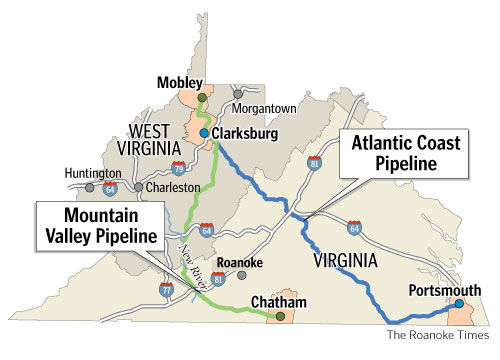
 In September a group of 57 gentry landowners in Virginia and West Virginia, backed by an out-of-state Big Green group, sued the Federal Energy Regulatory Commission (FERC) in an attempt to gut the 80-year old Natural Gas Act that gives FERC the right to grant eminent domain for pipeline projects (see VA, WV Landowners Sue FERC re Pipelines, Seek to Gut Natural Gas Act). Specifically, the colluding landowners oppose Dominion’s $5 billion, 594-mile natural gas pipeline that will stretch from West Virginia through Virginia and into North Carolina, and EQT’s $3.5 billion Mountain Valley Pipeline project, a 303-mile pipeline that will run from Wetzel County, WV to the Transco Pipeline in Pittsylvania County, VA. The frivolous lawsuit, titled BOLD ALLIANCE, et al. v. FEDERAL ENERGY REGULATORY COMMISSION, et al., was filed in the U.S. District Court for the District of Columbia. It claims the landowners’ property is a “taking” not properly compensated under the U.S. Constitution. Yesterday two important parties to the lawsuit–Dominion (representing Atlantic Coast Pipeline) and Mountain Valley Pipeline–filed a motion to dismiss the case. They have a strong argument. Why dismiss? Because the gentry landowners filing the lawsuit have ignored United State laws, which specifically state that (a) ONLY FERC has jurisdiction over the projects and decisions about whether or not they can get built, (b) if a supposedly aggrieved party disagrees with FERC’s decisions, they must first file for a rehearing, and if FERC still refuses, then (c) the supposedly aggrieved party can file a lawsuit ONLY with the U.S. Court of Appeals for the District of Columbia. The suers (Bold Alliance) did file for a rehearing and FERC has not yet ruled on the rehearing. Bold Alliance tried to sidestep the law by moving forward with a lawsuit prematurely. However, the really big no-no is that they filed in U.S. District Court for DC, NOT the Court of Appeals for DC. Big difference. We see no other choice for the judges in U.S. District Court but to dismiss the case since Bold Alliance should not have brought the case in their court in the first place…
Read More “Dominion, MVP File to Dismiss VA-WV Lawsuit Against Pipe Projects”

 In December MDN told you that Dominion’s $5 billion Atlantic Coast Pipeline (ACP) project had asked permission from the Federal Energy Regulatory Commission (FERC) to begin clearing trees along the path of the pipeline in all three states where the pipeline will run: West Virginia, Virginia, and North Carolina (see
  It’s looking more and more like co-tenancy legislation will pass this year in West Virginia (see
  Earlier this week TransCanada (i.e. Columbia Pipeline) broke ground for a new $100 million compressor station that will flow gas through the Mountaineer XPress Pipeline. MDN previously told you that at the end of December the Federal Energy Regulatory Commission (FERC) issued a final approval for Mountaineer (see
  It never ceases to amaze us at how an unshakable belief in the myth of man-made global warming drives normally sane people to do insane things. Like using millions in taxpayer dollars (“grants”) to figure out a way to convert shale gas into a more “environmental friendly” form of fuel for energy usage–explosive hydrogen. Methane (i.e. natural gas) has one carbon atom along with four hydrogen atoms–CH4. What do you do with that carbon atom when you split methane into its component parts? We can’t have that carbon atom mating with a couple of oxygen atoms and forming CO2 (carbon dioxide)! Perish the thought!! (Even though CO2 is what you exhale every time you breathe, CO2 has been bastardized into being considered a pollutant by the general population thanks to the efforts of Big Green.) West Virginia University, along with Southern California Gas Company and Pacific Northwest National Laboratory, is launching new research this month that aims to convert “methane to CO2-free hydrogen and solid carbon nanotubes”–that is, into hydrogen and “good” carbon, not “bad” CO2 carbon. Whatever…
 In April 2017, MDN brought you the news that Columbia Pipeline (now owned by TransCanada) had filed an application with the Federal Energy Regulatory Commission (FERC) to build a 3.5 mile, 8-inch pipeline that will carry natural gas from Pennsylvania to connect the Mountaineer Gas system in the Eastern Panhandle of West Virginia with the Columbia Gas Pipeline in Pennsylvania (see
 At the beginning of each new year the West Virginia legislature meets for a 60-day session. This year the session runs from Jan. 10 to Mar. 10. For the previous maybe 6-7 years, the shale industry has pushed for some sort of forced pooling legislation. Each year those bills, as close they sometimes got, were defeated. This year the industry is staying well away from saying anything about “forced pooling.” Last time around (in 2017) we came close with something MDN calls forced pooling lite–a bill that would have allowed for co-tenancy and joint development. That bill was eventually defeated (see
  Once again Marcellus Drilling News is happy to partner with and support the
  A relatively small number of landowners in West Virginia is using a novel legal argument to try and stop Mountain Valley Pipeline (MVP) from beginning construction. MVP is a $3.5 billion, 303-mile natural gas pipeline that will run from Wetzel County, WV to the Transco Pipeline in Pittsylvania County, VA. The Federal Energy Regulatory Commission (FERC) issued a final approval for the project in October (see
  Just yesterday MDN told you that Mountaineer NGL Storage wants to be THE main ethane/NGL storage hub for the Marcellus/Utica region (see
  Ridgetop Energy Services, headquartered in Canonsburg, PA, was started in early 2016 by Ridgetop Capital Partners. Ridgetop Capital is an energy and real estate investment firm. Since 2007, Ridgetop Capital has purchased 30,000 acres in the PA, WV and OH, and has invested $130 million in the region (often partnering with big drillers like EQT, Antero, Chesapeake, Range Resources and others). In addition to investing in acreage, Ridgetop also wanted in on some of the drilling action, so the company formed Ridgetop Energy Services in 2016 to buy up service companies that work in the shale space. In June, Ridgetop Energy bought Keystone Wireline (see
  Randolph County, WV is about to see some big changes in the coming months. Why? In “early spring” somewhere around 400-1,200 workers will descend on Randolph as work begins to build the mighty $5 billion Atlantic Coast Pipeline (ACP) being built by Dominion Energy. Members of the Rotary Club of Elkins heard a presentation earlier this week about what to expect when the pipeliners come a callin’. Some of those impacts include: higher traffic levels, more business for restaurants and convenience stores, an uptick in business at local laundromats, and higher occupancy for hotels and apartment buildings. According to Denise Campbell, community liaison for the ACP, “There’s a lot of opportunity.” Here’s a recap of Campbell’s comments to the Rotarians…
 Deals to lease land for Marcellus and Utica Shale drilling happen on a regular basis–even today. Perhaps not as much as several years ago when large deals cut by landowner groups were headline news. But lease deals still happen–you just don’t hear about them because they are private deals (deal terms are not recorded at the county clerk’s office). However, every now and again a public entity–a town or school–will lease land for shale drilling. And that IS a matter of public record. When we spot such deals, we like to bring you the details. Such a deal was cut on Monday, by the Ohio County Board of Education. The Board of Ed signed a deal with American Petroleum Partners (from Pittsburgh) to lease the 66 acre Wheeling Park High School campus for shale drilling–under (not on) the campus. Which is so cool for a number of reasons. First of all, the deal includes a $6,000 per acre signing bonus, and if/when the gas begins to flow, an 18% royalty. Second of all, it’s a school! How many times have we read about nutjob anti parents with their knickers in a twist over putting a shale well more than a half mile away from a school, like we heard about endlessly from those in the Mars School District (Butler County). It was a long, hard fight, but we eventually won (see