
OEPA Continues to Hunt Rover Pipe, Claims 2nd Spill Near River
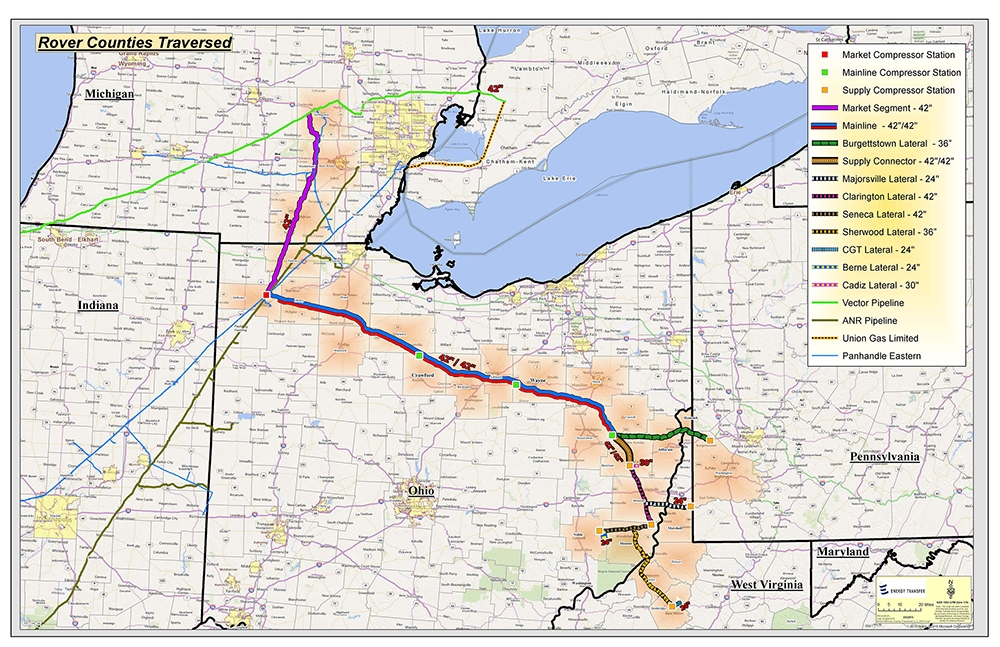
Ohio EPA (OEPA) director Craig Butler, aka Captain Ahab, continues his mission to harpoon that rascally great white whale known as the Rover Pipeline. Somehow Captain Ahab, er, a, Mr. Butler has “learned” that underground horizontal directional drilling (HDD) Rover was recently allowed (by the Federal Energy Regulatory Commission) to resume near the Tuscarawas River (over the objections of OEPA) has “lost” 146,000 gallons of drilling mud “down hole.” This is at the same location where Rover previously lost 2 million gallons of drilling mud down hole, some of which turned up back on the surface, at a swamp (aka “wetland”) located next to the Tuscarawas (see Rover Pipeline Accident Spills ~2M Gal. Drilling Mud in OH Swamp). That 2 million gallon “spill” in April of last year triggered a shutdown of all HDD work in Ohio. It was only in December that Rover was allowed, by FERC, to resume more HDD work at the Tuscarawas site (see FERC Gives Rover OK to Resume All HDD Work, Incl. Tuscarawas River). Butler’s spies have reported to him that more drilling mud, some 146,000 gallons, has disappeared into the earth during HDD drilling at the Tuscarawas site. Some perspective on this alleged news: First, how did Butler even know of a “problem”? OEPA doesn’t regulate the Rover project! Second, since Rover doesn’t answer to OEPA (which frosts Butler), Butler runs like a tattling child to FERC with every perceived violation he can trump up–even though he doesn’t have all the facts. Third, even though drilling mud may disappear down hole, that doesn’t mean the mud comes back to the surface. Sometimes it stays down there–forever. Fourth, even if the mud does come back to the surface, drilling mud is nontoxic–the same stuff used in kitty litter, cosmetics and toothpaste. The only thing an overabundance of spilled mud can do is smother a few fish. This latest ploy by Butler to tattle on Rover to FERC is his attempt to try and manipulate FERC into shutting down Rover’s HDD work once again…
Read More “OEPA Continues to Hunt Rover Pipe, Claims 2nd Spill Near River”
 NEXUS Pipeline, a $2 billion, 255-mile interstate pipeline that will run from Ohio through Michigan and eventually to the Dawn Hub in Ontario, Canada, is now under construction. NEXUS got final approval for the project from the Federal Energy Regulatory Commission (FERC) in August, the first major pipeline to get approved following a newly restored quorum at FERC (see
  Last September, amidst a heated state budget battle in Pennsylvania (where the phrase “severance tax” was on the lips of every Democrat and RINO in Harrisburg), a group of PA House Republicans did the hard work Gov. Tom Wolf and his cronies in the legislature refused to do: They figured out how to fund a wildly overspent budget without raising a single tax (see
 Big Green insanity continues at the so-called Pennsylvania Environmental Defense Foundation (PEDF). The only thing they “defend” is their own twisted philosophy of trying to gouge out the eyes of the oil and gas industry in PA–even at the expense of de-funding their own beloved PA Dept. of Conservation and Natural Resources. Last June, the PEDF won a case at the PA Supreme Court by the skin of their teeth (see
  Unstable people tend to create instability wherever they go–it’s just something we’ve noticed. Other people have noticed it too, at the highest levels of Pennsylvania state government. Business groups in PA are pointing a finger at unstable PA Gov. Tom Wolf. His repeated calls, his maniacal mission to force a severance tax on the Marcellus industry on top of the existing impact tax, is causing “instability” in the industry in PA. That is, companies are pulling back, not willing to drill as much, and investors are not willing to invest, because of the uncertainty of whether or not there will be a severance tax. It’s spooking the industry. These business groups, representing hundreds of thousands of PA residents, are calling on Wolf to end his unstable ways and quit calling for a severance tax. Specifically, they say, “He needs to stop it.” Is that blunt enough? Instead, these groups call on Wolf to reign in out-of-control spending. The less you spend, the less you need to rob from hardworking companies–companies providing tens of thousands of jobs and over a billion dollars of tax revenue for the state so far…
 It never ceases to amaze us at how an unshakable belief in the myth of man-made global warming drives normally sane people to do insane things. Like using millions in taxpayer dollars (“grants”) to figure out a way to convert shale gas into a more “environmental friendly” form of fuel for energy usage–explosive hydrogen. Methane (i.e. natural gas) has one carbon atom along with four hydrogen atoms–CH4. What do you do with that carbon atom when you split methane into its component parts? We can’t have that carbon atom mating with a couple of oxygen atoms and forming CO2 (carbon dioxide)! Perish the thought!! (Even though CO2 is what you exhale every time you breathe, CO2 has been bastardized into being considered a pollutant by the general population thanks to the efforts of Big Green.) West Virginia University, along with Southern California Gas Company and Pacific Northwest National Laboratory, is launching new research this month that aims to convert “methane to CO2-free hydrogen and solid carbon nanotubes”–that is, into hydrogen and “good” carbon, not “bad” CO2 carbon. Whatever…
 The “best of the rest”–stories that caught MDN’s eye over the break that you may be interested in reading. In today’s lineup: Blasting for Atlantic Sunrise Pipe; heding keeps M-U natgas production flowing; construction to begin on Mid-Ohio Valley compressor stations; NYC mayor adopts Cuomo playbook on o&g industry; DRBC in high stakes game of high-tech colonialism; science replaces art in oil drilling; U.S. withdrew record amount of natgas during cold snap; carbon capture hopes & questions; renewable power not the only solution to energy poverty; Japan natgas prices hit 2-year high; and more!
 Dear MDN Reader:
 Events related (or of interest) to the Marcellus and Utica Shale, primarily pro-drilling events.
 This is a bitter and sad day. The five Commissioners of the Federal Energy Regulatory Commission (FERC) released a decision yesterday (copy below) that FERC will not overrule an illegal decision by the corrupt Cuomo Dept. of Environmental Conservation (DEC) to block construction of the Constitution Pipeline (which FERC approved in 2014). Is this truly “lights out” for the Constitution? It would seem so. Cuomo’s DEC took more than two years to evaluate and eventually reject the Constitution Pipeline–a $683 million, 124-mile pipeline from Susquehanna County, PA to Schoharie County, NY to move Marcellus gas into NY and New England (see
  1/24/18 Note: We have edited this post to be less incendiary and more respectful of the opposing viewpoint.
  On Wednesday, Dominion Energy filed a request with the Federal Energy Regulatory Commission (FERC) to expand capacity along the existing Dominion Energy Transmission Inc. (DETI) pipeline from Pennsylvania to Ohio. Why? To flow more gas that will be used to generate electricity for the Midwest market. The project, called the Sweden Valley Project, is projected to cost $48 million and add another 120 million cubic feet per day (MMcf/d) of PA Marcellus Shale gas to the existing flow along DETI. Dominion says all 120 MMcf/d are already contracted and spoken for–by an unnamed customer. Notice the headline says “expand” and not “extend.” This project would build a tiny three miles of new pipeline, with the new pipeline lying next to existing pipeline (in Greene County, PA). The only greenfield construction is building a 1.75-mile pipeline to connect with the Tennessee Gas Pipeline in Tuscarawas County, OH. The other main part of the project is updating three units a compressor station in Licking County, OH. In the constellation of pipeline projects that disturb earth and disrupt landowners, this one is pretty minor–yet it will deliver big results by flowing an extra 120 MMcf/d of gas west to a new market…
 The dunderhead leaders of Monroeville, PA (Allegheny County, suburb of Pittsburgh) are at it again, acting hostile toward the shale industry, attempting to stymie any kind of shale activity within its borders. In September, Monroeville Council voted to enact a super-restrictive seismic testing ordinance (see
  In the fourth quarter of 2017 (Oct-Dec), 2.3 billion cubic feet per day (Bcf/d) of new/extra pipeline capacity was added in the Marcellus/Utica region, to carry our gas to markets outside the region. Even though production in the Marcellus/Utica has continued to climb every single month, that 2.3 Bcf/d of extra “takeaway” capacity had an immediate effect–prices for our gas began to rise. Here’s a bit of exciting news: By the end of the first quarter this year (that is, by Mar. 31st), another 3 Bcf/d of pipeline takeaway capacity will be online. We expect this new takeaway, combined with last quarter’s increase in takeaway, will continue to drive prices for our gas higher…