
Enbridge | Energy Services | Industrywide Issues | Millennium Pipeline | Pipelines | TC Energy/TransCanada
Millennium’s Two New Expansions Set Up Enbridge’s Project Beacon
 A new report from RBN Energy fills in a piece of the Project Beacon puzzle we haven’t fully covered: two separate Millennium Pipeline expansions — one already sanctioned, one still on the drawing board — that DT Midstream and TC Energy are advancing to feed New England’s growing appetite for Marcellus/Utica gas. One is moving fast. The other needs New York State’s blessing, which is never a sure thing. Read More “Millennium’s Two New Expansions Set Up Enbridge’s Project Beacon”
 Forward natural gas prices for this coming winter at the Cove Point LNG terminal in Maryland have gone parabolic — and if you produce, gather, or transport Marcellus/Utica gas, you should care, because the pipes behind this story are the same pipes you use every day. A quick primer: a ‘forward price’ is what buyers and sellers agree today to pay for gas delivered on a future date — think of it as locking in a price months ahead of time. When forward prices spike, it means the market is already betting on tight supply or high demand down the road.
  A unanimous Ohio Supreme Court has ordered the tiny Pickaway County village of Ashville to let voters decide the fate of a data center and natural gas power plant — a project the village council tried to fast-track by declaring it an “emergency” not subject to a public vote. The court didn’t buy it. But before opponents celebrate too hard, the ruling doesn’t guarantee a vote will actually happen this November — county election officials still get to decide whether the deal is even the kind of thing voters can weigh in on at all.
  PJM Interconnection and Dominion Energy are reviewing a July 22 event in Northern Virginia in which roughly 3,800 megawatts (MW) of data center load — the largest such disconnection in PJM’s history — unexpectedly ripped itself off the grid after a routine, correctly cleared transmission fault, forcing PJM operators to scramble to keep the grid stable. The event has reignited a fight over whether data centers, which are growing explosively across the PJM footprint (including Marcellus/Utica territory), need to be held to new “ride through” standards so they stop treating minor grid hiccups like five-alarm fires.
  Pennsylvania got off easy in the 2026-27 budget. Only one data center bill made it into law, and it was a toothless one. But the Pittsburgh Business Times reports Harrisburg is loading up for another round this fall — and this time the antis have a working blueprint to copy. It’s called New York, where Gov. Kathy Hochul banned new hyperscale data centers last month, and where the anti-fracking crowd has already spent a decade proving what happens when a state tells industry to go away.
  Remember when Dan Rice IV (older brother of EQT CEO Toby Rice) sold his landfill-gas company Archaea Energy to BP for $4.1 billion back in 2022, pocketing the Rice family somewhere between $720 million and $975 million in the process? Well, what goes around comes around: BP told investors this week it’s now looking to sell Archaea. On the company’s Q2 2026 earnings call, new BP CEO Meg O’Neill said Archaea has turned out to be a “capital-intense” way to play the biogas market, and BP would rather go “capital-light” going forward. Translation: RNG isn’t the money-printer BP thought it would be four years ago, and Big Oil’s would-be savior molecule is getting shopped to the highest bidder.
  OTHER U.S. REGIONS: Conservative group’s ‘right to natural gas’ initiative makes Colorado’s 2026 ballot; NJ data center makes case for on-site power generation during 6-hour hearing; NATIONAL: August heat helps lift U.S. natural gas futures; USA oil, gas workforce hits lowest level in years; Billionaires, misleading campaigns are at the heart of the climate-industrial complex; INTERNATIONAL: Crude steady as Iran risks persist; Indonesia and India are jointly planning a hydrocarbon-powered future; China’s great wall of fossil fuels.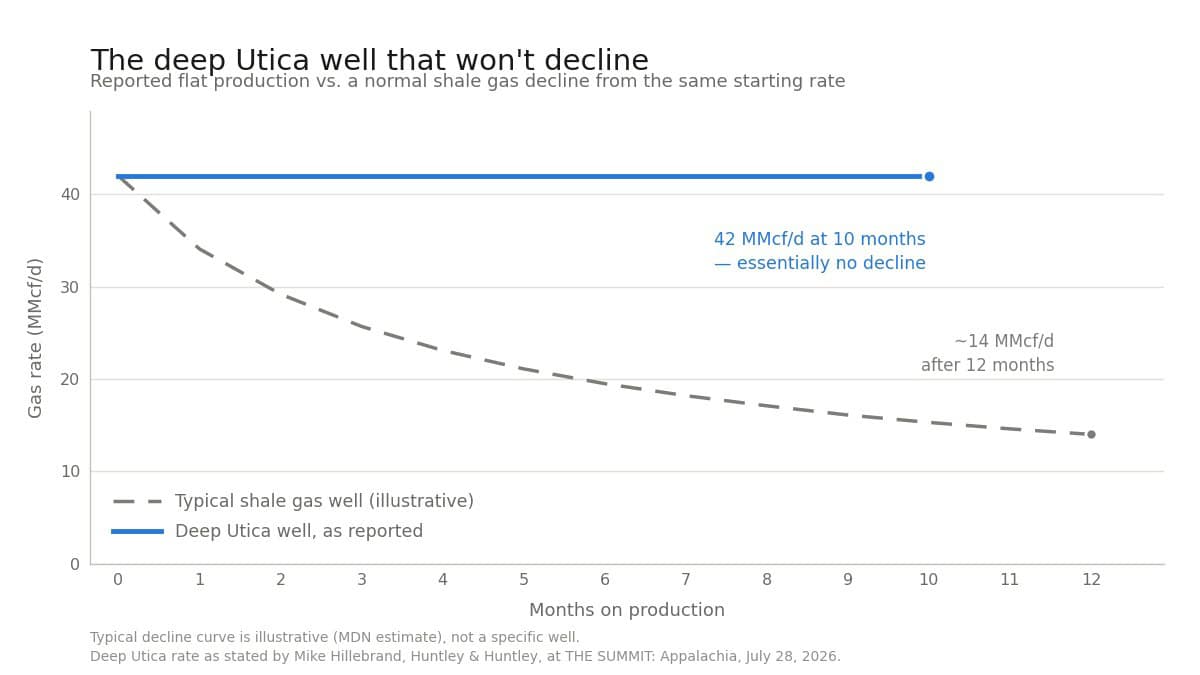
 Infinity Natural Resources (INR), the Morgantown, WV-based pureplay Marcellus/Utica driller, dropped its second quarter 2026 numbers on Monday and walked analysts through them Tuesday morning. The short version: production jumped 75% year over year to 348.5 million cubic feet equivalent per day (MMcfe/d), adjusted EBITDAX hit a company-record $114.7 million, the first wells from the Ohio Utica package INR bought from Antero came online ahead of plan — and INR quietly drilled and cored its first deep dry gas Utica well in Pennsylvania. Full-year guidance was reaffirmed. Not a bad quarter for a company that was still private 18 months ago.
  Babcock & Wilcox — the 159-year-old boiler maker headquartered in Akron, Ohio — announced yesterday that it signed an agreement with Siemens Energy to start work on 20 steam turbine generator sets totaling 1 gigawatt (GW) of capacity for gas-fired data center projects. Here’s the part that caught our eye: B&W hasn’t announced signed customers for all of them. The company is buying the factory slots first and lining up buyers second. That’s a real bet on gas-fired power demand — and it’s being made by a company sitting right on top of the Utica.
  A Nasdaq-listed company you’ve almost certainly never heard of says it has signed a binding term sheet to buy roughly 1,800 acres of unleased Marcellus mineral rights in “northern Pennsylvania,” drill a dozen wells on it, burn the gas in on-site turbines, and run a 200-megawatt AI data center behind the meter — with a stretch goal of 1 gigawatt. The company, Alpha Compute Corp. (Nasdaq: ALP), never says which county. We think we’ve figured it out: Tioga County. Here’s what’s actually known, what we deduced, and what nobody should be printing as fact yet.
 America’s biggest LNG exporter just had a monster quarter — and raised its full-year forecast for the second time this year. Cheniere Energy (NYSE: LNG) shipped 184 cargoes in the second quarter and is now building toward a platform that could eventually swallow more than 10 billion cubic feet of gas a day. Appalachian producers should be paying attention. Cheniere Energy reported second quarter 2026 results on Aug. 6, and the numbers were eye-popping. Revenues hit $5.73 billion, up 24% from a year ago. Consolidated adjusted EBITDA came in at $1.80 billion, up 27%. Net income was $3.07 billion, up 89% — though a big chunk of that is non-cash accounting noise we’ll get to in a minute.
  Devon Energy and Williams spent the last week of July doing something that doesn’t show up on a reserve report: teaching northeastern Pennsylvania teenagers how the gas business actually works. Then, on July 30, the Pennsylvania Chamber Foundation named both companies “Greatest Places to Intern in PA.” Six days later, Devon CEO Clay Gaspar told analysts he’s fielding “no shortage of incoming phone calls” about which assets he might sell — with the Marcellus at the top of everybody’s list. Which raises a question nobody on Wall Street is asking: who inherits the workforce machine?
  If you’ve been to an energy conference in the last year, you’ve heard someone say EQT is forecasting 100 Bcf/d of new natural gas demand by 2030. It happened at