
How to Calculate Royalties if Well is Co-Located with Gas Power?
 AI data centers are all the rage. The news (local and national) is full of such stories, playing up opposition to data centers. We’ve written plenty about AI data centers on MDN, given the close connection to gas-fired power that’s needed to operate them. We’ve also told you about a developing trend of “behind the meter” gas-fired power plants, built at the same location as a data center. That’s when the data center is built next to a power plant or vice versa. The electricity goes directly to the plant and never flows through the local power grid. Another part of this story is that sometimes the gas-fired power plant that’s on-site powering the data center receives its gas from a well drilled at the same site! The gas flows directly into the gas plant (bypassing gathering pipelines), and the plant produces electricity for the data center. And therein lies a potential, very thorny issue. Read More “How to Calculate Royalties if Well is Co-Located with Gas Power?”
 NATIONAL: U.S. natural gas jumps on colder weather outlook; USA Compression completes acquisition of J-W Power; WoodMac sees USA tight oil output shrinking in 2026; Climate policy 2025 was much good news; Victory as Trump withdraws America from UN climate framework & IPCC; Is natural gas a trade or a trap after hitting new lows?; Energy wisdom is lacking among public officials; INTERNATIONAL: Oil jumps as Iran tensions escalate; Trump says he’s inclined to exclude Exxon from Venezuela; European gas prices climb on heating demand, Iran risks.
  The Marcellus/Utica rig count gained 1 rig five weeks ago in the Ohio Utica, bringing the total to 39 rigs. For the past five reports in a row, the M-U has maintained that count—the most rigs it has operated in more than a year. Pennsylvania has held at 18 active rigs for eight consecutive weeks. Ohio has operated 14 rigs for five straight weeks (its highest in over a year). And West Virginia maintained 7 rigs, which it has operated since May 30, 2025. There were 24 rigs targeting the Marcellus and 15 targeting the Utica. The national count lost 2 rigs last week, bringing the total to 544 active rigs.
  Last year, Houston-based EOG Resources acquired Encino Acquisition Partners for $5.6 billion, establishing the Utica Shale as a “third foundational play” alongside its Permian and Eagle Ford assets (see
  Last summer, Texas Eastern Transmission Pipeline Company (aka TETCO, owned by Enbridge) filed to build the Appalachia to Market III Project, abbreviated A2M III (see
 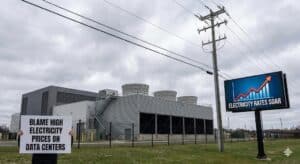 Data center forecasts — beyond existing data centers — made up 45% of the $47.2 billion in capacity costs in PJM’s last three capacity auctions, according to a report by Monitoring Analytics, PJM’s so-called independent market monitor. Data center load accounted for $6.5 billion, or 40%, of the $16.4 billion in costs from the PJM Interconnection’s December capacity auction (the most recent auction). PJM’s market monitor directly and unequivocally blames new data centers for higher electricity prices, instead of putting the blame where it really belongs: On Democrat governors who have restricted new gas-fired power plants.
 In 2025, U.S. natural gas prices at the Henry Hub averaged $3.52/MMBtu, representing a 56% increase from the inflation-adjusted record lows of 2024. This upward trend was fueled by rising LNG export capacity and intense winter heating demand, punctuated by late-year polar vortex events. Although record-high summer production and reduced electric power sector consumption moderated prices mid-year, regional volatility persisted. While most hubs saw increases, the Northeast experienced dramatic spikes due to pipeline constraints.
  It hardly seems worthy of a post to update you on new permits to drill in the Marcellus/Utica when just one permit was issued. We suppose there may be a lag at the various environmental agencies that issue permits, but maybe not. The sole permit issued last week was in Washington County, PA, to Rice Drilling (aka EQT). The details of that well are in the report below. We will re-run our permit search next week to see if any additional permits appear for last week, Dec. 29 through Jan. 4.
  Vickery Energy Partners, LLC, a portfolio company of the private equity firm Quantum Capital Group, announced yesterday that it has closed on the acquisition of Tribune Resources. The transaction includes assets located primarily in Wetzel, Tyler, Harrison, and Doddridge counties, West Virginia, totaling approximately 38,000 net acres and more than 200 million cubic feet equivalent per day (MMcfe/d) of net production.
  Iroquois Gas Transmission’s Enhancement by Compression (ExC) project would increase horsepower at three compressor stations — two in New York and one in Connecticut — by an extra 125 MMcf/d, to flow more Marcellus/Utica gas into New York City and New England. The two NY compressors are in Dover and Athens. The CT compressor is located in Brookfield. In September, we told you that the Sierra Club paid for a fake study bashing the Connecticut portion of the project (see
  Last October, a seven-member, all-Democrat group of Pennsylvania House of Representatives members announced a six-bill legislative package aimed at regulating the “responsible development” of artificial intelligence (AI) data centers in the state (see
  Despite claims by anti-fossil fuelers that the Tenaska Westmoreland Generating Station in southwestern PA would spread disease and death if built, it’s been up and running since 2018, producing power and generating revenue for both its builders and the community. Oh, and everyone is in good health. However, the plant has been operating under a state permit since it opened. It needs a federal Title V permit for long-term operation. The state Department of Environmental Protection (DEP) is the agency that issues such a permit and is proposing to do so, which (of course) has antis’ knickers in a twist (see
  Duke Energy is seeking regulatory approval for a $3.2 billion, 1,400-megawatt natural gas power plant in Anderson County, South Carolina. Scheduled for a February 2026 Public Service Commission hearing, the project aims for operations by 2031 to meet surging electricity demand in the region. Unlike other regional proposals, Duke’s facility avoids new interstate pipeline construction by utilizing the existing Transcontinental Gas Pipeline (Transco). The plant will use air-cooling technology to significantly reduce water use and has already secured turbines from GE Vernova. While Duke remains the primary owner, local electric cooperatives will hold a 7% stake in the facility.
  Deep River Data, a company with connections to the cryptocurrency industry, wants to drill for natural gas in Lee County, North Carolina. However, production from the well would not be used to power crypto mining, but instead to fuel an AI data center. If approved, the project would be the first commercial well drilled into the Triassic Basin, a natural gas repository underlying North Carolina and other Eastern Seaboard states. The planned well is conventional, not shale, so it involves no (or very little) fracking. Yet lefty environmentalists have whipped up opposition from the locals by urging them to “ban fracking.”