
EPA Public Mtg Examines Disposing O&G Wastewater in Lakes, Rivers
 In May the U.S. Environmental Protection Agency (EPA) launched a study looking into the possibility of treating oil and gas wastewater and (gasp) releasing the cleaned-up wastewater into lakes and rivers, instead of injecting it back down holes in the ground. Earlier this week the EPA held a public meeting to discuss preliminary findings and to elicit more input from the industry and from Big Green on their study, which is called “Study of Oil and Gas Extraction Wastewater Management” (due to be released early next year). Below is an update on the meeting with a slide deck used by EPA.
Read More “EPA Public Mtg Examines Disposing O&G Wastewater in Lakes, Rivers”
 Anti-fossil fuelers are on a holy mission to stop a 3.5-mile, 8-inch pipeline from being built under the Potomac River by Columbia Pipeline (see
  The Ohio Oil and Gas Association (OOGA) and St. Clairsville Area Chamber of Commerce sponsored an update on the Utica Shale and its impacts in southeastern Ohio at a one-day event held yesterday at Belmont College. The upshot of the day seemed to be this: The Utica is still creating thousands of jobs, and still attracting millions of dollars in investment. Among the speakers were reps from both EQT and Ascent, who had some interesting comments about their respective operations. Question: Who do you think is the largest natural gas producer in Ohio today? One of the speakers made the surprise claim that her company is now the top producer in Ohio.
 One year ago Chevron Appalachia and People’s Natural Gas teamed up to release a study called “Forge the Future: Pennsylvania’s Path To An Advanced, Energy-Enabled Economy” (see
  The “best of the rest”–stories that caught MDN’s eye that you may be interested in reading: Utica Shale Academy enrollment on the rise; Cabot subsidiary hiring in northeast PA; U.S. LNG exports edge down second week running; Senate GOP moves at ‘light speed’ to confirm nominee; Long-range warm risks seen as November natural gas called lower; How Bloomberg embeds green warriors in blue-state governments; Which is safer for transporting crude oil: rail, truck, pipeline or boat?; US green groups carry out Russia’s bidding in fracking fight.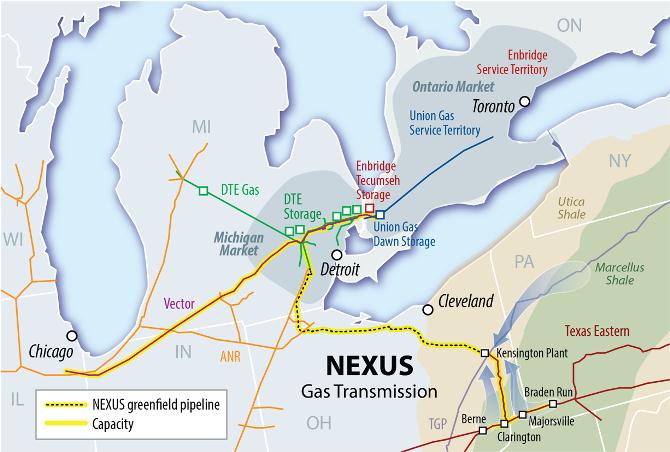
 In March 2016, MDN brought you news that Primus Green Energy, a gas-to-liquids (GTL) technology company, planned to build a 160 metric tons per day (MT/day) methanol plant at “a manufacturing site in the Marcellus shale region” in 2017 (see
  Earlier this week the Franklin County (VA) Planning Commission voted 5-0 to allow Roanoke Gas Co. to build and operate a “gate station”–a connection to the under-construction Mountain Valley Pipeline (MVP). Roanoke Gas is laying new pipelines in the area and needs natgas to feed its new customers. Antis showed up at the meeting (what’s new?) to complain and threaten and moan and whine. They actually tried to say there is no “public benefit” for MVP, and that this gate station is simply a ruse to give the appearance of a public benefit.
 In June we told you about a plan by MidWest utility company Vectren to build a 900-megawatt natural gas-fired power plant (and a 50-acre solar farm) to replace a retiring coal plant, in Warrick County, Indiana (see
  The expert analysts at RBN Energy have just published their “fourth and final” in a series of posts looking in detail at E&Ps (exploration & production companies, or “drillers”). One of the groups of E&Ps they examine are “gas-weighted” E&Ps–or drillers who mostly extract natural gas. In looking through the list, you immediately realize every one of them has operations in the Marcellus and/or Utica Shale region. Yes, a few also have operations in other plays, but they all have at least some operations here. The real value in the article is an accompanying spreadsheet comparing various financial metrics (apples to apples)–things like total revenue, lifting costs, production costs, and “pre-tax income,” meaning profitability. How do our drillers compare with each other?
 On numerous occasions we’ve pointed out the lunacy of the “keep it in the ground” gang–those who believe we should end the use of all fossil fuels as soon as possible. Why can’t we do it? For many reasons. Here’s just one: petrochemicals. Did you know that all sorts of products you use every day–things like plastics, fertilizers, packaging, clothing, digital devices, medical equipment, detergents and tires–come from oil and gas? Without oil and gas, we’d quickly descend back into the Stone Age, living short, brutish lives. That point was driven home in a new report titled “The Future of Petrochemicals” (full copy below), part of an International Energy Agency (IEA) series that shines a light on “blind spots” in the global energy system.
 On Tuesday, Enbridge, owner of the Texas Eastern Transmission Company (Tetco) Pipeline, announced it has put part of its Texas Eastern Appalachian Lease (TEAL) natural gas pipeline project in Ohio into service. TEAL boosts capacity along Tetco by 950 million cubic feet per day (MMcf/d), to flow Marcellus/Utica gas to the recently-completed-but-not-yet-online NEXUS pipeline (see
 Each large (over 475 megawatts) gas-fired electric power plant is an economic bonanza. The plants cost hundreds of millions of dollars to build–over a billion dollars for the largest plants. They provide hundreds of jobs during construction, jobs that last several years. They provide millions in tax revenue to local municipalities and schools. And best of all, each one of these plants uses an enormous amount of Marcellus and Utica Shale gas. There are 29 of these incredible projects already built or in various stages of planning and construction in PA, OH and WV. We have the list below.