
Sunoco Seeks to Use Alternate Pipe Near Philly to Get ME2 Flowing
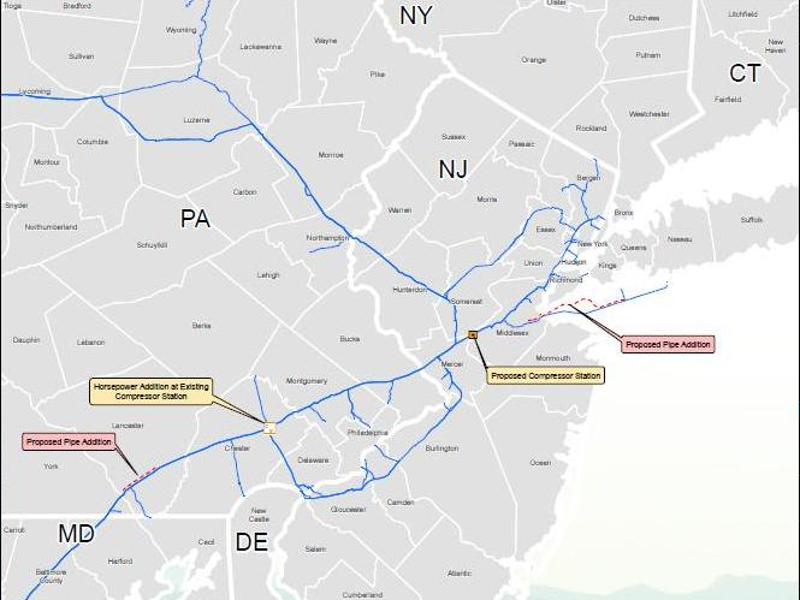
 Years ago when Sunoco Logistics Partners (aka Energy Transfer Partners) originally proposed and planned the Mariner East 2 twin pipelines from the edge of eastern Ohio through the entire length of Pennsylvania to the Marcus Hook refinery near Philadelphia, the completion date promised was the end of 2016. Little could Sunoco foresee the multiple lawsuits, regulatory hearings and illegal protest actions that would conspire to throw the project off schedule for more than a year and half. When pipeline companies plan such multi-billion dollar projects, they first get customers (drillers) to sign on the dotted line, guaranteeing there will be enough product (and revenue) to make the project worthwhile. Drillers *did* sign on the dotted line, and they’re still waiting. Waiting and now pressuring Sunoco to get the darned thing up and running. The pipeline itself is 98% complete–in the ground and connected. But an all-important 2% is still not complete, most of it in the Philly suburbs–Delaware and Chester counties. Sunoco continues to have problems with underground horizontal directional drilling and with ongoing litigation by towns in the Philly area. What to do, with customers breathing down your back? Sunoco has come up with an ingenious solution that is sure to send the crazies into orbit. Sunoco is asking the federal Pipeline and Hazardous Materials Safety Administration (PHMSA) for permission to use part of an existing 12-inch pipeline in that area that previously carried refined petroleum products (things like gasoline, heating oil, and jet fuel), repurposing the pipeline to carry NGLs (ethane, propane, butane, etc.). This is only a short-term fix until the last bits of the full ME2 is up and running…
Read More “Sunoco Seeks to Use Alternate Pipe Near Philly to Get ME2 Flowing”
 The married couple who started Lancaster Against Pipelines (LAP), Mark and Malinda Clatterbuck, are far-left radicals who pretend to be mom and pop, salt-of-the-earth, neighbor-next-door, aw-shucks common folks who would never engage in “violent” protests. Mark Clatterbuck admits to traveling to North Dakota to participate in the mass action against the Dakota Access Pipeline–a “protest” that turned quite violent and destroyed millions of dollars of property. No, we’re not saying nor implying that Clatterbuck himself engaged in illegal actions while there. We are saying the Clatterbucks’ sympathies lie with protest movements that sometimes result in such actions. The Clatterbucks made some big boasts–that some 1,000 people had pledged to protest and get themselves arrested to stop Atlantic Sunrise, a $3 billion, 198-mile pipeline project running through 10 Pennsylvania counties to connect Marcellus Shale natural gas from northeastern PA with the Williams’ Transco pipeline in southern Lancaster County. Something under 50 people have actually been arrested for illegal actions in trying to stop construction. As the Atlantic Sunrise project nears completion in all locations, including Lancaster County, apparently LAP is feeling neglected. Nobody talks about them anymore. They didn’t/couldn’t stop the pipeline, as they had boasted they would. So in an attempt to grab one more headline, Mark and another LAP protester, Elliot Martin, connected themselves together at a pipeline construction site using a “sleeping dragon”…
 Extreme Plastics Plus (EPP) has been manufacturing and installing well pad liners since 2007. Pad liners protect the ground from accidental spills of frack wastewater and chemicals used during the drilling process. Located in Fairmont, WV, EPP’s customers are in the Marcellus and Utica Shale region. In order to expand, EPP raised an undisclosed amount of investment money from Hastings Equity Partners in 2013 (see
  In May, MDN brought you a story of how New England was “this close” to rolling blackouts due to an extreme shortage of electricity during a cold snap (see
  Last September MDN told you that Shale Support Holdings, “a leading provider of frac sand and logistical solutions to the oil and gas proppant market” (headquartered in Texas, with an operations center in Mississippi), was stepping up its presence in the Marcellus/Utica region with a partnership with Tidewater Logistics (see
  In May 2015, the Obama rogue Environmental Protection Agency (EPA) along with the Obama U.S. Army Corps of Engineers (USACE) released a finalized rule clarifying what “Waters of the United States” (WOTUS) means vis a vis what can be regulated under the federal Clean Water Act (see
  The “best of the rest”–stories that caught MDN’s eye that you may be interested in reading: Hilcorp gets 3 Utica permits for Columbiana County, first new permits there this year; de Blasio should be prepared for climate lawsuit to be tossed; administrative law judge in Minnesota recommends against building natgas-fired plant; folks are waking up to what it means that Powelson is leaving FERC–and it ain’t pretty; fossil fuels still dominate U.S. energy consumption, although renewables gain some ground; preserve farmland with fracking; University of Arizona about to be outed for climate fraud; a new oil “cartel” threatens OPEC; and more!
 As is so often the case, radical Big Green groups, like PennFuture, attempt to intimidate (i.e. bully) by using threats of legal action, those who dare to use and (gasp) enjoy the monetary benefits of shale drilling. In early 2013 the Pittsburgh International Airport and Allegheny County, PA signed a deal with CONSOL Energy (now CNX Resources) to lease 9,000 acres surrounding the airport for natural gas drilling (see
 We write about Boardwalk Pipeline Partners every now and again. They don’t have a lot of pipelines in the Marcellus/Utica region–but what they do have is important. One of the pipelines operated by Boardwalk is the huge Texas Gas Transmission (TGT)–originally built from the Louisiana Gulf Coast to the upper Midwest to supply Illinois, Indiana and Ohio with natural gas. But then the Marcellus/Utica Shale happened and TGT needed to change strategies. Through a series of projects, TGT made the pipeline system bidirectional, so it could flow gas from the Marcellus/Utica to points south, going as far as the Gulf Coast. In May 2016 TGT began to flow up to 626 million cubic feet per day of Marcellus/Utica gas as far away as the Gulf Coast (see
 The Goldboro LNG export facility in Nova Scotia continues its march (shuffle?) toward construction. As we reported in February, Pieridae Energy (the builder) has enlisted the help of Morgan Stanley and Société Générale to help raise $10 billion to build it (see
  Oil and gas giant BP recently released its annual Statistical Review of World Energy–the 67th edition! (Full copy below.) A number of big energy companies, like Exxon Mobil, as well as government agencies, publish similar reports that characterize current and future world energy trends. However, one analyst we read says BP’s report is the best: “I have relied upon the BP World Energy report for years. It is not a report to be viewed with a partisan eye, but as merely one of the best, if not the best, energy trend device available anywhere. In comparison to government agencies like the U.S. Energy Information Administration (EIA) the global International Energy Association (IEA) or OPEC’s own World Oil Outlook, the BP report has proven itself to be far more valuable in finding investable trends. I would never recommend any oil sector without having the statistical evidence of the BP World Energy Report behind me.” This year’s report finds that oil and natural gas consumption increased significantly in 2017. It also finds the U.S. best-positioned to meet that increasing demand, thanks to the shale miracle. Below we have some of the key highlights from the report, followed by a full copy…
 Last Thursday, Ascent Resources, a company founded by Aubrey McClendon after he left Chesapeake Energy, announced it is buying 113,400 Utica Shale acres along with 93 operating wells located in eastern Ohio for $1.5 billion. The new acreage tips Ascent over the 300,000 Utica acre line and catapults the company into one of the largest privately owned drillers (exploration and production) in the U.S. The companies doing the selling are CNX Resources and Hess (selling a joint venture they co-owned, each selling their share for $400 million each, for a total of $800 million), Utica Minerals Development (a subsidiary of First Reserve, a private equity firm headquartered in Greenwich, CT, and EMG), and a fourth, unnamed mystery seller. The CNX/Hess acreage (78,000 net acres of the 113,400 acres) is located in the wet gas window of Belmont, Guernsey, Harrison and Noble counties. We’re not sure about the location of the other acreage. The CNX/Hess jv sale marks Hess’ total exit from the Utica Shale. So how will Ascent pay for all of their new shiny new assets?