
KM Plans to Convert Tennessee Gas Pipeline to Flow M-U NGLs South

Here’s a story that wasn’t actively on our radar. It’s an old story, but is now in the news again with the recent quorum reestablished at the Federal Energy Regulatory Commission (FERC). In August 2013, exactly four years ago, midstream giant Kinder Morgan and competitor midstream company MarkWest Energy (now part of Marathon Petroleum) signed a joint venture agreement to repurpose a significant portion of Kinder’s Tennessee Gas Pipeline (964 miles of it) running from the Louisiana Gulf Coast to Ohio. That 964-mile portion of TGP currently flows natural gas from the Gulf northward. Kinder and MarkWest want to reverse the flow and instead flow natural gas liquids (NGL) through the pipeline from the Utica and Marcellus region south to the Gulf Coast. The project would also build a new 200-mile pipeline from TGP in Louisiana to Texas. In order to make the project happen, the first step is to ask FERC for permission to “abandon” (stop using) the 964-mile segment, called Pipeline No. 1, from Louisiana to Ohio. Which TGP did in Feb. 2015. The project progressed. Last November FERC issued a favorable environmental assessment for the project (full copy below). And then FERC lost a quorum of voting members in February of this year, stalling further progress. With a quorum now restored, antis in Kentucky, a state that seems to be allergic to any kind of pipeline for any purpose, have begun bellyaching about it. Which is what caught our attention. We’ve gathered together information we can find on this project–a potentially very important project–to move Marcellus/Utica NGLs to the Gulf Coast…
Read More “KM Plans to Convert Tennessee Gas Pipeline to Flow M-U NGLs South”
 Anti-fossil fuel activists attempting to stop the unstoppable Rover Pipeline are doing their best to smear and prejudice people against the project. Rover has had its share of problems. We’ve chronicled those problems–like leaking 2 million gallons of drilling mud in Ohio when performing underground horizontal directional drilling (see
  Fantastic news to report! Dominion has asked the Federal Energy Regulatory Commission (FERC) for permission to begin flowing feed gas (for testing purposes) to parts of the Cove Point LNG export facility. We are now getting close to startup at the facility, which is supposed to go online in the fourth quarter of this year. Cove Point sits along the coast of Maryland. Dominion began work on the $3.5 billion plant in 2015. When complete, the plant will liquefy and export 1.8 billion cubic feet per day (Bcf/d) of Marcellus/Utica Shale gas to India and Japan. Currently there is only one export facility in the U.S. in operation, along the coast of Louisiana (Cheniere Energy’s Sabine Pass). That one facility has fundamentally changed the economics of LNG (liquefied natural gas) here at home and around the world. Just imagine what another 1.8 Bcf/d will do! And it’s ALL from our region. Here’s more about the good news that Cove Point is ready to begin testing…
 In a disappointing, but perhaps not all that unexpected decision (full copy below), the U.S. Court of Appeals for the Second Circuit on Friday ruled against the Constitution Pipeline and their lawsuit against the Cuomo-corrupted New York Dept. of Environmental Conservation (DEC). The DEC dithered, for years, on a decision about whether or not to grant stream-crossing permits (Section 401 permits, a federal Clean Water Act thing) to the Constitution Pipeline, a $683 million, 124-mile pipeline from Susquehanna County, PA to Schoharie County, NY carrying Marcellus gas. The Federal Energy Regulatory Commission (FERC) authorized the project in 2014. Since that time the DEC delayed, and eventually denied permits for the project (see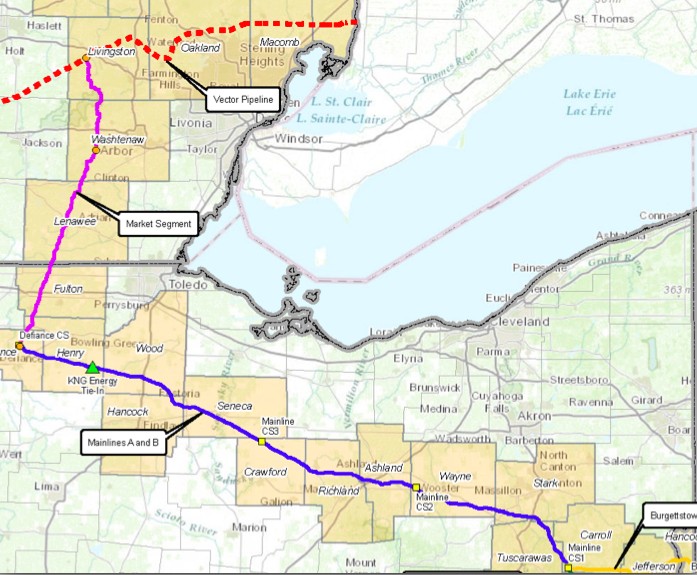
 Over the past year or more MDN editor Jim Willis has signed numerous petitions supporting the Atlantic Sunrise Pipeline project–but it wasn’t until he signed one at a recent Williams event that the got a response from Pennsylvania Gov. Tom Wolf. Atlantic Sunrise is a $3 billion, 198-mile natural gas pipeline project, most of which will get built in northeast Pennsylvania. The project is ready to begin construction, NOW, but still needs a few permits from the state Dept. of Environmental Protection (DEP). In an attempt to get the DEP (and Gov. Wolf) moving, Williams co-hosted an event in July to pressure the DEP and Wolf into granting final permits (see
  A brand new wireline oilfield service company called Reach Wireline has attracted an investment from private equity company Hastings Equity Partners. Reach Wireline, which is headquartered in Fort Worth, TX, either already has, or soon plans to have, operations in the DJ, Permian and Marcellus Shale plays, according to the company’s website. A wireline is a cable used to lower or retrieve equipment or measurement devices into a well for the purposes of well intervention, reservoir evaluation, and pipe recovery. Reach’s claim to fame is that it offers “leading edge greaseless cable.” The press release does not say how much money Reach received. Hastings Equity Partners focuses on investing in lower middle market energy services and equipment companies in the U.S. Hastings formed their “Hastings Equity Fund III” in 2014 with $172 million of commitments. Since that time Hastings has invested in a number of companies. Reach is the latest…
 Energy Transfer Partners (part of Energy Transfer Equity) is the company that built the Dakota Access Pipeline (now flowing, thankfully). They are also the pipeline company building both the Rover Pipeline in Ohio and Michigan, and the Mariner East 2 natural gas liquids pipeline from eastern Ohio across Pennsylvania to the Philadelphia area. Big company, big projects. ETP recently sold off 32% of the Rover project to Blackstone for $1.57 billion (see
  Nuverra Environmental Solutions (formerly Heckmann) is one of the largest companies in the United States that handles transportation and disposal of shale drilling wastewater and leftover rock and dirt from drilling. The company has major operations in the Marcellus/Utica region. In January 2016, the company, going through tough economic times, was de-listed from the New York Stock Exchange (see
  In 2012, Sunoco inked a deal with The Carlyle Group to form a joint venture to keep Philadelphia’s historic refinery operating (see
  Last night the Pennsylvania Dept. of Environmental Protection (DEP) held one final public hearing for the Williams Atlantic Sunrise Pipeline project–in Lancaster. As we previously reported, anti-fossil fuel nutters planned to gather prior to the meeting so they could choreograph a “walkout” of the meeting, as a form of protest (see
 The Washtenaw County (Michigan) Road Commission has written a letter to the Federal Energy Regulatory Commission (FERC), requesting FERC deny a certificate to build the NEXUS Pipeline because (they claim) NEXUS has bullied them. It seems the Road Commission has been working with NEXUS over the past year to prepare for the pipeline. The Road Commission wants NEXUS to jump through all sorts of hoops, do handstands, backflips, and in general, dance to the Road Commission’s tune. And because NEXUS isn’t willing to bend all the over backwards, the Road Commission is miffed. The Road Commission is the lord of their domain, and no outsider is going to do anything without their permission. So the Road Commission has run to mommy (FERC) and started bawling that NEXUS are meanies and they won’t pick up after themselves and they’re just BULLIES. So FERC should just go ahead and shut the whole $2 billion, 255-mile interstate pipeline project down (that will run from Ohio through Michigan)–because of one whiny Road Commission in one county…
 Jeff Tittel, the head of the New Jersey Sierra Club, last week called President Trump a “fossil fool in the White House” and panned Trump for doing his Constitutional duty in appointing new members to the Federal Energy Regulatory Commission (FERC). Tittel’s latest titillation came in response to PennEast Pipeline sending a letter to FERC last Thursday requesting the agency move forward posthaste with granting the project a final certificate to proceed to construction–something that terrifies Tittel and his sidekick, THE Delaware Riverkeeper, Maya van Rossum. Tittel and van Rossum have staked their reputations and the reputations of their anti-fossil fuel groups on stopping PennEast. So once the bulldozers fire up and begin digging trenches, it’s all over for them. They might actually have to find real jobs. Below is PennEast’s request to FERC along with the instantaneous (and paranoid) reaction from several Big Green radical groups….
 Somewhat surprising for our local Gannett outlet here in Binghamton (the Press & Sun-Bulletin), but on Sunday the newspaper published two opinion pieces that make a very strong case FOR building a natural gas transfer station (i.e. virtual pipeline) in the Town of Fenton, on the outskirts of Binghamton, by NG Advantage. One of the editorials was written by a resident who lives in the community where the station will get built. The arguments are compelling and destroy the NIMBYism and hysterics of local residents opposed to the project. The other editorial is from the fire chief and emergency management director from a community in New Hampshire that has two facilities to decompress gas delivered by NG Advantage. He speaks about the safety of the trucks and the gas carried on them. Bottom line: This facility is safe, the trucks hauling the gas are safe, and it’s good for the economy. There’s absolutely no reason why it should not get built in Fenton (near Binghamton)…
 The CORNballs of Ohio are not happy campers in their quest to try and shut down the $2 billion, 255-mile NEXUS interstate natural gas pipeline that will run from Ohio through Michigan and eventually to the Dawn Hub in Ontario, Canada. CORN stands for Coalition to Reroute NEXUS. CORNballs is what we affectionately call the group–as a way of pointing out their nutty real purpose, which is to try and shut the NEXUS project down. Their aim has nothing to do with “rerouting” and everything to do with shutting it down. In May 2017, the CORNballs revealed their true colors when they filed a lawsuit in federal court in Akron, OH (see