
KM’s Elba Island LNG Export Plant Approved by FERC

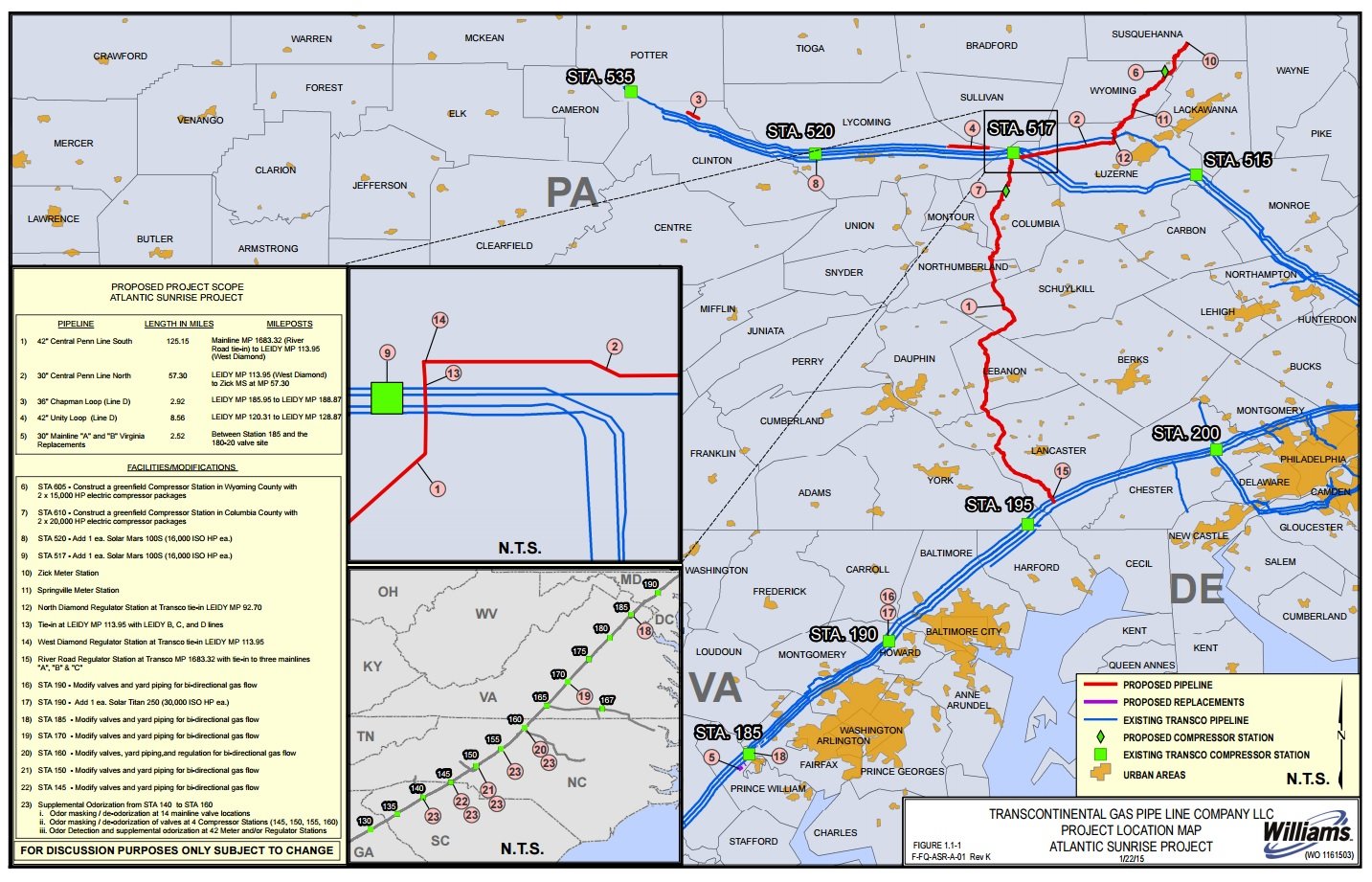
Great news! Kinder Morgan’s Elba Island, Georgia (near Savannah) proposed LNG export facility has gotten a green light from the Federal Energy Regulatory Commission (FERC). What does the Georgia Elba LNG plant have to do with Marcellus/Utica? Maybe nothing, but we suspect something. Kinder’s arch rival Williams owns the mighty Transco pipeline that connects, via the Elba Express pipeline, to the LNG facility. Currently Elba Island imports LNG. However, Williams has been on a mission to send Marcellus gas south–including to Georgia (see Marcellus Gas Heading to Georgia via Transco Pipeline). We don’t think it’s much of a stretch that Marcellus Shale gas, via the Transco, will be at least some of, if not the primary, source for gas exported from the Elba Island facility. FERC’s approval clears the way for construction to begin. The Savannah region will be the happy recipient of some $2 billion of investment to build the plant…
Read More “KM’s Elba Island LNG Export Plant Approved by FERC”


 There’s an old saying that goes like this: “Success has many fathers, but failure is an orphan.” Not long ago MDN reported that Eclipse Resources had drilled what is believed to be the longest horizontal well (on land) in the world–the 3.5 mile “Purple Hayes” Utica Shale well (see
 When did it become “vindictive” to prosecute criminals? That’s what we’re supposed to believe about the prosecution of a radicalized, anti-fossil fuel environmentalist who was just, after nearly one and a half years, sentenced to serve 15 days in jail for lying, falsely claiming local police assaulted her. In February 2015 Heather Doyle, a radical “activist” climbed a crane at the Dominion Cove Point LNG export facility to hang a banner that said, “Dominion get out. Don’t frack Maryland. No gas exports. Save Cove Point.” It’s bad enough that she endangered herself along with another activist who aided her. She also endangered rescue workers and police who had to remove her from the crane. Then Doyle lied to the police and claimed Calvert County Sheriff’s Office deputies assaulted her as they were removing her from the crane SHE climbed up. That’s a very serious charge–especially in this day and age. The police investigated and discovered she was lying, so the District Attorney pressed charges. And it took this long for the case to play out. On May 27, Judge Marjorie Clagett of the Calvert County Circuit Court sentenced Doyle to three months in jail, with all but 15 days suspended, 240 hours of community service, two years of supervised probation, and $165 in court costs. It ain’t much, but it’s a little bit of justice against radicals who frequently break the law in a misguided attempt to protest fossil fuels…
 We have nothing against renewable energy like wind and solar, per se. We just want them to compete with other forms of energy, like natural gas–without taxpayer money propping up renewable projects. Well-intentioned companies like Dominion frequently engage in dalliances with wind and solar projects–more of a public relations thing than a real effort at developing such sources. How can we say such a thing? Why be so harsh? Look at the recent announcement from Dominion that the U.S. Department of Energy has just withdrawn a promised $40 million grant the company was going to use to build two advanced-technology, 6-megawatt wind turbines in federal waters about 24 miles off the coast of Virginia Beach, VA. At peak production, the two turbines would generate enough electricity to power up to 3,000 homes. It will cost $300 – $380 million to build them. Compare that to a new natural gas-fired electric plant built by Dominion in Virginia that recently went online–the Brunswick Power Station. That plant cost $1.1 billion to build, produces 1,358 megawatts of electricity (even when the wind doesn’t blow) and powers 325,000 homes. So for about trip the cost the natgas plant powers 322,000 more homes than the wind project. That’s what we call a no-brainer–and a perfect illustration of why the government should not be in the business of funding dud wind projects…
 In last Thursday’s episode of “As the (Midstream) World Turns” (ATMWT) MDN told you that Williams still wants to marry Energy Transfer Equity (ETE), even though both companies are suing each other over the proposed merger (see


 Every now and again it’s fun to delve into some of the technical aspects of drilling a Marcellus (and Utica) Shale well. We pick up on some of those particulars from a survey conducted by Hart Energy. Hart surveyed Marcellus and Utica drillers and found that, unsurprisingly, what has worked continues to work: When a Marcellus driller drills and fracks a well, the driller uses slickwater and up to 11 million pounds of white sand. What IS surprising to learn is that Utica drillers who had favored ceramic beads instead of sand are moving away from using ceramic beads and toward the Marcellus tried-and-true slickwater with sand approach. Here’s a few more interesting tidbits, including the fact that Halliburton is king of refracks in the Marcellus…
 Earlier this month MDN told you about the “Purple Hayes”–a Utica Shale well drilled by Eclipse Resources in Guernsey County, OH that is thought to be the longest shale well every drilled, at 3.5 miles (see
 Recently the proposed merger/buyout of Baker Hughes (BH) by Halliburton crashed and burned (see
 Last July MDN told you about a group of so-called religious leaders from the Boston area who have taken to worshiping Mother Earth (the creation) instead of worshiping the Creator (see
 As MDN has previously pointed out, even during the downturn in the oil and gas market, there is at least one sub-sector that’s expanding: wastewater. Long after a well is drilled and fracked, once it begins producing, that well will continue to produce not only natural gas and/or oil and other hydrocarbons–it will also produce water from the depths. We’re not talking about groundwater or aquifers that sit several hundred feet down. Those water sources are well-protected by well casing. There is also abundant supplies of mineral-laden water deep in the earth that comes out of the borehole for years after a well is drilled. When drillers were sinking holes as fast as they could–and fracking them–that salty/minerally water from the depths (often called brine or saltwater) would be recycled and used for more drilling. But when there’s little or no drilling–what do you do with all that brine/wastewater? You still have to get rid of it. So the wastewater hauling/recycling/disposal industry is actually expanding. BlueJack Energy Solutions is one such new company, begun to service several shale plays including the Marcellus/Utica. Yesterday BlueJack announced it has received $100 million in investment capital from Energy Spectrum Partners–to help get the company launched quickly and into a full gallop…