
Eagle LNG Export Close to Building in Jacksonville? FL Easement
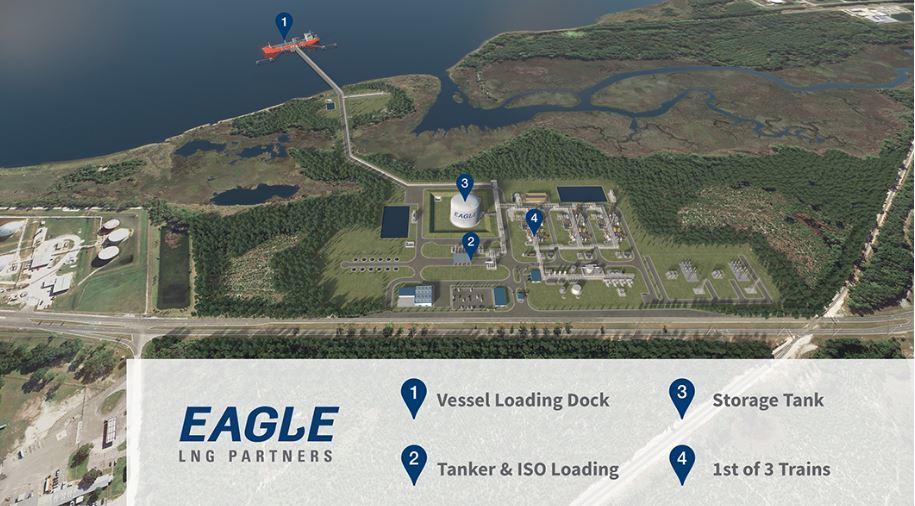
In September 2019, the Federal Energy Regulatory Commission (FERC) gave final approval to Eagle LNG to build a small LNG export facility project at a site on the St. Johns River in Jacksonville, Florida (see FERC Grants Final Approval to Jacksonville, FL LNG Export Plant). Some of the gas that will feed it will come from the Marcellus/Utica. It has been a looooong road, but we finally may be close to the beginning of construction of this smallish facility. The state of Florida is about to approve a lease for what is known as “sovereign submerged lands” controlled by the state–in essence, an easement related to a docking facility and permission for dredging.
Read More “Eagle LNG Export Close to Building in Jacksonville? FL Easement”
 The 303-mile Mountain Valley Pipeline (MVP) project is 94% complete and in the ground. About the only thing left to build is a short 3.5-mile piece on federal land (Jefferson National Forest) and crossings either through or under several hundred creeks and swamps. We are almost there. And yet anti-fossil fuel zealots believe they can still stop the project and block it from ever finishing. We read yet another fawning ode to environmental zealots article about a small group gathering to commiserate about how they dream of stopping MVP, and it struck us, as it often does, how these people speak of themselves and their efforts in religious terms.
 The only thing the so-called Pennsylvania Environmental Defense Foundation (PEDF) “defends” is their own twisted philosophy of trying to gouge out the eyes of the oil and gas industry in PA–even at the expense of de-funding their own beloved PA Dept. of Conservation and Natural Resources (DCNR). In two PA Supreme Court rulings, one in 2017 and another in 2021, PEDF won the right to limit how revenues from oil and gas drilling on state land can be used. The PA legislature reworded its budget directives and began using those revenues to fund day-to-day expenses at DCNR. PEDF sued again. Commonwealth Court rejected PEDF’s arguments against how the legislature allocated the money, and two weeks ago, the PA Supreme Court upheld Commonwealth Court’s rejection. Translation: PEDF just lost a major case they’ve been waging since 2017 to block drilling on state-owned land (by blocking how royalty revenue is used).
 Seneca Resources, a 100% subsidiary and the drilling arm of National Fuel Gas Company, announced on Tuesday that the company has achieved an “A” certification grade under the MiQ Standard for Methane Emissions Performance (MiQ Standard), the highest available certification level MiQ awards, for all of the company’s 1+ billion cubic feet per day (Bcf/d) of natural gas production in the Marcellus/Utica. Seneca can now claim it produces responsible gas and the molecules can be traded/bundled on the MiQ Digital Registry.
 It used to be that freedom and justice and capitalism were baked into our psyche via the U.S. Constitution. All of those things–freedom, justice, and capitalism–are rapidly disappearing. They are replaced with totalitarian statism. The people we “elect” actually think we serve them and that they tell us what we can and can’t do. Example: A pipeline expansion (looping pipe and expanding some compressor stations) by Williams in the Marcellus/Utica is now imperiled by authoritarians in New Jersey.
 U.S. Senator from West Virginia, Joe Manchin, supposedly “secured an agreement” to fast-track the completion of the 94% completed Mountain Valley Pipeline (MVP) in return for selling out the entire country by voting for the Big Green “Build Back Better” bill, renamed to the laughable “Inflation Reduction Act” (see
  Powerhouse consulting and accounting firm Ernst & Young (YN) has just published and released a new study called “US oil and gas reserves, production and ESG benchmarking study” (full copy below). The EY study shows U.S. oil and gas producers “recovered and reset” in 2021, posting increased profits of $73.7 billion and $211.9 billion in revenues, with significant deal activity that drove $144.1 billion in capital expenditures. The study documents how the industry’s 50 largest publicly traded exploration and production (E&P) companies responded to higher commodity prices in 2021 with an analysis of reserve and production information, as well as their environmental, social, and governance (ESG) disclosures.
 Candidate for governor of New York State running on the Republican line, Lee Zeldin, is pushing to reverse the now-permanent ban on fracking in the state. The frack ban was enacted into law as part of a sneaky budget bill Andrew Cuomo signed in 2020 while everyone was distracted with COVID (see
 U.S. Senator Joe Manchin (Traitor Joe) from West Virginia made a huge gamble in agreeing to vote for the so-called Inflation Reduction Act (IRA). Manchin got an agreement from Chuck Schumer and Nancy Pelosi to allow a vote on a separate bill sometime in the fall that will help the stalled 303-mile Mountain Valley Pipeline (94% done) to get completed. The gamble is that Pelosi will actually allow a vote and, if so, that she will use her iron fist to ensure it passes. Legal experts have reviewed the “deal” Manchin made with the devil and conclude it’s far from certain MVP will finish.
 The dirty deed is done. Dementia Joe signed the so-called Inflation Reduction Act (IRA) into law yesterday, and the country is harmed because of it. Tens of thousands of jobs will be lost. Businesses will close shop. It’s a pretty dystopian future we face thanks to a bill passed with absolutely no Republican votes. But face it we must. One of the first orders of business is to figure out how the new methane tax will work and to who it applies. Will LNG export facilities be subject to this incredibly harmful tax? Nobody knows. In fact, nobody knows how the tax will work, given certain loopholes baked into the bill at the last minute. The IRA is yet another exercise in total confusion by the Democrat left.
 Volatility is defined as “liability to change rapidly and unpredictably, especially for the worse.” Price volatility is the price of something (like natural gas) making big swings, both up and down, quickly and without warning. For years the price of natural gas was pretty much constant–it moved up or down here or there, but in very small increments. In fact, on MDN, we called the price of natgas, which was stuck under $3/MMBtu, “lower for longer.” But those days are now behind us. The price of natgas is high, and the swings up and down in the price for natgas are extreme. According to a new analysis by the U.S. Energy Information Administration (EIA), natural gas price volatility hit an all-time high during the first quarter of 2022.
 Last week the Bidenistas expanded the federal bureaucracy once again by adding two new offices, complete with top-level apparatchiks to mismanage them. The new offices are part of the Department of Energy, which is managed by the dullest tool in Biden’s cabinet toolshed–Jennifer Granholm. The new bureaucracies are (1) the Grid Deployment Office, and (2) the Office of State and Community Energy Programs. Together the two operations will funnel $23 billion of taxpayer money to favored Democrat donors and sycophants under the guise of modernizing and expanding the capacity of our nation’s power grid, and deploying cheaper, cleaner energy across the fruited plain.
 We spotted the following headline from EIA’s latest “Today in Energy” post: “EIA expects renewables to account for 22% of U.S. electricity generation in 2022.” Wow! Look at that renewable energy growing! Except when you dig into the numbers, you find the headline is VERY misleading. Renewables, which include not only wind and solar but hydropower and burning wood (causes CO2 emissions) together contributed 20% of all our electricity in 2021. EIA predicts that will rise 2% to 22% in 2022. Big whup. It’s a nothingburger.
 Gas Field Specialists, headquartered in Potter County, PA, is an oilfield services (OFS) company that works in the Marcellus Shale in northern Pennsylvania. The company also does OFS work in western New York State. According to a settlement reached with the Equal Employment Opportunity Commission (EEOC), Gas Field Specialists will pay a former employee (rig worker/mechanic) $184,000 after firing him because he had cancer.